




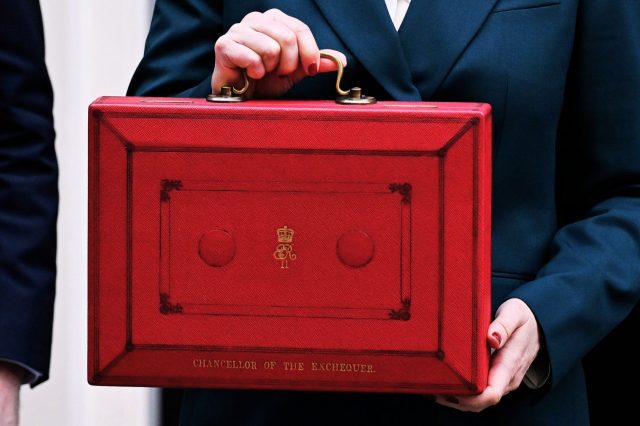
“The Chancellor’s little case does both at once: it has a pseudo-sacred aura about it that every press photographer in the business wants to capture.” (Rasid Necati Aslim/Anadolu via Getty Images)





All nations have budgets, but not many have a Budget. A Budget is a budget transformed into a solemn ritual, like the Latin Mass or the Changing of the Guard, heralded long before its arrival like Christmas or Halloween. It is the economy translated into ceremony, as the Chancellor John Healey, symmetrically flanked by his smiling lackeys, displays in public the magical red box which contains — what? His script? His lunch? Nothing at all? The economy itself, much like how a madman might carry around a bag that he believes to contain the Almighty Himself?
There is more than a touch of fetishism here, as the Chancellor raises his battered little case and exhibits it first in one direction and then another, as a priest displays the sacred host in the monstrance. Fetishism means endowing an inanimate object with an uncanny power, whether we’re speaking of the Budget box or a pair of tight leather trousers. The opposite of fetishism is reification, since to reify is to turn something animate into a thing. It’s the way Charles Dickens’s novels see people in general, as bizarre assemblages of bits and pieces. The Chancellor’s little case does both at once: it has a pseudo-sacred aura about it that every press photographer in the business wants to capture, but at the same time it turns something animate — the life and labor of millions of men and women — into a lifeless object.
This red box isn’t in the least beautiful. If Donald Trump were Chancellor it would be made of burnished gold and the photographers would have to wear shades. But the fact that it isn’t is the point. It’s a tarnished, much knocked-about little container that proclaims the word “tradition” in its every dent and blemish. Tradition, roughly speaking, means doing the same kind of thing your ancestors did. But the Americans tend to value innovation over continuity. Trump’s ancestors might well have engaged in much the same cruel and inhuman activities as he does himself, but he would probably consider this a drawback. I once showed an American friend around Oxford University, only for him to comment: “It’s very old.” It wasn’t meant to be a compliment. It wasn’t meant to be banally self-evident either.
There is a strange race of people called Laputans in Jonathan Swift’s Gulliver’s Travels who carry bags on their backs, which contain Language. They’re experimenting with a new kind of speech in which they dispense with words and instead take from the bag the objects they might need to converse about, holding them up mutely to each other. This might be alright for “toothbrush” and “coconut” but there are problems with “maybe” or “vertiginous”. The Laputans’ bags must be bottomless, given the number of things in the world one can talk about, but this, alas, is not so with the Chancellor. The economy may be extensive, but running and repairing it is confined to a highly limited range of tools, rather as driving an enormous truck depends on a surprisingly restricted number of instruments. This, however, is appropriate enough for the ritual nature of the event. In fact, it’s a wonder that John Healey doesn’t wear body-paint on the steps of No. 11. Tribal rituals resemble nothing as much as neurotic acts of repetition, as one seeks for the umpteenth time to exorcise demons, placate the gods or beseech them to bestow great riches upon you. The Chancellor, rather similarly, needs to drive out the demons of inflation and unemployment, placate the back benches and save a ton of money. Most tribal rituals are unsuccessful, which is one reason why they must be repeated, and the same goes for most Budgets, not least when it comes to the bestowal of great riches.
The curious thing about the Budget is that it is a theater, a spectacle, a public exhibition, yet one performed for grimly utilitarian reasons. In his classic work The English Constitution, the Victorian thinker Walter Bagehot famously distinguishes between the practical and ceremonial aspects of social life, and the Budget neatly combines the two. The English have only to look at a routine human activity to turn it into a theatrical rite. Instead of saying “Hey, have you locked up yet?” the Yeomen at the Tower of London bellow “Who Goes There?” “The Keys.” “Whose Keys?” “King Charles’s Keys.” Don’t try this at home. You’ll just end up carried away by the rhetoric, forget to lock the front door and have your washing machine removed by the neighbors.
Not all rituals resemble the Budget in having a purpose. Some of them are performed simply for their own sake. This used to be true of sport, before the capitalists got their hands on it. It’s still true of kicking a football around a school playground. Apart from feeding the hungry and caring for the sick, all the finest human activities are done just for the hell of it. Pointlessness is next to godliness. There’s no rationale for joking, falling in love or staging a Christmas panto in your community center. This is why the arts are exemplary of the good life. Simply by what they are, not necessarily by what they say, they offer a degree of resistance to the crudely instrumental form of reason which dominates our kind of civilization. They represent what Marx calls the flourishing of human powers as an end in itself, which was his definition of communism.
The more a society devotes itself to the functional and pragmatic, the less it knows what to do with what one might call the symbolic realm, other than to harness it to the business of making a profit. Traditionally, that realm has had three major constituents: the religious, the sexual and the artistic. The split between this and the business of acquisition and accumulation — the business, in a word, of the Budget — runs right down the human body. The more the body is reduced to a laboring or profit-making machine, the more the energies which might stymie these pursuits must be siphoned off elsewhere, to an insulated arena generally known as culture. This is certainly the case with religion. There used to be a saying that once religion begins to interfere with your everyday life, it’s time to give it up. This appears to mistake religion for alcohol, and doesn’t seem quite what Jesus had in mind when he preached that you are saved by helping the injured and visiting the imprisoned, not by some set of esoteric rites.
What religion, sexuality and art have in common in the modern age is that they are all privatized. Privatizing religion is known as Protestantism, which in its more radical manifestations views the whole affair of salvation as a private negotiation between oneself and God. Sexuality, too, becomes essentially a matter of what goes on in the bedroom, at least until the point when feminists and other sexual dissidents insist on its relevance to social and political existence in general. This, incidentally, had been the whole point of the churches seeing marriage as a sacrament. A sacrament is a sign or foretaste of a fulfilled human future beyond the frontier of history. It’s a matter of pointing to certain realities in the present, such as the enduring love between two people, and declaring that the so-called kingdom of heaven will be a bit like that. Whether the people in question are formally married, or of different genders, isn’t the point. The point is that such love cuts against the grain of a degraded present, and thus points in a shadowy way beyond it.
As for the arts, there was a time when they faithfully served various social functions. There were jobs for painters, writers and composers in those days. They could sing the military victories of the tribe, ritually recount its triumphant history, praise God, flatter a monarch or aristocratic patron, entertain the king at court, help to form a community of public-minded bourgeois, or (as in the Victorian era) play a key role in edifying and consoling a nation wracked by dire poverty, the fear of social revolution, the death of God and humanity’s newly discovered kinship with the ape. It’s true that having a function came at a high price. It meant that the arts were generally speaking a medium of political authority, and had to dance to the tune of sovereign power. When they ceased to have much of a social function, however, they were at least able to act as a critique of other social institutions. This was the moment we know as modernism.
Besides, from Romanticism to aestheticism, the utter pointlessness of works of art could be seen as exactly their point. Their function was to be functionless — to remind us that there’s a life beyond waste disposal, the accumulation of capital and Nigel Farage. Figures like Oscar Wilde could be politically relevant simply by being outrageously themselves (though Wilde was also a devout Irish Republican, which a lot of the British prefer to forget). To turn yourself into a work of art meant not to stand in the corner of the drawing room in a suitably alluring posture but to realize your creative powers as ends in themselves. Samuel Beckett was another Irish writer whose art is superficially unpolitical, though he was awarded the Croix de Guerre for his part in the French Resistance. Even so, his drama is all about failure, brokenness and defeat, thus acting as an oblique critique of the values of a Trump. Or, indeed, of Britain in its imperialist heyday. When Beckett was asked by a French journalist whether he was British, he replied: “Au contraire.”
Our own period has witnessed a reassertion of the political value of the symbolic realm. Art, religion and sexuality have been gradually recognizing their complex responsibilities to society as a whole. Just as some forms of art have become more politically sensitive, however, so politics has become more aestheticized. Much of it is now a matter of spectacle and “optics”, media and public relations, the grooming of stars and the assiduous polishing of images. The aesthetic has penetrated to the heart of modern political life, and in all the wrong ways. The quaint little ceremony we know as the Budget is by no means just for the hell of it. There is a lot in social life that can’t afford to be. But we mustn’t forget that if there is bread, there are also circuses.