




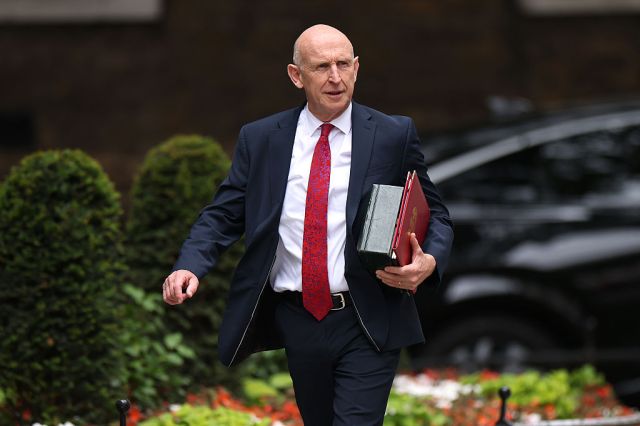
John Healey is reported to have rejected demands to equalize capital gains tax with income tax. (Dan Kitwood/Getty Images)





When Andy Burnham won the Makerfield by-election in June, he told voters that he would put an end to 40 years of neoliberal economic policy, characterized by “austerity, privatization, and deregulation”. It was a promise he would soon echo in his recent conference speech, where he proclaimed he would build “a new economy and a new politics” — making a clean break from the “flawed thinking of the last 40 years”. The trouble is that the man he appointed as Chancellor, John Healey, appears to have other ideas.
Take the proposal to equalize capital gains tax with income tax. Burnham had repeatedly stressed that Britain undertaxes wealth; and not so long ago, senior figures within the party were touting the equalization idea as a “wealth tax that works”. On Tuesday, though, a Treasury source dismissed the notion as “batshit crazy”. Healey is now reported to have rejected the equalization idea.
It’s not the only proposal that Healey has rebuffed. Some of his Labour colleagues wanted to lower the threshold for Labour’s planned mansion tax from £2 million to £1.5 million — a move that would have brought an estimated 137,000 additional properties into the tax. Again, Healey is reported to have said no.
He has defended businesses as well as home-owners. Burnham had previously suggested increasing rates on warehouses and out-of-town retail developments would be a way to help revive the nation’s high streets. But the John Lewis chairman Jason Tarry and the M&S chief executive Stuart Machin warned that additional rates would penalize retailers already struggling with higher employment costs, expensive energy and property taxes. Healey subsequently ruled out additional taxation of large retail warehouses.
That makes three proposed tax increases — all rejected within days of each other. Are we seeing the early signs of a divergence between Burnham and Healey? We have a Prime Minister promising to revive Labour’s post-war tradition of Government intervention and redistribution, but the Chancellor seems to recognize — possibly reluctantly — that Britain’s problem is not a shortage of taxation, but a chronic failure to generate economic growth. With the tax burden already at a post-war high, public spending continuing to rise and precious little fiscal headroom, there is little room for maneuver. The likely outcome? A surprisingly Right-wing Budget.
The argument about Labour’s economic direction is, of course, nothing new. For a brief moment, the leadership contest that brought Burnham to Downing Street threatened to become a genuine battle of ideas about Britain’s economic future. But the contest was over almost before that debate had begun, leaving Labour’s fundamental disagreements over economic policy unresolved.
One of the two factions was the Labour Growth Group, formed by 60 or so MPs — among them Wes Streeting — in the wake of Keir Starmer’s election victory in 2024. As its name suggests, the group was formed out of the frustration that Labour had spent far too much time arguing about how to divide up Britain’s wealth and nowhere near enough about how to create more of it.
In May 2026, its director Mark McVitie, with chairman Chris Curtis MP, published An Honest Day, a manifesto calling for more homes to be built, energy costs to be brought down, lower taxes on employment and to make Britain more attractive for businesses to invest. The manifesto correctly identified the high cost of housing, energy and other essentials as major obstacles to economic growth. Its authors also backed greater government intervention to address where markets were failing, alongside higher capital gains taxes to help finance a cut of up to 2p in employee National Insurance. It was an attempt to combine supply-side reform with Labour’s instinct for redistribution.
As Burnham’s star rose, the Labour Growth Group’s fell, with Curtis standing down as chair in June. Its arguments nonetheless reflected a recognition among some Labour MPs that the existing economic settlement was failing to encourage productive investment or reward work.
A different prognosis, meanwhile, has emerged from the Tribune Group, which represents a more Burnhamite vision of the economy, rooted in greater state intervention. The caucus was originally formed in 1964 and was revived in November 2025 by Labour figures including Louise Haigh, concerned at the rising threats of both Reform and the Greens. By January, the group reportedly had more than 100 Labour MPs among its members. Their diagnosis of Britain’s ills center more on questions of inequality and insufficient state intervention, with proposals including wealth taxes, greater public investment, progressive taxation, changes to fiscal rules and a stronger role for government in directing economic activity. Haigh is now First Secretary of State in Burnham’s government and has been pursuing precisely that agenda.
Both groups recognize Britain’s problems with weak productivity, expensive housing and disappointing living standards. The disagreement is about whether prosperity is best restored by removing barriers to private enterprise; or by giving the government greater control over how resources are distributed. One side sees the state as part of Britain’s economic problem, the other sees it as the solution. That is a considerable ideological divide for a governing party, particularly when its Prime Minister and Chancellor appear increasingly drawn to opposite sides of the argument.
Meanwhile, in opposition, the Conservatives are attempting to correct the economic errors of their own recent governments. In the years following Brexit, the party abandoned much of Thatcher’s free-market program and accepted higher public expenditure, greater intervention and an increasingly burdensome tax system.
The result is an economy that remains torpid: hence Kemi Badenoch’s attempt to restore some center-Right economic philosophy. On 4 October, she published The Right Way, a pamphlet that deliberately echoes the Thatcher-era The Right Approach. Badenoch’s document emphasizes private enterprise, competition, lower taxation and limiting government intervention.
Her new Shadow Chancellor, Andrew Griffith, has reinforced that message with proposals for substantial deregulation, arguing that Britain needs to reduce the barriers to investment and development. So the Conservatives are returning to the principles of sound money and economic liberalism that they spent years neglecting, even as Labour’s Chancellor appears to be moving towards much the same economic ground. One can discern echoes of the New Labour era, when both main parties broadly accepted the case for markets, fiscal discipline and private enterprise, even if they disagreed over the details.
The IMF, at least, appeared this week to think Healey was heading in the right direction. On Tuesday, the Fund published its October 2026 World Economic Outlook. British growth this year has been revised upwards from 1.0% to 1.3%, but the Fund expects the economy to expand by just 1.2% in 2027, down from its previous forecast of 1.3%. Higher energy prices and long-term interest rates are expected to weigh on consumption and investment, while inflation is forecast to average 2.8% next year.
The Government has welcomed the upgrade for 2026, but next year’s outlook is considerably less encouraging. The Institute for Fiscal Studies has identified substantial pressures on departmental spending: higher defense costs, rising health spending and plausible increases in both public-sector pay and the cost of delivering services, even as the Government tries to avoid making cuts elsewhere. As a result, the Chancellor could require an extra £35 billion a year by 2030–31.
It is with these constraints in mind that the IMF has urged Healey to maintain fiscal consolidation despite the pressures on public spending. Its chief economist, Silvana Tenreyro, told a press conference in Bangkok that “the message for the UK is simply stay the course and continue on that trajectory”.The IMF’s warning followed similar comments from the governor of the Bank of England. Andrew Bailey cautioned that the Government’s fiscal plans must retain the confidence of financial markets or risk another gilt market crisis, recalling the turmoil following Liz Truss’s disastrous 2022 mini-Budget.
That leaves the Government in a tricky situation. On one hand, it faces demands for more money for defense, hospitals and other public services. On the other hand, it needs to convince investors that it can afford to pay for those services. Perhaps Burnham and Healey will attempt to plug the yawning gap in the public finances via higher taxes on businesses and investors. But, paradoxically, this will make those same businesses and investors less inclined or able to create jobs, innovation and, ultimately, growth. The unfortunate reality is that previous governments have already squeezed the productive parts of the economy for as much as they could. Businesses are struggling with higher employment costs, expensive energy and weak domestic demand. Investment remains disappointing, productivity growth is anemic and the incentives to work, save and invest have been steadily eroded.
Healey consequently faces weak growth, expensive borrowing and a Prime Minister committed to expanding the state’s responsibilities. Rejecting additional tax increases may protect investment incentives, but it does nothing to reduce the expenditure commitments those taxes might otherwise have financed. The Chancellor may therefore find himself increasingly drawn towards the economic arguments being advanced by the Conservatives: spending restraint, welfare reform, deregulation and stronger incentives for private investment. This month’s Budget may offer the first indication of that shift, although the real test will come when Healey has to decide whether protecting the welfare state means confronting its increasingly unsustainable costs. Successive governments have spent years putting off difficult reforms, which is precisely why Britain finds itself in this position.
It’s not hard to see how this will become a problem for Burnham, who has built his entire political persona on Manchesterism; greater public provision and government intervention. Promising more services at little or no direct cost to the public is politically attractive. Paying for them is rather less straightforward. The autumn Budget, then, will provide an important indication of how Healey intends to reconcile Labour’s ambitions for a larger state, and Burnham’s ambitions in particular, with the financial constraints imposed by increasingly nervous gilt investors.
The party has an opportunity to put Britain’s dire public finances on a sustainable footing for a generation, potentially depriving the Conservatives and others of their strongest economic argument. An uncomfortably Right-wing budget would be the first of many difficult steps.
But if Healey starts squeezing departmental budgets, cutting welfare spending and reducing the size of the state, Burnham could find himself presiding over the very economic program he came to power to oppose. The economic recovery job will be a long one — but can Healey survive the next Budget, or the one after that? Is Labour prepared to tear itself apart to deliver the reforms Britain needs?
If Healey retreats every time Labour supporters object, though, we will simply repeat the mistakes that got us here in the first place. And we know where that ends: a gilt market crisis, spending cuts Britain refused to make voluntarily forced upon it, and at far greater cost. The longer politicians refuse to make the necessary decisions, the fewer choices they will eventually have. That is what decades of political cowardice have brought us to.
The question is whether Burnham would sacrifice his political convictions to keep his Chancellor, or sacrifice his Chancellor to save his premiership.