




Russell: reborn. (Oliver Touron/Getty)





In April 2024, Bear Grylls and Russell Brand stood shirtless in the River Thames. The water, which a scientist warned could contain E.coli, was now serving as their River Jordan. Grylls, the TV survivalist and evangelical Christian, lowered one of Britain’s most notorious celebrities backwards into the river. Brand vanished beneath the surface for a few seconds, then rose, streaming and grinning, folding into a three-way embrace with Grylls and another man. The photographs released afterwards have the heroic quality of an album cover: bare chests, cold water, redemption.
Less than a year before that crisp Sunday, Brand had been publicly accused of rape, sexual assault and emotional abuse. He denied any wrongdoing. He was subsequently charged with seven alleged offenses and today stands trial for them at Southwark Crown Court on three counts of rape, three of sexual assault, and one of indecent assault, together relating to allegations dating from 1999 to 2009.
To some, there was something opportunistic about the timing of Brand’s religious rebirth. But the more interesting story is what kind of Christian he would go on to become. For he did not simply become a tea-and-biscuits Anglican: he moved, like a moth to a flame, toward a distinctively American religious and political ecosystem, one whose ideas about rebirth, persecution and personal testimony fit both him and the American Right strikingly well — even as the same trends are now following Brand back home to Britain.
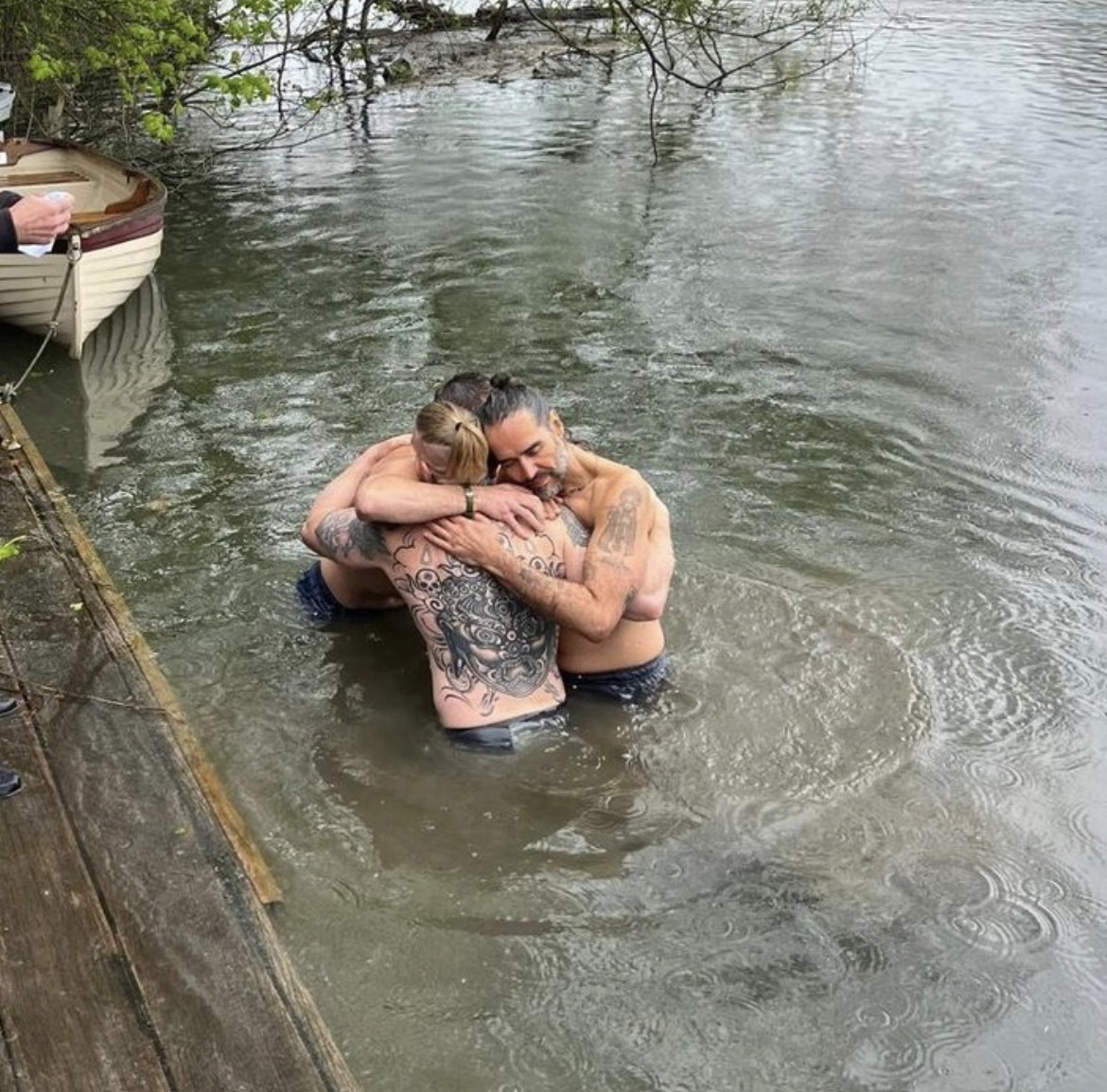
Brand came to Christianity via Grylls and Holy Trinity Brompton, the evangelical church in South Kensington. Yet if British Christianity offered him a font, that was about it. Within days of the baptism, Christian magazine Woman Alive cattily argued that it was too soon to hold him up as an example of God’s redeeming power. A few months later, Brand gave the publication’s pearl-clutching readers something else to worry about: he began baptizing people himself. One self-released photograph showed him officiating in a pair of white budgie smugglers. The convert was fully dressed. One vicar quoted in Premier Christian News quipped that he had baptized a great many people over the years — and had somehow always managed to keep his clothes on.
County Road 30A couldn’t be more different from South Kensington. Running for a little over 20 miles along the Florida Panhandle, following the northern spit of Florida until it reaches Alabama, 30A is lined by beach towns, whose tin roofs and picket fences evoke a dream of small-town America. Locals dart between pastel villages by golf cart, past pale quartz beaches and the Gulf’s turquoise water. Seaside, the area’s main town, was the set for The Truman Show, a 1998 film about a man living inside a television broadcast and whose neighbors, unbeknown to him, are all acting for the cameras.
Brand moved his family here in the autumn of 2024 — a few months after his baptism, and just before Trump’s re-election — explaining that he could no longer live in a country whose media, government and judiciary would always find a way to muzzle anyone who became an inconvenience. He did not come as a man hiding from the limelight. Neighbors reported seeing him as a permanent fixture at the Saturday farmers’ market; he cycled through Seaside calling out blessings to passers-by; one morning in December, after bumping into a group of groomsmen on the beach, he accepted their invitation to the wedding later that day.
Brand worships at Good News Church in Santa Rosa Beach, which invites people to be “born again through Jesus”. In November 2025, The Times reported that he had begun baptizing willing converts in a penguin pool at the Emerald Coast Zoo, a nearby Christian-themed attraction. Never one to miss an opportunity to furnish his followers with devotional content, Brand posted the footage himself with a penguin emoji. It’s an odd thing to watch: the shirtless celebrity, the solemn words, the tilt-dunk backwards, all in the company of a colony of flightless seabirds going about their business. Then again, this is Florida, America’s great subtropical carnival of roadside oddities, religious revivalists, get-rich-quick schemes and anti-government eccentrics, a place where the sacred and the absurd have always rubbed shoulders.
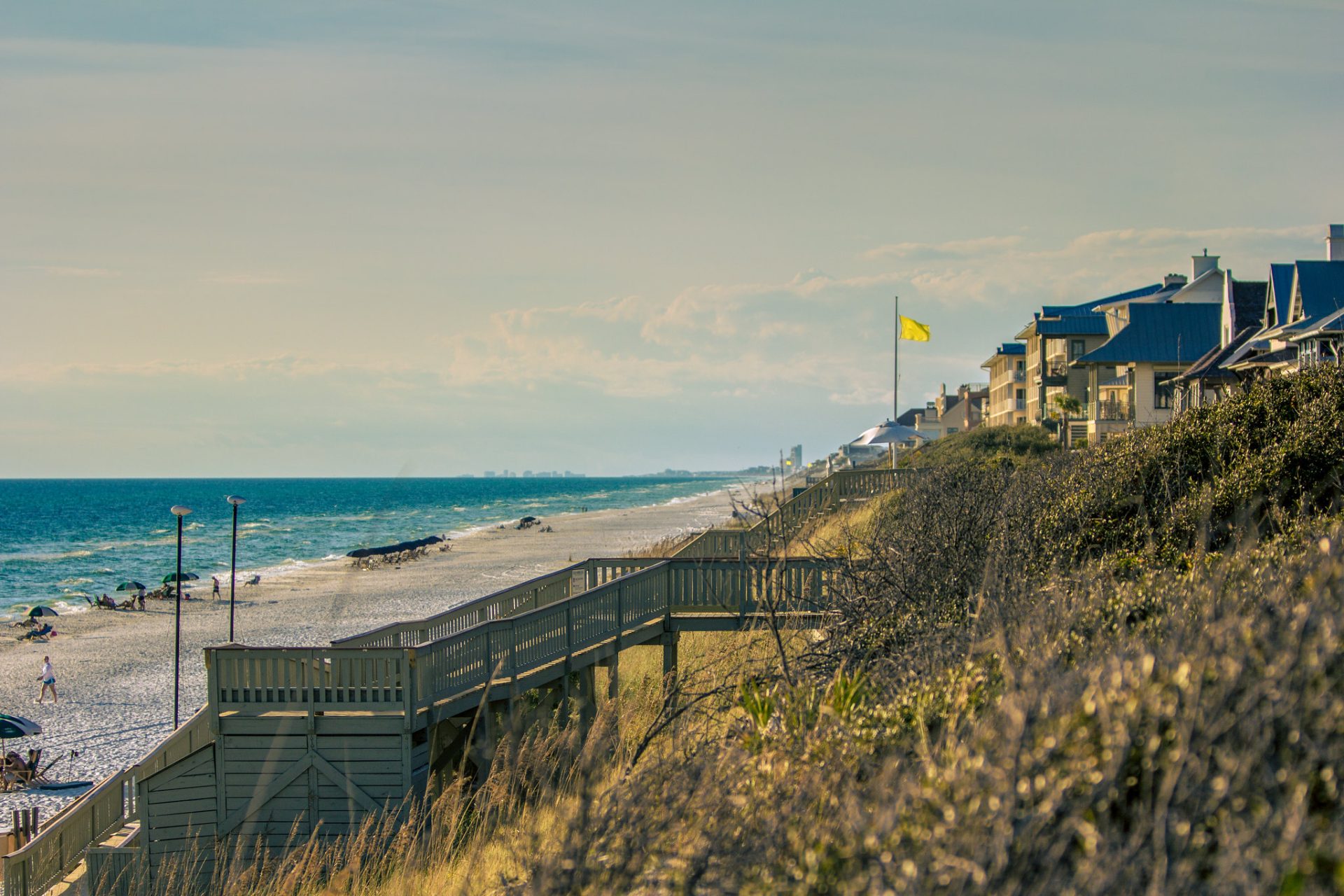
A parody to many Brits, Brand is legible to Florida in a way he could never be in Henley. He has also landed in a place where his new faith sits comfortably alongside almost everything he already believed. The wealthy, photogenic beach towns of 30A are hardly a wilderness of sackcloth and penance. Here, Christianity, biohacking, hot yoga and Pelotons coexist with remarkably little friction. A man who has spent decades moving between spirituality, addiction recovery, yoga and anti-corporate politics barely has to change his clothes.
From the churches of 30A, Brand quickly found rather more powerful friends. Among the first was Sean Feucht, a long-haired, guitar-strumming evangelist and Trump devotee, whose ministry has been dogged by allegations of financial mismanagement. By February 2025, a few weeks before he was charged, Brand was lauded at a black-tie gala at Mar-a-Lago hosted by America’s Future, a conservative organization that campaigns for “durable institutions” and “liberty”. There, Brand was handed a glimmering “Global Defender of Freedom” award, sharing the bill with Mike Tyson and the singer Ted Nugent.
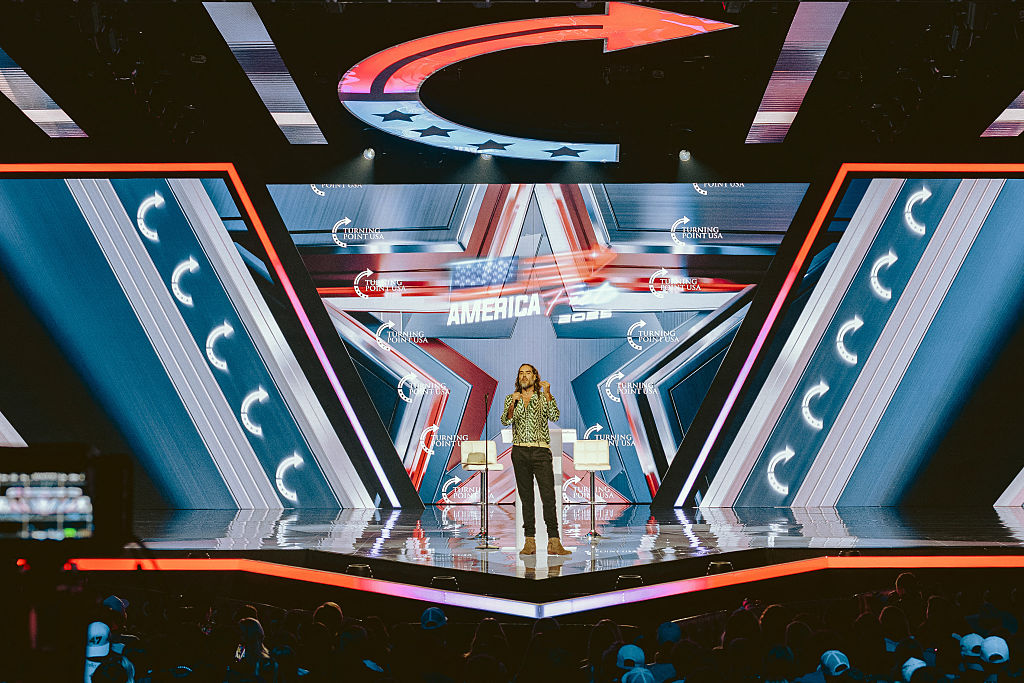
Then, at Turning Point USA’s AmericaFest in December 2025, the first since Charlie Kirk’s assassination, Brand opened his speech on his knees, thanking God for the example of forgiveness set by Kirk’s widow. He told the crowd that the words “turning point”, to him, meant repentance. When he replayed the speech a few days later on Stay Free with Russell Brand, his video podcast devoted to politics, spirituality and the supposed evils of the establishment, the episode came with a giveaway promoting Reborn, his own wellness brand, and which sells the sort of biohacking supplements beloved by the American alternative-health movement. First prize was a Jeep Wrangler and $10,000 cash.
Brand’s website continues in a similar vein, inviting visitors to join Awakened Wonders, a subscription community with whom he reads and prays weekly. The mailing list promises subscribers their “place on the ark”. Videos end with a nudge towards a premium channel on Rumble, where subscribers can join the “movement”. And this spring came a book, How to Become a Christian in Seven Days, 192 Tony Robbins-endorsed pages and yours for $19.79. The publisher: Tucker Carlson Books.
As these examples imply, Brand has entered a religious culture with few issues blending money and faith. From the television evangelists of the Seventies and Eighties, with their enormous hair, enormous congregations and even more enormous bank accounts, to the prosperity preachers of today’s megachurches, certain strands of American evangelicalism have proved remarkably adept at reconciling God with Mammon. Faith need not mean renunciation; it can promise abundance, better health, greater happiness and a more successful you. The language of salvation has mingled with that of self-improvement, and the American pulpit has become a platform from which to sell both.
It helps, too, that behind Brand’s swelling online following — 6.6 million YouTube subscribers and more than two million more on Rumble, a self-styled free-speech alternative — sits an architecture of belonging that he’s been building for years. Long before his conversion, Brand was cultivating a community of the supposedly awakened, first through online sermons railing against the mainstream media, then through podcasts and live events promoting his particular brand of enlightenment. Christianity has furnished the enterprise with a new vocabulary, especially given his new political contacts, but the business model is remarkably familiar.
Theology plays a role here too. “Born again” is a phrase from the third chapter of John’s Gospel, in which Jesus tells the Pharisee Nicodemus that no man will see the kingdom of God unless he is born anew. For much of Christian history, this was interpreted as the slow, lifelong work of worship. It was the Protestant revivalists of the 18th century who turned it into an event: a datable, theatrical moment in which a person becomes something new.
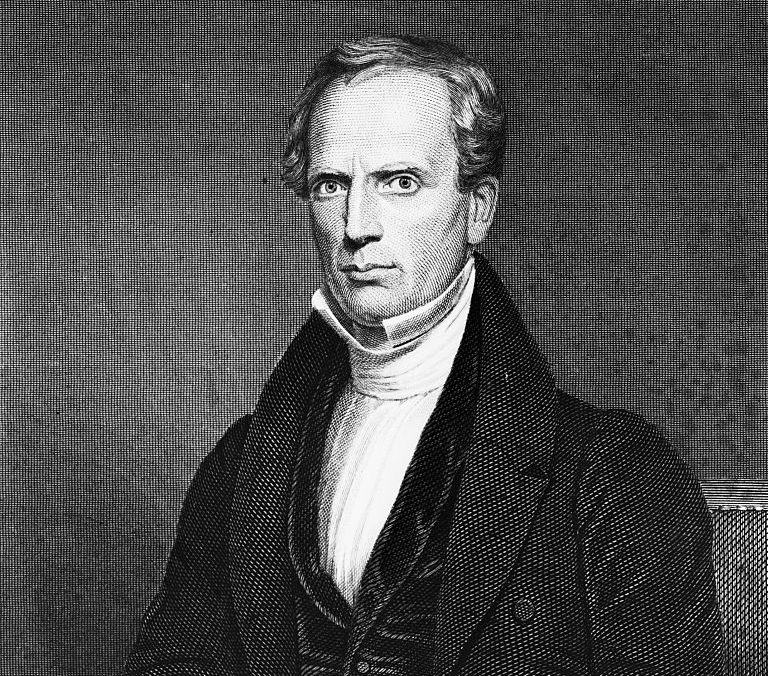
American evangelism has always had a special fondness for the “twice-born”. Take the revivalist minister Charles Finney, leader in the 19th century of the Second Great Awakening. He would seat the unconverted on an “anxious bench” at the front of a tent and publicly wrestle with their souls in full view of their neighbors, establishing “testimony” — confessional, mea culpa monologues — as a form of popular entertainment. It’s a short hop, conceptually at least, to the Emerald Coast penguin pool. The spectacle attracts the faithful; the faithful become followers; and followers, as Brand knows better than most, can be monetized.
Compare all this to British Christianity. Charismatic Anglicanism — the CofE’s emotionally expressive branch that emphasizes personal encounters with the Holy Spirit — may have given Brand a theology of dramatic renewal. But it also came embedded in a national church whose instincts run pastoral and discreet, in a country where public displays of piety are more likely to provoke embarrassment than applause. The American habit of treating salvation as both a public spectacle and a commercial opportunity has never quite taken hold here. In Britain, a celebrity finding Jesus is more likely to raise eyebrows than confer authority. In America, though, finding Jesus can be the beginning of a lucrative new public life, even the start of a second career.
As Brand’s embrace by Magaworld implies, meanwhile, this is especially true given the broad political context. The New Apostolic Reformation, the radical fringe of the American charismatic network, whose ideas have shaped figures like Feucht, now talks about Christians conquering the “seven mountains” of culture: from government and media to education and the arts. “We want souls, and we want nations,” declares Lance Wallnau, one of the movement’s leading evangelists. And, under Trump, this vision of politics as spiritual warfare has found a receptive audience. A 2025 survey found that two-thirds of white evangelical Protestants sympathized with or embraced Christian nationalist ideas. To be clear, not all these belong to the NAR, but the numbers suggest how far this fusion of faith and politics extends. Certainly, on 6 January 2021, as rioters stormed the US Capitol, leaders of the New Apostolic Reformation gathered outside, blowing horns, speaking in tongues and praying for angels to drive a demonic serpent from the Senate. For them, the struggle for political power was quite literally a battle between heavenly forces. In this cosmology, opposition from the press or the courts can be read not just as mere politics, but as a kind of spiritual resistance, a sign the believer is doing something right.
Some of the congregants of Santa Rosa Beach remain unconvinced by their neighbor’s transformation. Josh Parish, a local Christian real estate agent, was quoted as saying he thought Brand was “a charlatan, a snake-oil salesman”. But to those who want it, a language is available — woven through its politics and increasingly through its churches — in which demonetization, de-platforming, hostile coverage can be narrated as the familiar sufferings of the faithful.
Little wonder Brand continues to make inroads into politics. In September, he appeared at Washington’s lavish Make America Healthy Again (MAHA) summit, moderating a discussion on healthcare reform with senior Trump administration officials. Vice President JD Vance and Health Secretary RFK Jr were also on the program. The spectacle captured something of the new American Right: evangelical Christianity, alternative medicine, self-optimization and political grievance mingling in a movement that has made suspicion of established authority practically a qualification for belonging. Brand, whose joss-stick spirituality and conspiracy-laden sermons have made him an increasingly eccentric figure in British public life, has found himself a place amazingly close to the center of US power.
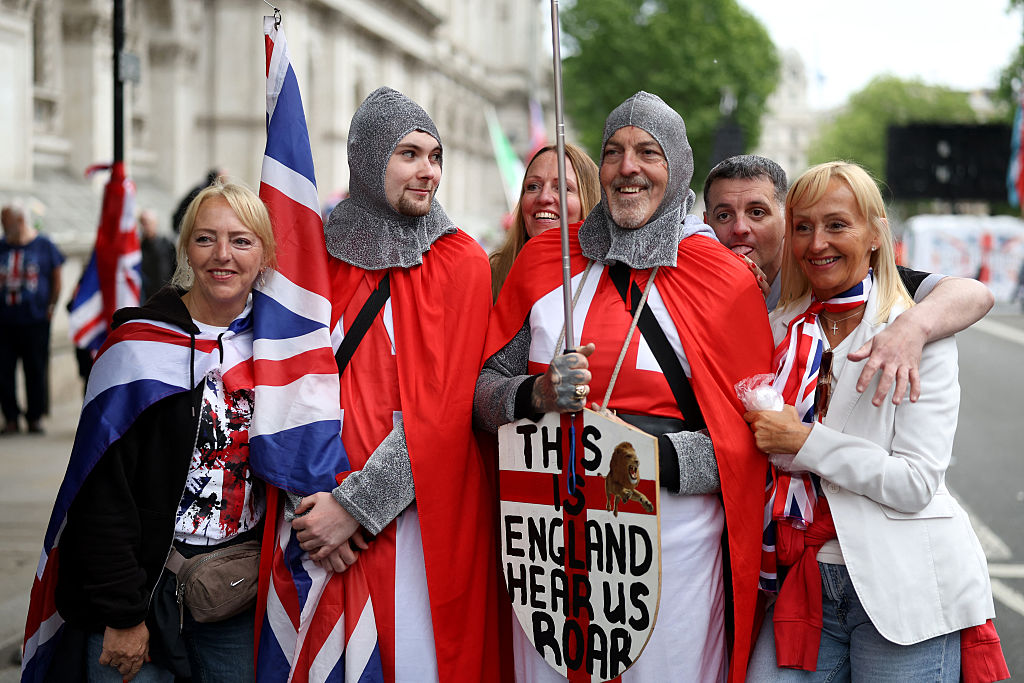
And in a sign, perhaps, of how strong American culture-war currents now are, something similar is now happening back across the Atlantic. Where the nationalist Right once invoked Christianity largely as a marker of British heritage, some of its more radical figures are increasingly embracing the language of evangelical revival. Tommy Robinson, for instance, claims to have found Jesus in prison. Last year, at Robinson’s Unite the Kingdom rally in London, crosses rose above a sea of St George’s flags; crowds chanted “Christ is King”; and a minute’s silence was held for Charlie Kirk. All this dismays many British church leaders. “The church is not the chaplain to any political tribe,” stressed Mike Judge, editor of the Evangelical Times. The Church of England, from which Brand’s religious journey began, has also joined Pentecostal, Baptist and Methodist leaders in warning against misusing the cross to exclude others.
Yet more than politics or commercialism, there is one more way of looking at Brand’s conversion: as the latest in a long line of reinventions. After all, he has spent most of his life killing off previous versions of himself. There was Russell Brand the heroin addict; Russell Brand the priapic MTV presenter; Russell Brand the Hollywood actor and husband of Katy Perry; the revolutionary who wanted to overthrow capitalism; the wellness guru; the anti-establishment broadcaster who railed against big pharma, big data and the global elite. Christianity has offered him perhaps his most dramatic transformation yet, albeit with the added promise of eternal life.