




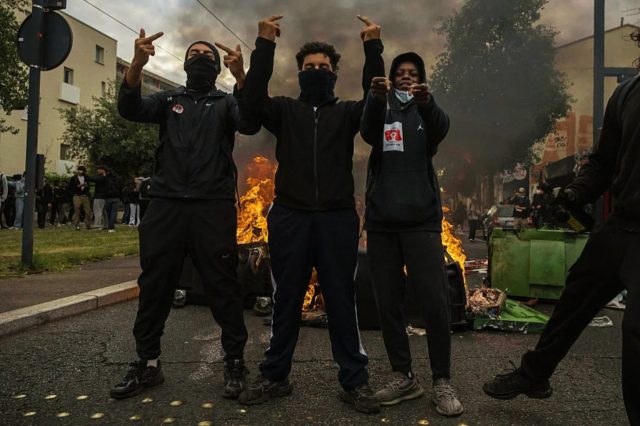
“The French public is now accustomed to scenes that in any other country would look like freeze-frame snapshots from a war zone”. (Ed JONES / AFP via Getty Images)





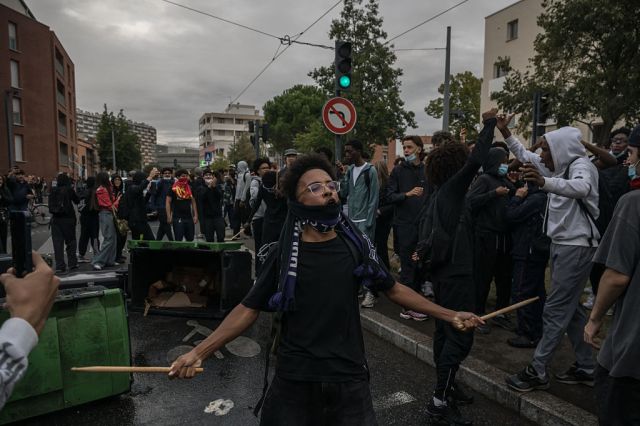
For most of the past week, the main French news channels have been leading with images that are familiar but still frightening to the French public. The images are of burning trash bins, overturned cars, gangs of masked youths taunting the police and throwing missiles at them — fireworks and Molotov cocktails — as well as attacking firefighters. The police, wearing heavy riot armor and carrying shields, have charged into the crowds of youngsters. They have used not only tear gas, but flash-balls, rubber bullets that constitute a “less-than-lethal” but nonetheless powerfully disabling weapon. Additionally, police have been indiscriminately smashing heads with batons.
At first sight, there is not much new here: after a decade or so of street violence, from the demonstrations of the Gilet Jaunes to the recent protests against pension reform, taking in the 2023 riots against the police killing of young North African in a Paris suburb along the way, the French public is now accustomed to scenes that in any other country would look like freeze-frame snapshots from a war zone.
It is, however, the vicious quality of the violence from young people which has been genuinely shocking. Notably, in Paris, a lone young trainee female police officer was pursued, tripped and then battered on the ground by a gang of youths. In Belfort, a city in northeastern France, a plain-clothes officer was almost killed by a “lynch mob” — so-called by the press — of hooded teenagers who pinned him to the ground and repeatedly kicked his head. And in Marseille, a young woman at a bus stop was sprayed in the face by an improvised flamethrower wielded by a laughing kid.
Equally terrifying is the eerie, almost incomprehensible way that the violence, which has erupted outside schools all over France, from Lille to Marseille, came apparently out of nowhere. So far, over 1,000 secondary schools have “mobilized”, which means student strikes, barricades and fires in school buildings. The damage will cost millions of euros to repair. Over 3,000 arrests have been made, mainly of young people.
The unrest began at the end of September, taking the form of a series of reasonable protests in the Paris region by school pupils. They decried the degraded state of the French educational system, making legitimate complaints about poor timetabling, lack of teachers, and rotten buildings in a state of Soviet-style shabbiness: freezing in winter and unbearably hot in summer heatwaves. It is not only the students but also the teachers who have been complaining about these conditions. My friend Laurence has taught science in a variety of Parisian schools over the past 10 years and testifies that she has never seen conditions so bad or students so angry. “It is as if the government actively despises us,” she said.
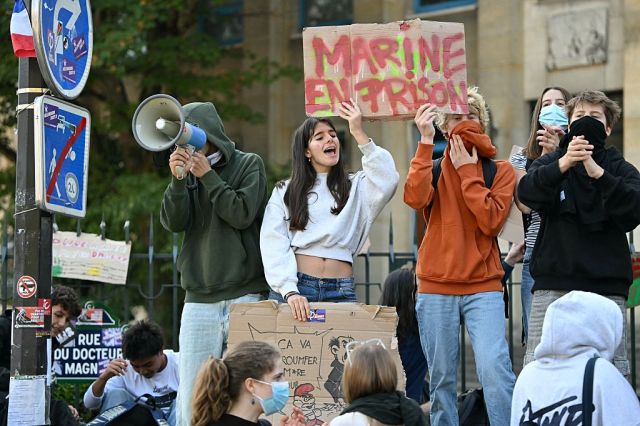
Student anger has also focused on the “Parcoursup”, an online system that, in 2018, replaced the old university application system. Parcoursup offers students the ability to apply to many more universities than previously, and allows universities to rank applications via perceived merit rather than allocating them by lottery, as its predecessor did. But the basis of the rankings is opaque, with the Left arguing that it privileges better-off students, that France is not a true meritocracy, and that this is an assault on the core concept of “égalité”.
This has been one of the rallying cries of the radical Left party La France Insoumise (LFI), led by Jean-Luc Mélenchon. The party is the closest challenger to the Rassemblement National (RN), led by Marine Le Pen, who is currently leading the polls for the presidential elections next year. The LFI has been courting school-age students and teachers for years, with their strategies for further investment and a reshaping of university policies, controversially opening up elite colleges to educationally disadvantaged students. But this is the first time that the Macron government has explicitly pointed to the LFI’s role in deliberately stirring up subversion. This at least was the view of the Prime Minister, Sébastien Lecornu, who, while calling a crisis Cabinet meeting last Friday, pointed the finger directly at Mélenchon, stating that “the LFI and its ultra-Left proxies are at the origins of this movement”.
His accusation has been given substance by the sight of the LFI Mayor of Saint-Denis, Bally Bagayoko, jubilant and dancing in front of the burning shell of the Lycée Paul Eluard. There have also been calls by the LFI activist Ritchy Thibault “to march on the Elysée Palace and burn it down”. Intelligence agencies for the police have also spent much time tracking preparations for the disorder on social media since early September, noting among the calls for “armed action”, the language of the far-Left — notably “the end of neo-Liberal democracy”, “disrupting the social order”, “challenging state violence”.
Mélenchon has been, as ever, mercurial, playing both sides at once. He has called for a “march of peace” today, with students, teachers and parents, united in wearing white hats or caps, coming together to show their disgust with the government. At the same time, LFI rhetoric argues that in all its forms, from bad schooling to police brutality, “state violence is not legitimate”. The students have a right, says Mélenchon, even a duty, “to take revenge”. He has publicly denounced both Lecornu and Valérie Pécresse, the centrist President of the Île-de-France region who wanted to charge Bagayoko’s administration €100,000 for the damage caused, as “racist”, leveling the same charge at the news channel BFMTV, which has shown some of the most graphic images. The present democratic structure of France, says Mélenchon, is loaded with “white privilege” and part of “an already obsolete present”. He calls for a “citizen’s revolution”, driven by “the force of numbers”, and led by the new postcolonial generations to come. (France already has 7.6 million second-generation immigrants aged 30 or less.)
Unsurprisingly, the student protests are now conflated with Gaza, Palestinian flags are everywhere, and there are calls for a “Sixth Republic” — effectively rewriting the present constitution — and “a New France”. Mélenchon’s overall aim is a revolutionary one: to create a France for the 21st century, one that is constructed out of its new second and third generation of immigrants. The aim is not assimilation into an old order, but destroying it altogether.
All of this has the potential to backfire on Mélenchon. Two years ago, the Minister for Justice, Gérald Darmanin, identified the overall LFI strategy as “bordelisation” — a word that is hard to translate but roughly means in slang terms “deliberately creating chaos”. More recently, Bruno Retailleau, former Minister of the Interior and a presidential candidate for 2027, described the LFI as “an absolutely seditious party with a fascination for violence” and called for a debate on banning the LFI. Mélenchon’s slyly sarcastic response to Retailleau was that this was “absurd” and that not a single LFI document could be traced to recent disturbances, unless he had incited them “by telepathy”.
Mélenchon is smart, but he also underestimates the extent to which conservatism, in a political or simply a social sense, is still a force to be reckoned with in the “Old France” — which still makes up the majority of French people. With his strategy of organized disruption, Mélenchon is clearly playing once again into the hands of Le Pen, whose agenda is the opposite of Mélenchon’s. A recent poll in the newspaper Le Figaro found that 78% of French people thought that the LFI was “aggressive”, and 70% thought they were actively “dangerous”.
The precedent for all this violence and rebellion is of course the near-revolution of 1968, still a nostalgic meme for Old Leftists. Students and school kids who were in revolt angered the older generations so much that they effectively delivered Right-wing governments until 1982.
But the 21st century is a totally different political landscape in France, shaped by tensions over race, religion and ethnic identity as much or more than the neo-Marxist dreams of revolution cherished by the LFI. This is why Le Pen also has a substantial youth vote to match or even overtake the LFI, a youth which craves order and discipline over anarchy. I have been to enough RN rallies over the years to see how Jordan Bardella, Le Pen’s young and handsome protegé and president of the RN, is greeted with pop-star style adulation when he speaks to an often hip and well-informed young audience. We are a long way from the fascist brutes of the old days of the Front National, the predecessor of today’s RN.
Le Pen has now come out on national television, accusing Mélenchon of stirring up trouble in the schools. Her prescription, sidestepping the issue of immigrants, is for new, stricter laws to punish so-called “casseurs” — the most destructive of the rioters.
None of this stops Mélenchon from invoking the specter of “fascism” when he talks about his opponents, and especially Le Pen and the RN. The more he does this, however, the more even centrists and those on the Right, normally opposed to Le Pen, see the sense in her analysis of the situation. Put simply, the harder Mélenchon drives the strategy of chaos, the more deeply retrenched even the milder conservatives become, scared of the forces yet to be unleashed and what their country might look like if Mélenchon ever comes to power.
It would be a savage irony if the LFI, the party of insurrectionary challenges to the “bourgeois order”, also turned out to be the party that opened the way for an RN presidency.