









October 12 2026 - 1:45pm
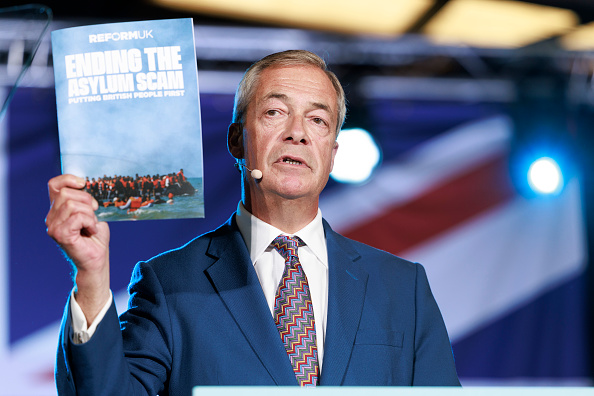
This morning, Nigel Farage and Zia Yusuf announced that a future Reform UK government would suspend the asylum system for at least a full parliamentary term. At a press conference in Kent, standing in front of a giant inflatable dinghy, they told reporters that all current applications would be rendered void once Reform took office, and that new applications would be rejected automatically. Failed asylum seekers will be returned to their home countries, or the nearest safe neighboring country.
It is worth taking stock for a moment of just how significant a change this represents. For the last 30 years, British governments have talked about the need to control immigration and stop illegal arrivals, to deport people who have no right to be in the country, and to build systems which balance humanitarian obligations with voters’ wishes. But at no point during that time has any government hinted that it will close the asylum system entirely.
That Britain has a duty to offer refugee status to people in certain circumstances has been accepted as a given by Labour and Tory governments alike in recent decades. The bedrock of this was the 1951 Refugee Convention, initially laid down as a rebuke to the democracies which had failed to allow in Jews from Nazi Germany in the Thirties, but subsequently expanded through judicial and political reinterpretation far beyond its original scope.
This is reinforced by an array of legislation which obliges the Home Office to consider particular characteristics of an asylum seeker’s case, and which empower claimants to appeal and fight rejections and deportation orders. These include Article 8 of the European Convention on Human Rights via the Human Rights Act, as well as more recent additions such as the Equality Act and the Modern Slavery Act.
But more than just the legislation, there is a basic assumption that accepting people from other parts of the world is a moral obligation which is incumbent on advanced Western nations. The exact parameters of this, be it numbers or the circumstances that trigger it, are not defined: it’s just something we ought to be doing, for our own spiritual health as much as for the refugees. This was reflected in Labour Party Chair Bridget Phillipson’s statement in response to Farage’s plans that Reform was “running away from basic decency”.
Phillipson went on to claim that “the vast majority of British people will reject it as an assault on our common values,” but she knows perfectly well this is unlikely to be the case. The appeal of a prospective Reform UK government is limited by concerns about professionalism far more than it is by moral revulsion at policy proposals. Nobody who had previously made their mind up to vote for the party will be alarmed by the ethical concerns of suspending the asylum system or revisiting grants made in recent years.
Having been taken for granted for many decades after the Second World War, the case for accepting refugees is no longer self-evident to much of the public, either in Britain or in similar countries. That is not to say that people have lost compassion: if asked to make a decision on a case-by-case basis, most Britons, including many Reform voters, would be generous toward families who have been forced to flee their homes.
But, at a policy level, the gulf between what people think of when they imagine refugees and the reality of the post-2015 inflows into Europe and Britain is simply too vast to be reconciled. The continuous drumbeat of stories of depraved sexual and violent crime by men from places including Afghanistan, Syria, Eritrea and Somalia has reinforced more mundane signs of the new arrivals’ incompatibility with a functional, high-trust society.
This is a bold and controversial move by Farage and Yusuf, and one that would not have been foreseeable even a month or two ago. The catalyst was the announcement by Home Secretary Shabana Mahmood last month of the imminent opening-up of new refugee pathways from Palestine and Afghanistan. It is hard to conceive of a Government policy that could be more diametrically opposed to public sentiment or political reality. And even in a policy that was supposedly tailored around the needs of female refugees, there was a recognition that three-quarters of the arrivals from those places would likely be men. Phillipson, and others who have accused Reform of extremism for this announcement, would do well to consider quite how far the status quo has strayed from the initial assumptions of welcoming refugees.
Chris Bayliss is an independent consultant who works on energy infrastructure in the Middle East.
 baylissbaghdad