









October 3 2026 - 7:45pm
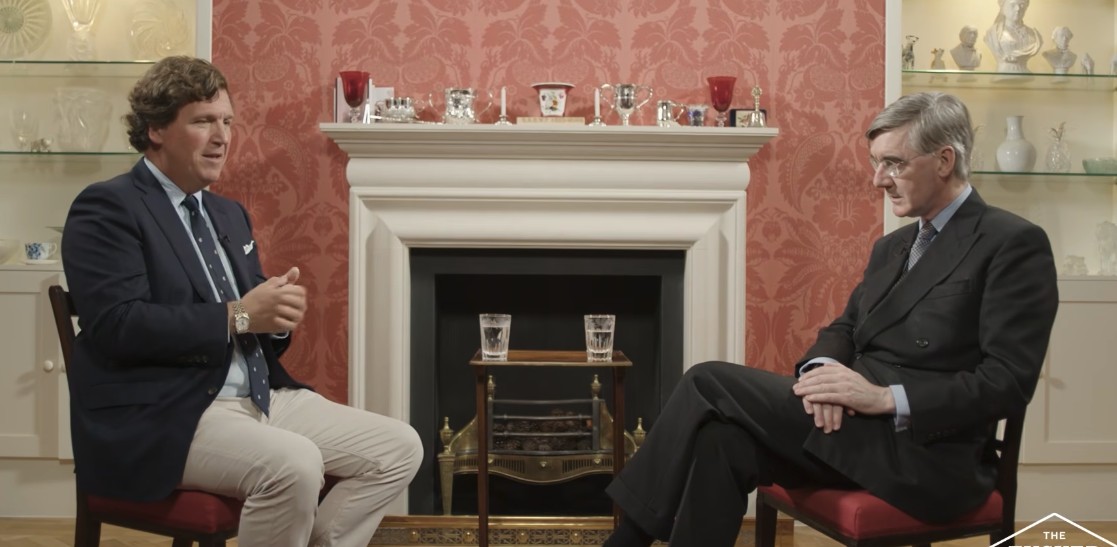
In online parlance, “mogging” refers to the act of dominating a room by means of one’s height, strength or some other superior attribute. The word derives from the acronym AMOG (“alpha male of the group”), but after his heroic performance on the Tucker Carlson Show, the word should be attributed to Jacob Rees-Mogg instead.
It wasn’t just the jaw-dropping spectacle of the interview that was significant, but what it tells us about the contemporary state of British conservatism versus American Right-wingery.
The most farcical moment came when Carlson insisted that the British economy is smaller than Russia’s. Rees-Mogg immediately put him right on that one. In response, Carlson tried to downplay the significance of GDP, pointing to Russia’s physical size and abundant resources — only for Rees-Mogg to ask why so little has been made of this vast natural inheritance (not to mention a population more than twice the size of Britain’s). It was a polite but brutal mogging to which Carlson had no answer.
Then came the most shocking moment, when Carlson’s sympathies for the Russian position in the present-day Ukraine conflict gave way to an apparent defense of the German position in the Second World War. He repeatedly claimed that “Hitler did not want to go to war with the UK”. Really? Is that why Nazi Germany invaded our allies and then their own? Not the most convincing demonstration of the Führer’s bona fides.
At this point in the podcast, Rees-Mogg came close to expressing a degree of exasperation with his interviewer: “I’m very surprised you’re verging on defending Hitler. I think this is not really what you want to be doing.” Carlson assured us that he was not in fact “a secret Nazi”, but he does appear to be articulating a vision of “peace” in which the great powers should be allowed to dominate their neighbors — and that if the West dares to support the sovereignty of its friends, then the resulting death and destruction is our fault.
None of this would matter if Carlson were a fringe figure, but he’s not. During the last presidential election, he still had a place by Donald Trump’s side (though they’ve since fallen out). His position on Russia is far from unique among MAGA Republicans and the most influential anti-Ukraine voices in the US are on the Right. As for the Trump administration itself, it has pursued policies that have destabilized the Western alliance, and made bizarre overtures to hostile powers such as North Korea.
There is almost no equivalent to any of this on the British Right. Among the populist parties, Nigel Farage has put aside his Putin-curious provocations and Reform UK’s foreign policy is officially pro-Ukraine. Some figures in the party have cultivated a relationship with JD Vance, who has previously clashed with Volodymyr Zelensky, but given the VP’s Anglophilia, these links should be encouraged. Even Restore Britain, which is strictly anti-interventionist, does not oppose Nato.
As for the notion that Britain would have been better off not fighting the Second World War, that is as close as the British Right gets to heresy. The occasional exceptions to the rule are now regarded as eccentrics at best and traitors at worst.
Fundamentally, we don’t ask whether fighting Hitler made us materially worse off than we would have been. Rather, we believe that when evil reveals itself unambiguously, it is our personal duty and national destiny to resist it. In that respect, British conservatism is in fact more religious than its often cynical American counterpart — and all the better for it.
Peter Franklin is Associate Editor of UnHerd. He was previously a policy advisor and speechwriter on environmental and social issues.
 peterfranklin_