




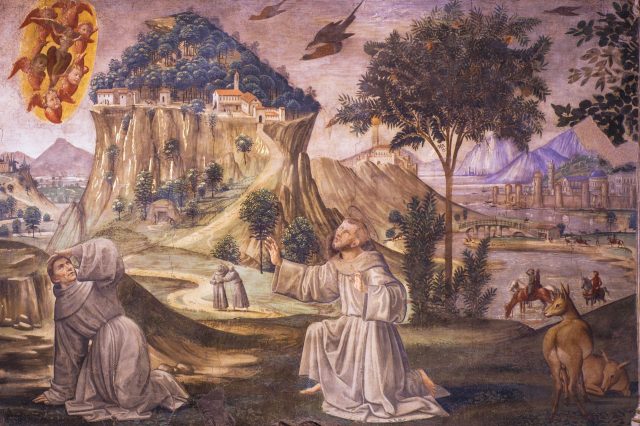
From Domenico Ghirlandaio's fresco cycle in the Sassetti Chapel. (Getty)





The tomb is in the crypt, beneath two vast churches stacked one on top of the other, beneath Giotto, beneath Cimabue, beneath an acre of fresco and several thousand tons of pink and white Subasio limestone. The foundation stone of the Basilica di San Francesco was laid on 17 July 1228, the day after Francis was canonized and less than two years after his death. The man who owned nothing was given the biggest house in town. Nobody in Assisi finds this odd.
This month marks 800 years since Francesco di Pietro di Bernardone died at the Porziuncola, on the plain below Assisi, on the evening of 3 October 1226. He was about 44, blind, stigmatized and completely worn out. Kenneth Clark, in the third episode of Civilisation, called him a religious genius, “the greatest, I believe, that Europe has ever produced”. What was the genius?
Not doctrine. Francis had almost none, and what he had he got from hearing the Gospel read aloud and taking it literally, which is the one thing the Church has never wanted anyone to do. It was a position on property. The Franciscan Rule of 1223 puts it in a sentence: “Let the brothers not make anything their own, neither house, nor place, nor anything at all.” They are to go through the world “as pilgrims and strangers”, and they are forbidden money in any form. In his “Testament”, dictated in his last weeks, Francis added that the Rule was to be understood “simply and without gloss”, which is to say: do not let the canon lawyers near it.
The distinction the Franciscans drew, and had to keep drawing for a century, was between use and ownership: usus and dominium. A friar eats bread, wears a tunic, sleeps under a roof, but owns none of them. He has, as the theologians put it, the bare use of the thing, usus facti, while every right of property is renounced. The argument reached back way beyond Roman law to Eden, where all things were held common and nothing belonged to anyone. Ownership entered the world with the Fall. To live without property was therefore not a penance but a return: it was to live as human beings had been made to live.
The position was there before the doctrine. In 1206, in the piazza in front of the bishop of Assisi, with his father, a cloth merchant, demanding his money back, the young Francis took off his clothes, folded them, handed them over and walked away naked. There was no Rule yet. The gesture was the Rule.
This is an extremely radical position. It is communism before the word, or anarchism, or both at once, though without a program, a party or the smallest wish to seize anything, since seizing was the whole problem. It was also, as the Church immediately saw, good for business. The friars were mobile, poor, eloquent and wildly popular, and a movement like that is either contained or burned at the stake. Francis was contained.
The Church took the celebrity and quietly dropped the message. Francis was canonized within two years of his death and the basilica was built in his memory. The Order, meanwhile, was flooded with educated recruits who wanted books, and with gifts of land and buildings from patrons who wanted to be buried in them. By the time the first generation of friars had died, the Order had tens of thousands of members and no longer resembled the man who founded it. It even rewrote him. In 1263 Bonaventure produced the official life of Francis, and in 1266 the Order ordered every earlier life destroyed.
What followed was a hundred years of argument about a single question, and it is worth being clear about the question, because people were killed over it. If the friars own nothing, how do they have libraries, churches, granaries, and a basilica? Two parties formed inside the Order. The majority, later called the Conventuals, were content to let the buildings be held for them by intermediaries, so that the friars used what they technically did not own. The minority, the Spirituals, said this was a lawyer’s trick: the Rule meant poor use, not just use without title, and a friar in a stone convent with a library was no poorer than a bishop.
The Church kept trying to close the question. In 1230, four years after Francis’s death, Gregory IX ruled that the “Testament”, the deathbed text with its plea for no gloss, was not binding on the Order; the friars were to follow the Rule as the Pope read it, not the founder’s last words. In 1279 Nicholas III settled the ownership problem with an elegant fiction: everything the friars used, down to the bread in their mouths, belonged to the papacy, which held it on their behalf, so the friars had use and the Pope had title. He then forbade anyone to discuss the matter further. They discussed it for another 50 years.
John XXII, a canon jurist with a lawyer’s patience for paradox and love of equivocation, ended the game, in two moves. First he dealt with the Spirituals. In 1317 he ordered them to accept granaries, cellars and ordinary habits like everyone else. Those who refused were handed to the Inquisition as disobedient, which in that world meant heretical, and in May 1318 four of them were burned at Marseille. Then he dealt with the doctrine. In 1322 he renounced the papal fiction of ownership and handed the property back, so that the friars now owned what they used whether they liked it or not, and he made the point that the whole distinction was unreal: when you eat the bread there is no bread left, and a use that destroys the thing is indistinguishable from owning it.
In 1323 he went for the root. It was declared heresy to say that Christ and the apostles had owned nothing. The whole Franciscan case rested on that claim: if Christ had had property, then poverty was not the imitation of Christ but a private eccentricity. The head of the Order, Michael of Cesena, refused to accept it and in 1328 fled from the papal court at Avignon to the protection of the Emperor, taking the philosopher William of Ockham with him. Both died as excommunicates. The rest of the Order became what it has been ever since: an institution, with houses. This is the world of The Name of the Rose, which Umberto Eco set in 1327 for a reason.
In The Highest Poverty, Giorgio Agamben argues that the Franciscans lost because they fought on the wrong ground. They let poverty be defined juridically, as the negation of a right, and so were always one bull away from refutation. What Francis had actually invented, Agamben thinks, was not a legal doctrine but a form of life, in which one does not apply a rule to a life but lives so that the living produces the rule. The naked man in the piazza is not obeying anything.
And while the message was being glossed away, the monument kept going up. Each decade of the argument added another layer: the Lower Church in the 1230s, the Upper Church above it, Cimabue in the 1280s, Giotto’s cycle of the saint’s life in the 1290s, so that by the time the Spirituals were burning at Marseille the poor man of Assisi had the most richly painted interior in Italy. Brother Elias, who ran the Order after Francis and had a genius of a different sort, had raised the money and hired the builders. He also hid Francis’s body, so thoroughly that it was not found again until 1818. For nearly six centuries the most visited saint in Christendom was celebrated in a basilica that had, in effect, lost him. The church is a betrayal, of course, but I am glad of it; I would not want a world without the Giotto frescoes. But the contradiction is exact. Francis owned nothing. In death, he became the Order’s principal asset.
At least one person saw the building for what it was: Angela of Foligno, an illiterate widow from a dozen miles down the road. The most wonderfully extreme of all the mystics went on pilgrimage to Assisi in 1291 and, at the door of the basilica, fell down and began to scream, asking love why it had abandoned her. Her confessor, Brother Arnaldo of the Friars Minor, was mortified and told her never to come back. He then spent years writing down everything she said. She was canonized in 2013, by a pope who had just taken the name Francis. Angela did not dispute the Rule. She screamed at the door.
What, then, is a saint? Not a good person; there are plenty of those and no one builds them churches. Not a hero either, who acts, wins and is remembered for the act. A saint is someone whose life has become a form, legible enough that others can live inside it. The saint is the answer to the question “how should I live?” given not as a self-help book but as a being of flesh and blood. This is why saints have bodies and why the bodies matter. Caroline Walker Bynum notes that, for all the fame of his stigmata, Francis is one of only two men in the history of the Church to have claimed all five visible wounds of Christ. The saint’s flesh is a text, and an argument.
It is also why the lives of the saints were, for something like a thousand years, the most read books in Europe after the Bible. The Golden Legend, a Dominican friar’s compendium of saints’ lives arranged by the feast days of the year, compiled around 1260 and read aloud in churches and households across Europe, survives in more manuscripts than almost any other medieval book. Remember what the Order did to the earlier lives of Francis in 1266. It tells you what a saint’s life is for: it is not a record but an instrument, endlessly revised, and the revisions are where the authority lies. Nobody read the Golden Legend for information. They read it the way we read biographies of musicians: to find out whether a certain kind of life could be lived, and what it cost.
What do saints do, then? They demonstrate. They show that a form of existence everybody had agreed was impossible, living without possessions, without violence, without fear of death, is possible, because here is someone doing it, badly fed and in a filthy tunic, on the plain below Assisi. The demonstration does not require that you follow; most readers of the Golden Legend kept their houses. But it changes what the word “impossible” means.
I do not know what to do with the end-times feeling that has settled on everything, the sense that the systems we live inside are at once all-powerful and coming apart, that the weather is wrong and the politics worse and the machines have learned to talk and are about to wipe us out. But the feeling is proprietary. It is the panic of people who own things, or who thought they did, watching their title deeds dissolve: to land, to a future, to their own attention. Francis’s answer to a world that was passing away was not to save it. It was to stop claiming it. Use it, care for it, sing to it (his “Canticle of the Creatures” is the first great poem in Italian, and it is a poem about not owning the sun) and hold none of it as yours. There is a politics in that which neither Left nor Right can presently say aloud, since both are, in the end, arguments about who gets the property.
Who is the Francis of this moment? The honest answer is that you would not be told. Saints are recognized late, usually after they are safely dead, by the institution that spent their lifetime trying to gloss them. The last man to take the name, and to mean something by it, died in the Vatican, which is where popes die, and which is a vast piece of richly arrayed real estate. If there is a Francis now, he or she is doing something we currently regard as impossible, somewhere unimportant, quite possibly with no religion at all, without a rule anyone has written down yet, and is being ignored by exactly the people who will one day lay the foundation stone.