




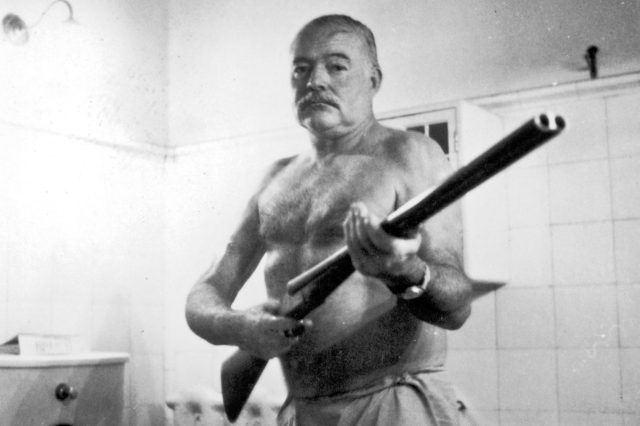
“Do you think that I had my prick shot off?” (Getty)





It is hard to write about Hemingway. You must write simply and truly and without adjectives, unless they are good adjectives. You must know many things about Hemingway and leave most of them out, and the things you leave out must be the important things, because if they are not important things, you have merely written fewer things. The things you know and leave out should be plentiful, like fish in the Gulf Stream…
I’m sorry. I know I shouldn’t. But you have to admit: the man is just so easy to parody. In 1934, F. Scott Fitzgerald succumbed to the same temptation as I did in the pages of Esquire: “There was an old biscuit in my dish and if there’s anything gloomier than one dead biscuit on a windy morning I don’t know about it.” By 1977, a whole “International Imitation Hemingway Competition” had been set up in the United States, yielding over the next 30 years such instant classics as “Big Too-Hardened Liver” and “The Old Man and the Flea”.
Sometimes, it seems, a writer’s style and sensibility can seep into the public consciousness so thoroughly that it washes away all particular facts about the works themselves. Ernest Hemingway is perhaps the paradigm case. Everyone agrees that he is gruff and terse and manly and emotionless; his main interests are bullfighting and big-game hunting and deep-sea fishing and overusing the word “and”. Most importantly, the things that tend to preoccupy other great novelists — interpersonal relationships, the delicate gradations of human thought and feeling — tend not to get much of a look in.
It is for this reason that readers who open up The Sun Also Rises, which celebrates its centenary today, might be in for a surprise. Hemingway’s first major novel follows the American military veteran Jake Barnes as he drifts drunkenly around war-scarred European cities: first Paris, then Pamplona in northern Spain. There is, admittedly, a fair amount of gruffness and taciturnity on show in Jake, but it is quickly made to point in a rather deeper, more obviously psychological direction. In the novel, Hemingway leaves the precise nature of Jake’s torment to the reader’s imagination: “Of all the ways to be wounded,” Jake says cryptically at one point while staring into a full-length mirror. “I suppose it was funny.” Later in his life, however, faced with pesky journalists insinuating Jake was just a stand-in for himself, Hemingway gave the game away: “Do you think that I had my prick shot off?”
Once you realize what is, or isn’t, going on in Jake’s trousers, The Sun Also Rises reveals itself as a remarkably psychological novel. All the famous Hemingway rough-and-tumble — the bullfights and fistfights, the endless macho posturing to win the hand of the beautiful, promiscuous aristocrat Lady Brett Ashley — become explicable in basically compensatory, Freudian terms. Jake gazes longingly at bullfights — he is, the pamploneses all agree, a true “aficionado” — then befriends the toreador, deliberately leaving him alone at the bar with Brett in the hope they will go home together. The Sun Also Rises is, in fact, a study in all the ways in which human beings displace their simmering frustrations and resentments into other zones of their lives, and a blueprint for many of the other, classic Hemingway scenarios from the Twenties and Thirties: the fishing trip that serves as a refuge from war trauma in “Big Two-Hearted River” (1925); the moment of mad, rash courage on a hunting expedition that compensates for romantic humiliation in “The Short Happy Life of Francis Macomber” (1936). It is hard not to read these works and be reminded of the fact that Hemingway was writing during one of the great golden ages of Freudianism in North America — a time when Eugene O’Neill was selling out Broadway theaters with plays about the Oedipus Complex, and Freud’s nephew Edward Bernays was dredging up his uncle’s theories to persuade American women to smoke. Meanwhile in Paris, where Hemingway lived, the Freud-obsessed surrealists were putting themselves in trances and speaking in tongues in order to try to get some of their respective unconsciouses to leak out onto the page.
Yet for anyone familiar with Hemingway’s later trajectory, these early affinities with psychoanalysis might seem rather surprising. By the time Hemingway won the Nobel Prize in 1954, he was regularly exploding in print at any journalist or biographer who dared mention the word “psychology” and “Hemingway” in the same sentence: “How would you like it if someone said that everything you’ve done in your life was done because of some trauma?” he complained in Time magazine. “To tell a writer he has a neurosis,” he grumbled in a letter to one of his most eminent critics a few years later, “is as bad as telling him he has cancer.” By the time Hemingway took his own life in 1961, the battle lines were drawn: Papa Hemingway on one side, psychoanalytic critics on the other. Over the next few decades, Leslie Fiedler argued that all the hunting and fishing was simply a way to flee the terrifying responsibilities of adult heterosexuality; Kenneth Lynn noted Grace Hall Hemingway’s peculiar penchant for dressing up her young son as a girl; and Mark Spilka made an immense fuss out of the fact that a lot of Hemingway’s female love-interest characters seem to have short hair. In the academy, Hemingway became a kind of anti-Freudian bogeyman, a monster of male repression, and the task of his critics was to do what he, in his own life, never could: understand himself.
How do we explain this rift? Did Hemingway simply become old and crotchety, disavowing the things that made his early work so great? I suspect there might be another explanation. Hemingway may have come of age in America’s first great golden age of Freudianism, but he lived long enough to realize that the fashionable new language could be deployed in two very different ways. On the one hand, there was the vague conviction of depth psychology that informed Hemingway’s own “iceberg” theory: the idea that within a work could be discerned all kinds of repressed desires and unacknowledged drives, such that the writer didn’t always need to spell out what a character was thinking in order for their motivations to make sense. On the other hand, there was the idea that this procedure should be performed on the writer — that understanding a work of literature was simply a matter of putting its originator on the couch. As he grew older and crankier, more famous and misunderstood, Hemingway sensed that the latter conception was beginning to crowd out the former. Put simply, he was one of the first American writers to discern, and inveigh against, the rise of what today we call “therapy culture”.
Contrary to popular belief, if you look carefully in Hemingway’s work, you find it absolutely full of characters who talk a lot about their feelings — it’s just that these characters are inevitably the frauds and phonies and self-deceivers, men who could use a hunting expedition or two to clear their heads. In The Sun Also Rises, the role is performed by Robert Cohn, champion boxer at university and reader of far-fetched romances set in South America, who spends most of the novel punching people, then tearfully seeking amends by explaining how lovesick he is for Brett. You can hear an adumbration of 2026: Oh, I’m sorry I ignored your messages, but that’s how my trauma response manifests. Won’t you forgive me? In perhaps the greatest Hemingway short story, “Hills Like White Elephants” (1927), the structure is even clearer. For three or four pages, the male protagonist inveigles his girlfriend into having an abortion by going on and on about how it is her choice and he will support her no matter what. He is communicative, attentive, and articulates his own preferences in a spirit of what seems to be openness and honesty: “I think it’s the best thing to do. But I don’t want you to do it if you don’t really want to.” It is, I think, one of the saddest scenes in 20th-century fiction.
If characters in Hemingway resist saying things, it is because they know, just like Papa himself, that the more you try to articulate your psychic life in an open and honest way, the more you end up either falsifying it, or else cynically deploying it in some new scheme. Curiously, given the generations of American feminist critics who turned Hemingway into a model of male repression after his death, one of the people who seemed to grasp this most intuitively was Simone de Beauvoir. In The Prime of Life, she recalled the shattering impact Hemingway had on her and a young Jean-Paul Sartre: “A great many of the rules we imposed on ourselves in our novels were inspired by Hemingway,” she wrote; in some ways, in fact, Hemingway was the great precursor to the mid-century French existentialist hero, for whom “there was no separation between the head, the heart, and the body”.
It is an example worth taking seriously today, too. The therapy culture whose first stirrings Hemingway detected in the Fifties has come to dominate art, literature and entertainment to a staggering degree: Marvel superheroes are given arduous psychological backstories; pop stars opine publicly about their attachment styles; the real villain of the last Disney film I watched seemed to be something like “intergenerational trauma”. Contemporary literature is often even worse: these days, the surest way to literary stardom is gently to imply that your book is the thinly veiled fictionalization of your own traumatic experiences with drugs or family or money or sex. Everywhere, in fact, the assumption seems to be that the role of culture is to drag the various ordeals that motivate human action out into the open. Read Hemingway, however, and you will soon begin to know better. You will know that men are often at their most revealing precisely when they cannot explain themselves, and at their most dishonest precisely when they can. You will know that if the truth of the human soul is to be found anywhere, it will be in the golden haunches of a lion, or the white pebbles at the bottom of a river, or the scales of a Gulf Stream fish, or the horns of a bull.