




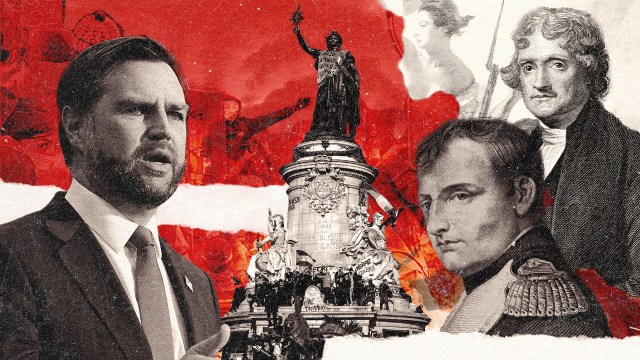
France influenced American politics from the beginning. (JG Fox/Getty)





Two weeks out from the midterm elections, JD Vance finds himself at the lowest point in his career so far. A war with Iran that he privately opposed — how vigorously is debatable — has turned into a genuine quagmire. Tehran’s (predictable) closing of the Strait of Hormuz has spiked gas prices, putting inflationary pressure across the economy and making a mockery of the Trump administration’s affordability agenda. Democrats are way ahead in the polls, and competitive in places, like Texas, where they shouldn’t be. The podcast bros have soured on him, the populists accuse him of being too close to Big Tech, the Groypers point out that he’s (literally) in bed with Big Hindu. And Donald Trump still withholds his endorsement for 2028.
Vance, in short, is rediscovering political gravity. And yet he remains the Right’s most viable and promising leader, and will likely retain that status regardless of what happens in November 2026 — or even 2028. Post-Trump, he is the only figure who can hold together a Republican Party that could otherwise easily splinter into four or five mutually suspicious factions. He has maintained bridges to each of these factions, and has learned to address himself acutely to the one anxiety all share, a fear that recently found a name — France.
France functions for America’s various conservative factions as a kind of crystal ball. In the looting, arson, and rioting that tore through major French cities over the past fortnight, America’s conservative groupings see their own future: that is, unless mass migration is halted and, at least to some extent, reversed. In France, they see the tipping point already past. So many culturally incompatible newcomers have piled on, in their telling, that society, properly speaking, is no more. What remains is an agglomeration of strangers, arrayed now in hostility, now in cold peace.
Several years’ worth of public and private conversations with Vance have convinced me that this is his central animating cause, the source of both his fears and his ambitions. The various factions on the Right, he feels, might have their disagreements — among themselves and with the Left — over issues ranging from tech policy to social welfare to war and peace. But all those other discussions must take second place to the complex of issues around immigration, assimilation, demography, and social cohesion.
For Vance, those other disagreements determine the shape of the polity — whereas the migration issue determines whether Americans have a polity at all. As he has repeatedly told me, it’s impossible to build up social solidarity “if society is always in flux”.
Turmoil in France has served as a foil for American statesmen going back to the two nations’ launch as twin revolutionary republics founded on Enlightenment ideals. Among the founding generation, Thomas Jefferson went furthest in championing the French revolutionary cause. As he saw it, the Jacobins had unleashed in the Old World the same spirit that had inspired American colonists: the spirit of a freedom that could no longer accept the yoke of kings and priests.
Yes, Jefferson wrote in a 1793 letter, the French Revolution had had its excesses: most notably, the killing of “guilty persons” without trial (how had they been judged guilty without trial? Jefferson didn’t say). But these excesses were par for the course in a “struggle which was necessary”. So necessary, in fact, that “rather than it should have failed, I would have seen half the earth desolated”, with only “an Adam and Eve left in every country”.
Others of Jefferson’s generation disagreed. Alexander Hamilton, speaking for the conservative Federalists, followed news of the Reign of Terror with great distress. Directly contradicting Jefferson, he argued in 1793 that the difference between the American and French revolutions is “no less great than that between liberty and licentiousness” — between orderly self-government and mob rule.
The French Revolution’s assault on religion didn’t seem to bother Jefferson one bit. But to early American conservatives, it was not only blasphemous, but self-defeating. While far from orthodox in their personal religious belief and practice, the more conservative-leaning Founding Fathers saw virtue as a necessary precondition of self-government, and they held up religion, in turn, as an indispensable support to virtue.
Thus, John Adams observed of revolutionary France: “I know not what to make of a republic of thirty million atheists.” On National Fast Day on 9 May 1798, instituted by President Adams amid deteriorating relations with the French republic, the head of Yale University, Timothy Dwight, took to the pulpit to warn that “to destroy us, our enemies must first destroy our Sabbath” — as they already had in Paris.
As has often been the case since, America’s geopolitical interests dissolved these ideological divisions. When it became undeniable that the French Revolution had empowered a new emperor with an appetite for world domination, Jefferson shrank from his earlier Francophilia. In 1802, and now President, he described Napoleonic France as “our natural and habitual enemy”. France’s encroachments on New Orleans, and along the Mississippi on what was then the western frontier, should prompt the Americans to “marry ourselves to the British fleet and nation”.
Through the 19th century, France’s image in America more or less solidified into what it is today: as a place that riots a lot, and whose politics seesaw between the extremes of revolt and reaction. There was an undeniable element of hypocrisy in this reception. Americans had their own volatile divisions, which escalated into civil war in the middle of the century, claiming some 600,000 lives. Class struggle in Gilded Age America and in the early 20th century didn’t look so different from the Paris Commune.
Then again, which quarrelsome couple doesn’t feel better about itself while listening to the family shouting match in the apartment next door? American conservatives have long framed their society’s internal contradictions and domestic rancor as foreign. An entire genre of US conservative thought is devoted to uncovering the European — specifically German and French — roots of progressivism, to the neglect of its origins in Anglo-American liberalism.
Which brings us to today’s French anxieties on the American Right: to US fears of immigrant “no-go zones” and seething multitudes apt to riot when their “paper” country — France — defeats their real homes — Algeria, Morocco — in a football match. Fear of ill-assimilated banlieues encircling major cities like Paris and Marseilles. Fear of Islamo-gauchisme, with the white Leftists mouthing the lofty slogans and the Arab or African toughs doing the nihilistic looting, all while making it clear that their political attachment to France is all but nonexistent.
It’s easy to caricature these fears as overblown, ignorant — or, at any rate, irrelevant. American immigration and assimilation dynamics are different from those in France (and Western Europe more generally). Unlike with the French or the British, Americans haven’t struggled to define a place for the descendants of former colonial subjects — they haven’t had to deal with the transition from empire to nation-state. And it’s a cliché but nevertheless true that US culture is easier to assimilate into precisely because it’s relatively “thin”: the culture of a commercial empire with a voracious appetite for labor and dynamism.
All the same, it’s a mistake to dismiss wholesale the American Right’s current French anxieties. For starters, there is more than a kernel of truth to the American conservative diagnosis. There are sensitive areas in France where the police must tread carefully. There are mosques and imams whose preaching casts into severe doubt the very possibility of expecting political loyalty of certain communities. Take a walk through Parc Georges-Valbon and Saint-Denis into central Paris — I did so at Christmas last year — and you can’t help but feel that the rate of demographic churn is so high that, in certain areas, majority-minority distinctions completely break down, leaving only different minorities mustering different levels of street-level and institutional “strength”. France, such as it is, is something vestigial in these areas, marked only in streets named after long-forgotten saints, kings, novelists.
Riots aside, this generates what I’ve described in these pages as diversity stress: a kind of constant, low-grade anxiety associated with having to negotiate normative and linguistic differences, public-resource competition, and simple unfamiliarity. It challenges people’s expectation of order and familiarity, which is just as much a part of being human as is the taste for novelty.
While the nature and source of the migration differs between Europe and the United States, moreover, the underlying dynamic is the same: the mass movement of people from the Global South to the Global North that began in the postwar decades and was turbo-charged beginning in the mid-2010s (coinciding, for an obvious reason, with the rise of populism on both sides of the Atlantic)
Why so many in the past decade — more than a million to Europe under Angela Merkel’s Wir schaffen das regime, and some eight million in the Biden wave? Partly to shore up aging demographics and the pension systems that depend on fresh labor; partly because migration is another form of wage arbitrage for employers; and partly (above all, perhaps) because migrants can more easily reach the West, thanks to prosperity in the Global South that allows a growing subset of people to cross vast distances relatively cheaply and quickly.
The upshot of all this is that the migration anxieties that twice catapulted Trump to the White House will long outlast his messy reign. A majority of Americans might disapprove of his handling of immigration, recoiling from the performative cruelty of ICE. But those same majorities still tell pollsters that they prefer the same or lower levels of migration as today (when Trump has already sealed the southern border and drastically cut legal migration and naturalization).
The result is that immigration restrictionism will remain the American Right’s top concern for the foreseeable future. It is the one cause upon which an otherwise notoriously fractious movement can converge even after Trump leaves the historical stage. Today, the movement is divided between five main factions. We might call them the Restorationists, the Tech Accelerationists, the Christian Nationalists, the Populists, and the Catholic Solidarists. All demand less migration, albeit for different reasons and in a different tone.
Start with the Restorationists, those who hope to restore the GOP’s old ideological fusion of pro-business libertarianism, foreign-policy hawkism, and moral traditionalism. Historically, this group was the most amenable to mass migration, not least because it’s what the pro-business donor class insisted upon. But things have changed. For one thing, this faction has been chastened by the rise of Trump and Trumpism, and its most classically liberal elements have more or less defected to the Democratic Party (where they will have to contend with an ascendant democratic socialism).
More important, supporters have come to view mass migration as one of the main drivers of anti-Israel sentiment — and they’re not entirely wrong. Politicians with names like Abdul El-Sayed and Zohran Mamdani are products of post-1965 immigration, when the United States threw open the gates to newcomers from Asia, Africa, and the Middle East.
The children and grandchildren of those migrants attended US universities where various grievance-studies courses were commonplace, where questioning American exceptionalism was de rigueur, and where campus activism meant backing Students for Justice in Palestine if you, as a member of, say, the Asian and Pacific Islander group, hoped to win support for your own pet causes. This is also why Vance, in a leaked address to the Republican Jewish Coalition, argued that anti-Israel sentiment could be mitigated by cutting migration. He was pushing on an open door: the remnants of the old-school GOP today are far less hospitable to migration than were their predecessors in the Reagan or Bush era.
Which brings us to the Tech Accelerationists — those who believe fervently that America’s salvation lies in staying ahead of China when it comes to artificial intelligence and other frontier technologies. This group, too, could historically be expected to support certain kinds of immigration to fill positions in research, data science, and the like with STEM workers from the developing world who’d work for much less than their American-born peers — and who didn’t dare demand higher wages or organize into unions, since their right to stay was often tied to a single employer.
But this, too, is changing. Like the Restorationists, the Accelerationists have been chastened by the populist tide. Insofar as they wish to remain part of the Right, they have to bargain and compromise with populism, just like every other faction. In December 2024, one of their chief spokesmen, Vivek Ramaswamy — a vocal champion of guest-worker programs — was attacked online after he blamed American cultural mediocrity for tech firms’ reliance on foreign labor (the subtext being that America still needs visa schemes that overwhelmingly benefit Asian, and specifically Indian, tech workers).
Then, too, the rise of AI and automation is rendering many lower-level tech jobs redundant, and an automated economy doesn’t need endless low-wage migrants. Here, too, Vance can bridge the gap between populists and Big Tech: as he told me in a 2024 interview for the New Statesman, immigration restrictionism is the “tech-forward” position, since the easy availability of cheap labor in certain sectors discourages firms from investing in efficiency boosting technologies.
Of the Populists, not much need be said, since they are the most likely to oppose all immigration, legal and illegal, skilled and unskilled, for reasons that range from economic and cultural to nativism and outright racism. The Christian Nationalists form an adjacent and overlapping faction. They once served as the evangelical backbone of the old GOP but have now gone their own way, having concluded that the bargain with pro-business libertarians and foreign-policy hawks wasn’t worth the candle (the libertarians got their tax cuts, the hawks got their wars, but the Christians who marshaled the votes got… much less).
Largely because Protestantism is Christianity nationalized, this group has never been as comfortable with pro-migration moral universalism as Catholics. In places like Texas, this group’s economic anxieties about migration have blended with cultural concerns over the rapid build-out of mosques and Hindu temples associated with recent migrant flows. When Vance addresses the civilizational discomfiture brought on by mass migration in Europe, he hits this group’s sweet spot.
That leaves the Catholic solidarists (or the Common-Gooders, if you will). This group — in which, cards on the table, I count myself — isn’t exclusively made up of Roman Catholic intellectuals. But they tend to prevail and set the tone. Their objections to mass migration aren’t racial or identitarian — apart from anything else, Catholic doctrine bars that — but practical: mass migration undercuts the wages and bargaining power of American-born workers, squeezes welfare systems, and makes it harder to foster class-based solidarity. Union density in the United States is inversely proportional to migrant flows; for good reason, Whole Foods uses “heat maps” to track the risk of unionization at its stores, with those in diverse, high-migration areas seen as lowest risk, while those in relatively homogenous areas register as high-risk.
Here, again, Vance appears as a bridge figure. His Catholic conversion memoir, Communion, published this year, is in many ways a critique of the old religious Right that preached personal virtue uplift while neglecting the material and political-economic foundations needed to shape virtuous souls. At one point in the book, he even favorably cites Herbert McCabe, an Irish Dominican friar who sympathetically engaged with Marxism and who once wrote, “The class struggle is not something we are in a position to refrain from. It is just there; we are either on one side or the other.”
Vance’s answer to those who criticize the second Trump administration for neglecting its pro-labor promise is, more or less: stop immigration first. That might be self-serving. But it isn’t illogical, for the same reason that most of the Right’s Solidarists emphasize restrictionism. At any rate, it’s what Vance believes the half of the country that elected him wants.
The danger in this tying of everything to immigration should be obvious. It can look like — and, perhaps for some, it is — an attempt to evade the domestic, homegrown sources of American malaise. But after decades in which discontent with high migration flows was pooh-poohed or written off as bigoted, there remains a lot of political space for addressing what nearly all of the Right’s factions view as a generational crisis. The negative example thrown up by France this month has been too urgent and searing to ignore.
Sohrab Ahmari is the US editor of UnHerd. His next book, on The Triumph of Normal, is forthcoming from HarperCollins.
 SohrabAhmari