




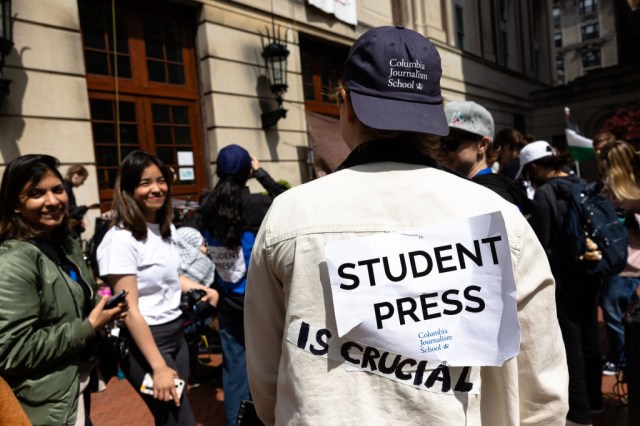
A campus mob has come after ‘The Columbia Sundial.’ Credit: Getty





The notifications kept coming: “I hope you sit in the discomfort of the backlash you are rightfully receiving and realize that, even then, you are experiencing only a fraction of the pain, torment, and degradation that Jane Doe has been experiencing in every moment since that night.” “Brother you gotta kill yourself.” “What the fuck is wrong with you?” “I hope [you] are shown the same cruelty you carry in your heart for someone you don’t even know.”
Over the past couple of years, a comforting narrative took hold: namely, that intolerant progressive identity politics and “cancel culture,” of the kind that characterized the mid-2010s and early 2020s, has receded. I hate to be the bearer of bad news, but that’s not always true, especially around certain topics. I’d know. I’m a junior at Columbia University, and I’ve spent the past 48 hours under a barrage of messages, like the ones above, urging me to commit suicide or demanding that my career and life be destroyed.
My crime: publishing an essay in a student magazine, The Columbia Sundial, that questioned the ironclad narrative on campus that Jane Doe, of the “Cornell 7” controversy, is a victim of rape.
My co-author, Christina Ma, and I argued that the case highlights a contradiction in American liberalism: we celebrate libertine sexuality while infantilizing women when this yields predictably troubling results, such as those at Cornell. “The sexual revolution,” we wrote, “created a hyper-liberal, pro-sex culture that insists that ‘women can do whatever they want with their bodies.’ In the world that, for better or worse, follows from it, we cannot claim to stand for sexual freedom and then recoil in disgust when there’s a possibility that a young woman simply chose to exercise it.”
More to the point: I believe that this globally divisive topic should be — indeed, must be — subjected to good-faith, reasonable contestation. (I write here in my personal capacity, and not as the Sundial’s deputy editor.) My detractors disagree. Even in our supposedly “post-woke” age, any debate on the Cornell matter is immediately mistaken for “misogyny.” To investigate is to promote “rape culture.” To raise doubts is to undermine the “lived experience” of all women.
The Sundial was founded in 2024 to foster debate, counter excessive editorial censorship, and publish ideas from an array of perspectives that Columbia’s other publications won’t touch. The project has been difficult: the general student body finds the publication too “conservative,” conservatives find it too “liberal,” pro-Palestinian students consider it to be “genocidal,” and Zionist activists on campus complain when we publish Israel-skeptical views.
Yet precisely this heterodox ethos, Ma and I and some others on staff believed, needed to be carried into our coverage of the “Cornell 7.” The process was controversial, even on our board. Our three-member editorial board, of which I am part, subjected the piece to extra scrutiny. One board member even ended up resigning after the article was published, in the wake of the massive backlash that ensued.
Nonetheless, Ma and I pushed the piece through, and it received the sign-off of all members of the board, including the since-resigned member. On the same day, we published a piece from an opposing point of view, taking issue specifically with my own writing and public statements on the “Cornell 7” affair.
Within hours of the story going live, Ma and I received more than 60 comments on Instagram and more than 100 “shares.” As of the time of this writing, it has garnered more than 300 “shares.” Students posted about it relentlessly, and with limited exceptions, in abusive language — attacking both Ma and me, and Sundial writ large. Very few people messaged me personally; instead, they chose to harass other members of our staff for being associated with me.
The Sundial is no stranger to controversy. At the height of the Gaza encampments, the magazine dissented from pro-Palestinian groupthink. But no backlash has been as intense, uncompromising, and extreme as the one that now confronts us.
The campus, en masse, has turned against us. The student-run Columbia Political Review published an open letter to the Sundial. It claimed a commitment to the “dissemination of multipartisan ideas” but added that “journalism relies on standards of respect and zero tolerance for sexism and sexual assault.” It accused us of unspecified “inaccuracies,” and of perpetuating “a culture of campus violence, rape, and assault.” The CPR also pressed the Sundial to re-evaluate its publishing guidelines and “commitment to public safety,” and conduct a review of our decision-making process.
Even the Columbia Open Discourse Alliance, or CODA, of which I was once a board member, has condemned us. The group wrote in a statement that “CODA exists because we believe in free expression and the open exchange of ideas, including ideas we disagree with.” But, you know, not really. The statement went on: “Open discourse requires that every member of our community be able to speak. This article does the opposite: it promotes rape culture and works to silence survivors of sexual assault.”
CODA also canceled a student press panel that was scheduled to take place, in which the Sundial’s editor-in-chief was slated to participate. The Columbia Daily Spectator, the campus’s principal student publication, weighed in with their reporting, which heavily relied on claims that our essay raised concerns about “safety” and quoted two of our staff members who are circulating a petition around campus for the Sundial to “cease organizational operations” until their demands are met.
Our student opponents, in effect, believe that prevention of sexual assault — a term that has come to encompass any activity that the accuser finds unwanted or distressing — can be accomplished through punishment of the perpetrators; to this end, allegations of sexual assault must be believed without question.
This activist position has long elided the difference between violent rape, a crime, and a host of other more ambiguous situations that are regrettable but not criminal, and are difficult to punish by law. Our essay argued that the libertine culture that both men and women participate in is responsible for many situations perceived as assault, and that in order to prevent this form of assault, the culture itself might need to change.
Activists may wish to silence this perspective, but student journalists and self-proclaimed “free-speech” organizers shouldn’t. It is distressing that students can believe that they are in favor of “multipartisan ideas,” “open discourse,” and “journalism” — all while silencing dissenting voices on topics that are less comfortable. Members of my generation, who were mere children when the first wave of cancel culture crested, appear to have learned nothing where it really matters.
