









October 18 2026 - 3:00pm
“Good things,” wrote Roger Scruton, “are easily destroyed, but not easily created.” He had in mind the “collective assets” of “peace, freedom, law, civility, public spirit and the security of property”, but he might equally have been writing about architecture.
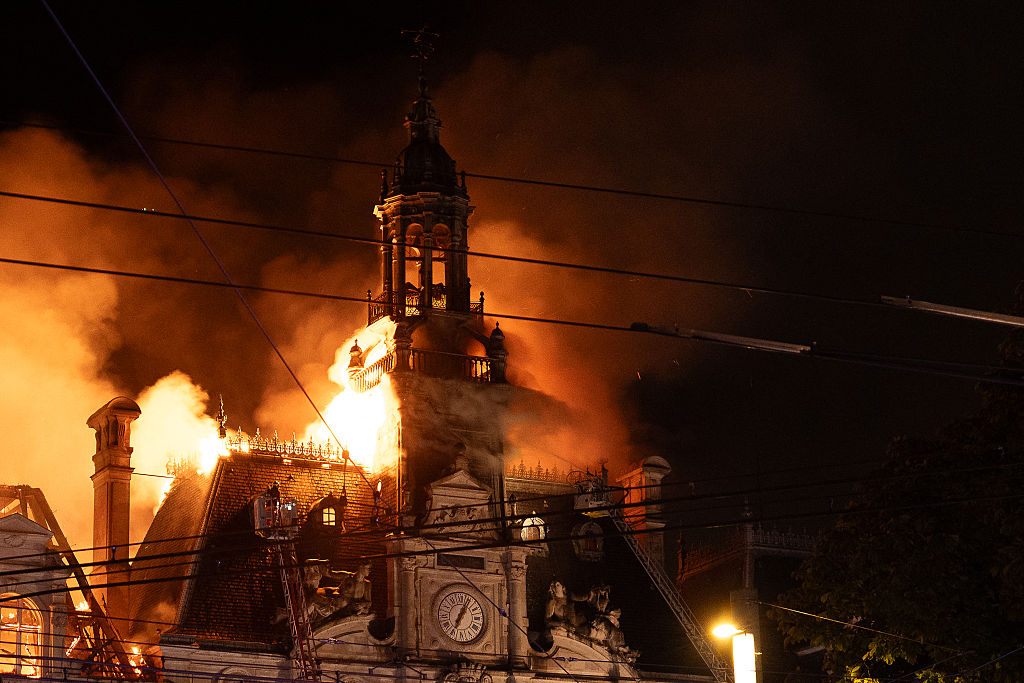
Yesterday, in what the mayor of Limoges, Guillaume Guérin, has called a catastrophe patrimoniale (a “heritage catastrophe”), French rioters did what revolutionaries have always done. Seeking to overturn their own civic culture, they burned a civic building, Limoges Town Hall. This was no accident, no stray spark igniting a conflagration. Rioters broke into the building and deliberately torched it, threatening to murder those who tried to stop them. In scenes heartbreakingly reminiscent of Notre Dame’s flèche collapsing into the fire in 2019, Limoges Town Hall’s elaborate clock tower and belfry folded into the flames live on French television to audibly horrified gasps. “It’s Notre Dame again, we are heartbroken,” lamented one news commentator.
I know Limoges Town Hall a little. Like Britain’s Stoke-on-Trent, it is a ceramics center. Unlike Britain’s Stoke-on-Trent, Limoges is prosperous; its historic beauties are not tumbling but well-polished and preserved.
Limoges was no building dropped on the ring road by a modernist town planner. It was on the site of the Roman city of Augustoritum’s forum. During the Middle Ages, the Priory of Saint-Gérald stood there, and its buildings were later repurposed as a town hall. In 1875, as the city boomed, Limoges demolished the priory’s remains and replaced them with the elaborate Neo-Renaissance and Louis XIII Hôtel de Ville that was destroyed yesterday. Big and bountiful, Limoges’s civic heart was a rich medley of medallions and mansards with elaborate rustication, high windows and a doorway to die for. “We are Limougeauds, we have been here for 2,000 years and we love our city,” it proclaimed. Alas, no more.
Revolutionaries like to destroy things. It obscures their thuggish stupidity in shock and smoke. In truth, it is not just the revolting French. During the 1831 British Reform Riots, the mob burned Nottingham Castle and Bristol’s Bishop’s Palace and Mansion House. The Paris Commune toppled the Vendôme Column in 1871 declaring it “a monument of barbarism, a symbol of brute force and false glory”. In scenes prophetic of yesterday’s destruction, the Paris Commune also torched the city’s Hôtel de Ville, the model for Limoges’s Town Hall.
War brought further destruction. The town halls of Arras, Reims, Bapaume, Le Havre, Caen, Brest and Dunkirk were all lost or severely damaged during the First or Second World Wars.
What has changed is how we rebuild. In the 19th century, Europe was rich in new town halls, at once harmonious and elaborate. They sang of their city through their scale and through the richness of their detail. Some were Classical like Birmingham or Leeds Town Hall. Some were Gothic like Manchester Town Hall. In France, as in Limoges and Paris, the favored style was Neo-Renaissance.
When a town hall was lost, it was either restored properly or replaced with something bigger or better. Thus, Paris’s Hôtel de Ville, torched by the mob in May 1871, was rebuilt by 1882, just as the Vendôme Column was re-erected in 1874.
These days we have no such luck. Modernist architecture and a cultural reluctance to rebuild mean that, almost without exception, every town hall built in Britain or France over the last 80 years has been a loveless lump, incapable of generating or channeling civic pride. Consider the town halls of Brest, Grenoble, Bobigny, Créteil and Le Havre in France, or of Hove, Sunderland and Brent in Britain. Or rather don’t, if you do not wish to depress yourself.
This is why architectural destruction endangers our collective future. We risk replacing lost beauties with modern horrors, thus further atrophying our mutual civic trust, and we cannot afford that luxury. Limoges Town Hall was an excellent example of the organic city, of the long continuity of improvement and creative destruction abandoned during the 20th century.
France should do what it did so brilliantly at Notre Dame: “build it back”, but make it even bigger, better and more beautiful.