




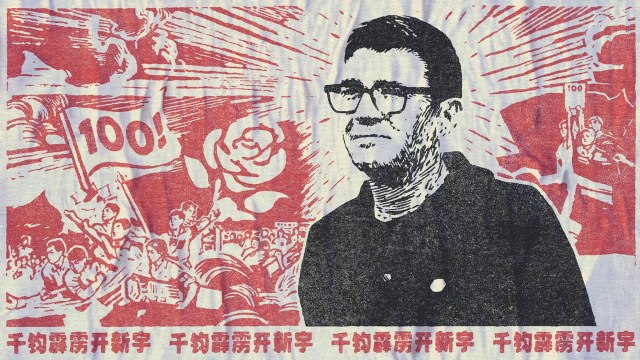
The PM has improved Labour’s polling. (JG Fox/Getty)





“Everything under heaven is in chaos,” Mao is reputed to have told his wife. Then, with relish, he added: “The situation is excellent.” While that quote captures something of China in 1966, as the Red Guards formed and the Cultural Revolution promised to upend the social order, its power lies in a deeper truth: moments of turmoil, however terrifying they may appear, provide an opening for those willing to take risks. Just look across the Channel, as disorder on the streets of Paris and Lyon not only compounds the likelihood of a Le Pen presidency, but also keeps Jean-Luc Mélenchon in the spotlight. Chaos can make the impossible feel inevitable. Incumbents flounder, insurgents thrive.
In his own understated way, Andy Burnham has also profited from turmoil: first from the oddly dysfunctional Starmer years and, more broadly, nearly two decades of economic malaise. So while Milan and Tirana are beset by disorder, and French town halls are ablaze, British politics suddenly feels like a haven of calm — however fleeting that may ultimately prove. Normal without being boring, charming without feeling pompous, Burnham’s personal qualities are enhanced by the chaos preceding him. He is, for many, a welcome antidote to the broiling disorder of Southport, Southampton and Gosport in recent years.
It’s true, of course, that Burnham has reached the 100-day mark without facing any big challenges. And if tomorrow’s Budget risks changing that, it’s also true that the Prime Minister is better placed to endure the storms ahead than his hapless predecessor. Unlike Keir Starmer, after all, our latest prime minister is at ease with social media, especially when “out in the country” beyond SW1. His daily missives on parking fines, and people “sodcasting” on public transport, are guerilla policy-making perfectly tailored to the attention economy. And if Starmer generally viewed such trifling issues as “noise”, Burnham’s No. 10 now recognises that permission to address the big issues, from the social-care crisis to the pensions triple lock, requires getting everyday concerns right. Rather than playing a fatuous game for eyeballs, the objective is to win time and trust — two things in short supply when you’re the country’s seventh leader in a decade.
There are strong echoes of Harold Wilson’s “little things that mean a lot” initiative here. There were no iPhones or Instagram back in 1974, of course, and the emphasis was less on a comms strategy that could connect with the public. But both Labour prime ministers are passionate about the local and seemingly mundane: back then it was local breweries and banning hare coursing, today it’s fly-tipping, potholes and bus fares. More than Wilson’s, though, Burnham’s politics are arguably most informed by the Great Helmsman himself as a heavily personalised form of centralisation, which goes hand-in-hand with mass politics.
While fighting a guerilla insurgency against both the Japanese occupation and Chiang Kai-shek, Mao developed his theory of the “mass line”. Put simply, this meant the party’s positions were informed by their engagement with the masses in the Chinese countryside — the very people Mao and his cadres relied on for survival. Those experiences were later codified, not least in a report written by Mao for the CCP’s central committee in 1943. Overall, Mao advised, leadership should consist in first going to the masses and learning from them, allowing the party to synthesise their experiences into clearly articulated principles and policies. From there, the party should disseminate formed-out ideas among the people, exhorting them to put principle into practice. Condensing the whole approach into a pithy sentence, Mao described the mass line as “to the masses, from the masses, to the masses” — though, this being Communist China, there was no actual voting.
Far from abstract idealism, these theories had huge implications, from the “patriotic health campaign” of the Fifties, which sought to address public hygiene and eradicate scourges like cholera and malaria, to the “Barefoot Doctors” who transformed healthcare in much of China’s rural heartland. Neither policy was overtly ideological, instead focusing on helping the working class, embodying the slogan of “serve the people”. And, notwithstanding genuine disasters like the Great Leap Forward, Mao’s efforts really did help create a literate, healthy and politically unified society. By 1978, when Deng Xiaoping became leader, life expectancy already stood at 63, far above the derisory 35 of 1945. At the same time, these successes laid the foundation for China’s system today, defined by some as “consultative Leninism”.
There’s a striking comparison to be made here with policy formulation in the Labour Party during the Corbyn years: and not because the tabloids cast him as an Islington Red Guard with an allotment. After all, following Corbyn’s surprise leadership victory in 2015, members increasingly determined party policy, a tendency which culminated in Labour backing a second EU referendum during its 2019 conference. Never mind that Corbyn objected — Rejoining proved disastrous in that year’s general election. This was, in essence, the Bennite vision of Labour: a party led by the wishes of its members, rather than the often exaggerated necessities of parliamentarism, or the compromises of the trade-union bureaucracy. It’s worth saying here that a similar approach is presently being tested by the Greens, though Labour’s conference was never sovereign over policy, something ultimately determined by the party NEC.
The approach of Burnham’s Labour, which embraces certain aspects of Left populism, appears to have entirely disavowed this activists-take-all approach. Instead, the Prime Minister seems to have adopted a kind of consultative Leninism, where centralised authority to actually do stuff goes hand-in-hand with input from below. That includes social-listening exercises on digital platforms, something Labour had started to get good at before Starmer’s demise, but which the ex-PM seems to have had little interest in. When Burnham used the term “Boriswave” on GMB yesterday morning, you can be certain that a great deal of data and analytics went behind it. Besides that is Burnham’s policy shop. Even before Labour won the by-election in Wigan, Josh Simons, the ex-MP for Makerfield, was reputedly taking soundings on policy development from a wide range of voices across the party — including think-tankers and campaigners close to the Labour Left. Anti-social behaviour on trains, new powers on fly-tipping, and Burnham’s harsh words on HMOs are all downstream of that process.
Most important, though, is the role played by the party’s metro mayors, whom the Prime Minister appears to take more seriously than any of his colleagues in the Commons. Unlike MPs, mayors have the resources, and scale, to act as policy incubators. As a result, they are increasingly central to the policy-making process, regularly attending the National Economic Council, which meets at No. 10 North, where they work alongside the leaders of the devolved national administrations as well as Louise Haigh, Burnham’s deputy, and Chancellor John Healey. What makes this unique is that policymaking, and listening, includes figures from parties other than Labour: a precursor, perhaps, to a time when Labour must work alongside other parties under PR. Either way, its guiding animus is wholly different to the adversarial norms of Westminster.
While the appointment of Healey as Burnham’s Chancellor surprised many, it really shouldn’t have — not least because the veteran Brownite is happy to do as he’s told. It’s ironic, perhaps, that a Prime Minister who has promised to transfer power beyond Westminster is simultaneously concentrating more power in his person and office than anyone since Thatcher. Even before entering Downing Street, Burnham’s team was briefing about the need to move away from an “imperial” Treasury machine. And while the media may have focused its attention on the subsequent announcement of “No 10 North”, the creation of a new Office of the Prime Minister and Cabinet was what really mattered. This is, in Britain’s own way, an emerging form of consultative Leninism: at least within the context of the country’s extraordinarily arcane, labyrinthine civil service. It’s a major development, but Labour’s critics — on both the Left and Right — are yet to see it. Some act like they’re still fighting Starmer.
But if Burnham understands the value of an outward-facing populism, but without much input from party members — then what about his colleagues? And while he’s transforming the government he runs, is the same happening within the Labour Party itself? In an inversion of Bennite orthodoxy, the PM is addressing the state, and indeed the public, before being particularly bothered about his own party. Might that backfire?
Perhaps. But moves are certainly afoot, with Labour’s political culture on Burnham’s radar too. That can be discerned from last month’s appointment of Joe Fortune as the party’s new general secretary. Fortune, like Burnham, hails from the North-West, but the two men aren’t reputed to be especially close. Labour’s latest top bureaucrat is, however, an ally of soft-Left powerbrokers like Haigh and Annelise Midgley, Burnham’s chief whip, as well as enjoying close links to the big trade unions. Precisely what Fortune will do to placate members if they try to drive party policy on issues like Palestine, or removing the triple lock, remains unclear. What is certain, though, is that in the place of influence over policy, members will need other outlets. The idea, perhaps, is that they will increasingly focus on local concerns, not least as larger local authorities are created and more metro mayoralties established. At any rate, the notion of constituency Labour parties driving national policy, as the Left dreamed under Corbyn, seems farther away than ever. Of course, many won’t mind in the medium term: as long as progress continues to be made in the polls, and political defeat for Reform looms on the horizon.
The irony, here, is that in a strange way, the political foundations of Burnhamism aren’t so different to those professed by Nigel Farage: hyperleadership and robust policy-making in the centre, driven by the perceived concerns of the public at large. Yet that’s where the similarities end. Because while Burnham does appear to have a genuine connection to the public, not least through powerful regional actors like Steve Rotherham and Tracey Brabin, Reform’s policy-making process is already subject to capture by the ultra-rich. This is less a criticism of plutocrats buying influence in the political process — though that’s certainly a problem — but simply an observation that it leaves Reform ill-equipped to address the grievances of the country’s downwardly mobile working and middle class. As a result, they are retreating to being a single-issue party.
Not, of course, that the next election is won just yet. But it’s been a hugely impressive first 100 days from the new prime minister, from reconfiguring parts of the state to delivering an effective comms strategy and taking votes from both his Left and Right. Perhaps, to paraphrase another Chinese statesman from the 20th century, Zhou Enlai, it’s still too soon to know the true consequences of a fraught, and often confused, decade of politics since Brexit. The chaos might not be over — but Andy Burnham clearly intends to take advantage it.
Aaron Bastani is the co-founder of Novara Media, and the author of Fully Automated Luxury Communism.
 AaronBastani