




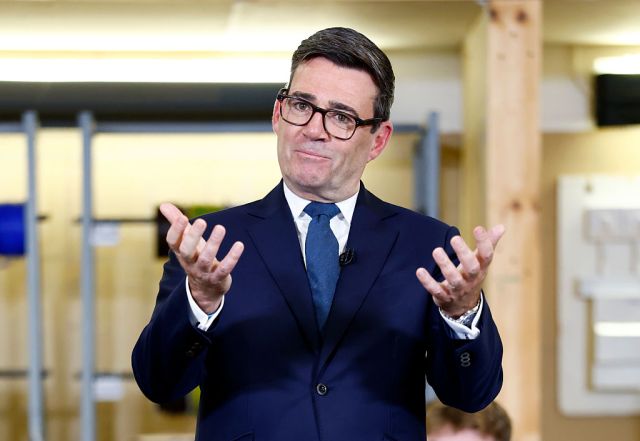
Weighing up his options. (Jeff J Mitchell/Getty)





Decades before Brexit, in one of the landmark speeches on Britain in Europe, an orator hailing from their party’s Right flank asked their audience: “What does federation mean?” The answer was nothing good. Powers, the speaker warned, would be “taken from national governments and given to federal parliaments”. And then? Nothing less than “the end of Britain as an independent nation state” — “the end of 1,000 years of history.” This was no Powellite rant, nor some excerpt from Thatcher’s famous Bruges speech. Rather, that evocative “1,000 years of history” line was conjured by Hugh Gaitskell, the modernising leader of the Labour Party from 1955 until his untimely death eight years later.
How times have changed. For Labour now has a Prime Minister apparently intent on reopening the Brexit debate, even as he frames his political project around reasserting state power over the market, something seriously undermined by EU membership. Never mind Andy Burnham’s attacks on the Brexit “status quo”, let alone Treasury plans to reignite “Project Fear” — for decades, the British Left understood this contradiction perfectly. Postwar socialism, proclaimed by Attlee in the hallowed year of 1945, relied too heavily on statist mechanisms, from tariffs to industrial subsidies, basically incompatible with the freedoms of the European bloc. Facilitating free trade through a giant continental single market was a concern for the capitalists, for the bosses — not for the labour interest.
As Gaitskell’s thundering speech makes clear, meanwhile, this approach to Europe was once near-consensus even on the Labour Right, uniting him with socialist firebrands like Nye Bevan. As Gaitskell’s rival once put it, supranationalism was a symptom of “political malaise” that “elevated the marketplace”, resulting from a failure of socialists “to use the sovereign power of their parliaments to plan their economic life”.
Here, perhaps, are faint echoes of Burnham’s nostalgic lament for a social democracy sacrificed at the altar of market efficiency. Where Bevan identified Europe with mammon, and where the Right’s Friedrich Hayek rhapsodised over “Interstate Federalism”, today Burnham identifies Brexit as one of his “four horsemen of Britain’s apocalypse”. The irony, of course, is that his other three riders are deindustrialisation, austerity and privatisation: each engendered as heartily by European technocratic elites as by Britain’s homegrown ideologues.
All the same, there is a political calculation at the heart of Burnham’s pre-EU shift. His immediate electoral challenge lies in reuniting Britain’s Left-wing voters behind the Labour banner, yet the fiscal picture is bleak. Manchesterism’s promise of large-scale renationalisation, green investment, municipal housebuilding — all could potentially attract Labour-Green defectors back into the fold. But they would also raise the ire of gilt traders all too aware of Britain’s inability to either constrain current spending or manage major capital projects effectively. Europe, then, offers a cheap salve, a way of rallying the twin forces of urban Remainia and provincial Bregret, while reinjecting dynamism into “UK PLC” without imposing huge costs on John Healey’s Treasury.
The problem is that this sets Burnham on a path towards breaking his so-called “Makerfield test”: that policies should be judged against their putative benefits for blue-collar and postindustrial Britain, as exemplified by his Wigan constituency. Unfortunately for Burnham, though, Makerfield voted 65% Leave. And while that enthusiasm is sure to have declined of late, the idea that there would now be a natural majority for Rejoin remains fanciful.
The break in the collective Labourite omertà on Europe, then, could be seen as part of a grim, reluctant acceptance of a future divorced from “Makerfield Man”: with Labour a progressive party, not a labour party, one made up of public-sector workers in alliance with urban social renters and young, downwardly mobile graduates. Rejoinerism might represent the final breach of a historical obligation, emotionally preserved by party bigwigs even today, that Labour should reflect its roots as an electoral vehicle built by and for the organised working class.
That nostalgia likely explains why the next Labour manifesto ultimately won’t promise British re-entry or even another referendum. Burnham, too, is as romantic as Gaitskell. No amount of polling data on Labour’s new base of white-collar professionals will rid him of his belief that the party should orient itself, at least rhetorically, towards some notion of “the traditional working class”, however broadly conceived. Of course, Labour will be happy to nurture a pro-European vibe, not least around some amorphous “reset in relations”. But don’t expect genuine pan-Europeanism, in the style of the Liberal Democrats or, indeed, Tony Blair, anytime soon.
As with much of Burnhamism, the point is in the signalling, not the substance. We might therefore see some limited reassociation, or a new, closer customs arrangement. And, to be fair, these options could offer a way to cut Brexit red tape without reopening the broader constitutional question. Still, even an unenthusiastic rapprochement could quickly cause trouble. Dominic Cummings has noted the paradox of Europhile progressives who champion regulations at home, yet who bemoan the imposition of bureaucratic hurdles on multinationals around cross-border trade. Meanwhile, some Brexit stalwarts will see any realignment as an undemocratic capitulation. And if the Treasury does indeed lay out the modelling numbers for various options, from re-joining the customs union to the full hog, it would still be a brave party leader to turn freedom of movement into an electoral issue come 2029.
If that again hints at a party in limbo — trapped between its old Makerfield base and its new professional-managerial one — there are more practical reasons to be suspicious of Brussels. After all, neither the single market nor the customs union have been panaceas for Europe’s long-term trend of relative decline. Indeed, Britain has outgrown both France and Germany since leaving the EU’s free-trade and regulatory regimes. If AI really is the sector of the future, then Europe’s data regulations exclude the continent from its windfalls. Besides, the bloc Britain would now rejoin is not that of Mitterrand or Kohl: it would be the Europe of Marine Le Pen and Alice Weidel. The dissonance between the Europe of the Remainiac imagination and the actually-existing EU grows wider by the day — not least given the recent disorder in France. Besides, Britain would enter this unhappy arrangement without exemptions from the Euro and Schengen, nor the significant budget rebate, all available before we left.
Through all this, Burnham could do worse than recalling the lesson of his predecessors: embracing their Labourism not just in romantic rhetoric but in practice. The Prime Minister’s programme, as sketched so far, is an attempt to “roll back the Eighties”: public ownership of utilities and rail, and a reindustrialisation drive that favours British firms in public procurement. Each of these risks being stymied by the legal architecture of EU membership. European treaties make nationalisation and compensation processes far more complex. Procurement rules require open tendering and preclude preferences for domestic bidders. The free movement of capital forecloses the controls that Attlee relied on to steer investment. Rejoining would not deliver the “social Europe” promised by Jacques Delors in 1988, instead binding Labour to a settlement that Burnham’s own programme is designed to escape. That’s why Gaitskell and Bevan opposed Common Market entry over half a century ago, and why Burnham can’t now both pass the Makerfield test and commit to rejoining.
Here, of course, Burnham would be swimming against the tide. Left Euroscepticism, once hegemonic, is now relatively niche. In the 2016 referendum, “Lexit” was backed by only a smattering of half a dozen or so Labour MPs, the Communists, the Socialist Workers, and the Rail Maritime and Transport Workers Union. One notable holdout was Jeremy Corbyn, who former allies tell me likely voted Leave. The eccentricities of this merry band don’t detract from the incompatibility of the EU with building a more cohesive national economy.
While frictionless trade and globalisation will find few defenders on the Left today — not in an age of “securonomics” and so-called “post-neoliberal” growth models — freedom of movement was itself an integral pillar of economic liberalisation. The creation of a single employment market, one stretching from Belfast to Bucharest, imposed a sham level playing field upon populations with vastly divergent employment practices and payment standards. The UK, with its relatively unregulated labour market, then became what Helen Thompson has called “the employer of last resort”. And, concurrently, the old Left transformed into an altogether different political tribe, more defined by what Wolfgang Streeck calls “cosmoliberalism”, far more concerned with preserving European constitutional arrangements than with adherence to traditional social democracy. Borderless capitalism, once trumpeted by Hayek and his ilk, should be as unloved on the British Left as it is still among British voters.
And, here, perhaps, is one more lesson of history. Whatever Burnham’s own muddled blend of romance and reality, politics and pragmatism, the basic truth remains: the grand European vision of Jean Monnet and Robert Schuman never fully took hold in our small island nation. Even for British pro-Europeans, people like Gaitskell’s old protege Roy Jenkins, being “in Europe” long meant little more than inclusion in modernity, in the world of services and capital, and the competition it unleashed on old-fashioned British industry. It was a pragmatic arrangement, rarely viewed in romantic or grand historic terms. It was only after Brexit that the metropolitan middle classes began to get teary eyed about the 12 gold stars and Beethoven’s Ninth. And even then, the most regular complaint heard was over passport checks at the airport — not Anglophone exclusion from some lofty transnational demos. For peoples who had, on several occasions, engaged in mass slaughter over the constitutional status of Alsace-Lorraine, the EU may have felt like the realisation of Enlightenment brotherhood after centuries of war. For Britain, though, its customs were alien, its languages incomprehensible, its people Other. Gaitskell understood that dilemma six decades ago, and changing Labour’s electoral coalition has not made it disappear.
Jonny Ball is a Contributing Editor at UnHerd. He formerly wrote under the name Despotic Inroad.
 DespoticInroad