




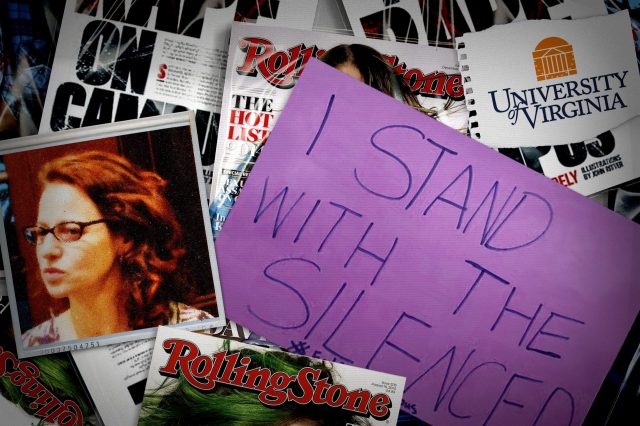





Before there was “Jane Doe” — the young woman accusing seven Cornell students of gang-raping her — there was Jackie. In 2014, Jackie, who has never been identified, told a story of frat-house rape at the University of Virginia so brutal, so harrowing, it threatened to break social life across America’s 2,600 or so colleges and universities. And in a way, it did. A dozen years later, when a similar account of gang-rape emerged, this time at Cornell, it was met with fierce and unrelenting skepticism in many media and online quarters. A share of young Americans, and of the nation writ large, now responds to such allegations with a shrug, or else by vociferously attacking the accuser. The issue, in other words, has become one more axis along which the two halves of the country are polarized.
The stark shift in the public reception of alleged rape victims in 2026 is, in some respects, directly attributable to the failure of institutions to lay a responsible groundwork for addressing allegations like Jackie’s more than a decade earlier. Instead of standing on factual probity and prudence, agencies from government to the press created a climate of hysteria and punitive legalism. They did this to advance a preconceived activist narrative into which Jackie’s story fit perfectly.
Only, Jackie’s claims amounted to an elaborate hoax whose unraveling gravely set back the cause of improving sexual ethics on campus.
Her story first came to public notice thanks to an exposé, by the journalist Sabrina Rubin Erdely, published in Rolling Stone. In Erdely’s telling, Jackie hailed from a rural part of Virginia and worked hard to fit in at a school that had long catered to the Southern elite. Founded by Thomas Jefferson as a bastion of Enlightenment values, UVA had a reputation as a party school — perhaps the nation’s first — where the sons of the Southern planter class once drank and caroused in between taking courses in the liberal arts and sciences and studying for professions like law and medicine. By the 2010s, however, the university had evolved into a highly ranked college, one of a very few top state schools, alongside the likes of UCLA, Berkeley, and Michigan.
Jackie at first felt inadequate among her elite peers, so she was delighted when “Drew” — also never identified, but for a different reason, as we will see shortly — took an interest in her. She’d met him while they both worked as lifeguards at the UVA pool, and he soon invited her to a party at his top-tier fraternity, Phi Kappa Psi, home to some of the most affluent boys on campus.
But the invitation was a ruse. Shortly after Jackie arrived at the party, Drew asked her if “she’d like to go somewhere quieter,” ushering her upstairs to a pitch-black bedroom, where gruesome events would transpire. She was pushed into a low table, whose glass top shattered under her weight. “Grab its motherfuckin’ leg,” a voice commanded. For the next several hours, she was raped by multiple young men, seven in all, while Drew watched, “swigging beer” and giving instructions. The ordeal appeared to be part of a fraternity pledging ritual.
Jackie wasn’t drunk, but she lost consciousness, awaking well after midnight and leaving the frat house wounded and disheveled. She called a friend for help. The friend arrived, along with two other of her closest friends (two boys and a girl). One of them, a boy named “Randall,” urged that she be taken to a hospital. But the other boy in the trio reminded Randall that the two of them hoped to be accepted into fraternities, and the girl added, “She’s gonna be the girl who cried ‘rape,’ and we’ll never be allowed into any frat party again.” So she was returned to her own dorm and sat with her story for two years, keeping it mostly quiet, save for a few confidants, including Nicole Eramo, then a UVA dean and the head of the university’s sexual-misconduct board.
When Jackie confided her story to Eramo, the latter did nothing. Eramo appeared in Rolling Stone as a “trusted dean” who “discouraged [Jackie] from sharing her story.”
Jackie thus suffered in silence, fearful that speaking out further would mean social destruction on a Southern campus where loyalties still ran thick. That is, until she decided to go public with it in her third year. The recipient of this soul-shattering tale was Erdely, who ended up placing it on the Dec. 4, 2014, cover of Rolling Stone.
None of it was true. There was no “Drew” who worked as a lifeguard at the UVA pool. There wasn’t even evidence that Jackie had visited the fraternity house at the time in question. This wasn’t a case of an important magazine story that was accurate in its thrust, even if a few substantive details had been mischaracterized. Rolling Stone — and, soon, many other institutions — fell for a troubled young woman’s narrative concoction.
With precious few exceptions, the prestige press and other elite institutions initially accepted the story at face value and framed it as a moment of reckoning: for Greek life; for universities; for a nation that for too long had neglected women’s safety in the name of protecting reputations, especially those belonging to the rich and powerful — the sons of affluent America, plus deans and other university administrators fearful of rocking the boat.
The Washington Post, which later helped discredit the Rolling Stone piece, initially wondered if the allegations should serve as a “tipping point” on the place of Greek life on campus. A writer for the paper urged that “we should automatically believe rape claims” (the line was later changed to “generally believe”). In response to the doubters, a writer for The New Republic huffed: “It is symptomatic of exactly the patterns of incredulity and easy dismissal of rape accusations that keep many assaulted women and men from ever bringing their stories to authorities or to the public.” Bustle magazine, meanwhile, dismissed all skepticism to conclude: “It’s not just an account of a rape, alleged or otherwise. It’s about rape culture itself. You have to identify a problem before you can solve it, which is exactly what the Rolling Stone piece set out to do.” A Slate contributor accused the skeptics of “denialism.”
When Erdely’s essay appeared, “the initial reaction from everybody [at UVA] was just that of outrage,” a source familiar with the night’s events and their aftermath told UnHerd. “Across the university people were appalled that this could happen. People believed it.” Students rose up in protest. The Phi Kappa Psi fraternity house was vandalized. UVA faculty circulated emails demanding the abolition of the entire Greek system. University President Teresa Sullivan partly complied by suspending Greek life.
The members of the fraternity were widely demonized. As Stephen Scipione, the then chapter president, reflected at the time: “It’s completely tarnished our reputation. It’s completely destroyed a semester of our lives, specifically mine. It’s put us in the worst position possible in our community here, in front of our peers and in the classroom.” Eramo, to whom Jackie had confided, ended up looking heartless in the Rolling Stone story — and, more to the point, neglectful of basic duties of care toward a victim.
In reality, Eramo had followed best practices, offering to help Jackie contact law enforcement or launch a campus investigation, but not pushing her to do so, an approach that is considered to be “trauma-informed,” since it allows the victim agency in the decision to press charges or not. Eramo also put Jackie in touch with a campus organization for survivors, headed by UVA’s sexual-assault-leadership council chairwoman, Emily Renda. And Eramo followed up a few weeks after the initial meeting.
In the end, the fraternity and the school were vindicated. By the following year, the local police department completed its investigation of the allegations and released the results: none of Jackie’s story could be substantiated. As it emerged from testimony and email evidence, it seemed most likely that Jackie had made up the events as an attempt to elicit sympathy from one of the friends who showed up that evening — “Randall,” later identified as undergraduate Ryan Duffin — for whom she had unrequited feelings. Rolling Stone retracted the story and was compelled to pay nearly $1.7 million in damages to the fraternity. A jury likewise awarded $3 million to Eramo after concluding that she had followed all guidelines of care in dealing with Jackie’s claims when she first raised them with her.
The Columbia Journalism Review later conducted an investigation and issued a report, published in full by Rolling Stone, which concluded that “A Rape on Campus” amounted to “avoidable failure” at every level of the journalistic process, encompassing “reporting, editing, editorial supervision, and fact-checking.”
The damage was done. The UVA Jackie case became the second major allegation of gang-rape by elite college students that came apart in as many decades, the other being allegations of a gang rape by the Duke lacrosse team in 2006, which also turned out to have been fabricated. The nation now confronts a third such story, though one that isn’t nearly as fictitious — Jane Doe’s allegations regarding the “Cornell 7” — but the landscape has irreversibly shifted.
The early 2010s were a time of dramatic change and, in some ways, hope when it came to the treatment of sexual assault on campus. Jackie’s story was far from the first of its kind. The public had been outraged by high-profile crimes, such as the gang-rape of an unconscious undergraduate by football players at Vanderbilt in 2013; and by the history of institutions sweeping sexual assault allegations under the rug, as happened in 2012 at Florida State, where an alleged victim’s complaint against a star football player went inadequately investigated by both police and the university. Female students and the public at large were demanding change.
In this heady moment, the definition of sexual assault was changing as well, both legally and in the eyes of many young women. As the author Vanessa Grigoriadis writes in her 2017 book on the topic, Blurred Lines: Rethinking Sex, Power, and Consent on Campus, a growing number of complainants “made the nation comfortable with a new definition of sexual assault: one that embraced a spectrum of sexual behavior, including previously acceptable areas of consent.”
Unwanted touching and grabbing, coercive speech, denigration — all were reclassified as assault. Gray-zone sexual encounters were forced into black or white. The emblematic example of this was the case of Emma Sulkowicz, Columbia University’s “Mattress Girl,” who complained that a man had initiated unwanted anal sex in the course of an otherwise consensual encounter, as reported in Grigoriadis’s book. Sulkowicz carried her mattress with her everywhere she went on campus, in protest of the university’s finding the male student “not responsible” and a district attorney’s conclusion that there were insufficient grounds for “reasonable suspicion” of a crime.
Forming the legal backdrop to this was a directive issued in 2011 by then-President Barack Obama’s Department of Education to colleges that received federal funding. The directive — which came to be known as the “Dear Colleague” letter, after its opening — didn’t make new law. But it radically altered how the relevant law — Title IX, prohibiting sex-based discrimination in higher education — was to be applied.
To wit, the “Dear Colleague” letter treated sexual assault as a serious form of sex-based discrimination that had to be addressed in university-based hearings under Title IX, separate from any other police or justice-system investigation. Far more controversially, the letter banned mediation as a potential outcome to such complaints; discouraged allowing the accused to confront or cross-examine their accusers; and set the evidentiary threshold for a guilty finding to a “preponderance of evidence,” which is quite a ways off from the “beyond-a-reasonable-doubt” threshold applied in criminal cases.
The attitude towards these changes was largely positive, or at least open-minded, at first. The feeling that women had been wronged in the past, and deserved a redress, ran high. Even when Jackie’s story turned out to be a hoax, sexual-assault advocates worried only that Jackie’s lies would damage the credibility of all women — rather than seeing a potential unfairness to men. Bystanders at UVA who were swept up in the scandal were also thinking of the women. “I found myself on an international news stage, talking about a very real, serious issue in the context of a story that had the potential to damage the credibility of a lot of other people who would legitimately need help in similar situations,” one told UnHerd.
But a decade and a half later, it is safe to say that hope has dissipated — a result of the several institutional and activist failures that converged on cases like Jackie’s.
Start with the Obama administration’s failures. Even before the “Dear Colleague” letter, some universities were using disciplinary hearings to adjudicate claims of sexual assault in ways that were deeply troubling from a due-process standpoint. It wasn’t uncommon, for example, for accused men to be convicted of some of the most heinous charges in human legal history on the basis of little more than a scintilla of evidence in the accuser’s favor.
In 2006, for example, a Brown student named William McCormick was accused of sexual assault and was almost immediately removed from campus by university authorities — before any adjudication and before any criminal charges (which never came). McCormick sued the Ivy over these due-process defects; the case eventually settled.
In some cases, accused students were allowed to bring legal counsel to hearings, but the lawyers were barred from speaking or intervening. The right to cross-examine accusers, a bedrock of Anglo-American legal procedure, was sometimes denied to the accused. And charges of rape — which often involve DNA and other complex evidentiary elements — were being adjudicated by school officials, many of whom had scarcely any experience in law enforcement.
In effect, the Obama administration took these procedures — which were already crying out for reform — and imposed them on the entire college system as mandatory. This primed the mistrust among male students and their parents, but more than that, it put more and more university administrators in the position of law enforcers. And made them deeply fearful of any approaches but the legalistic.
As we have noted in these pages, such abridgments of due process have already marred the “Cornell 7” case. One accused student, Scott Kretzschmar, was exonerated of rape and sexual exploitation charges at his Title IX hearing — only to be convicted of attempted sexual exploitation, a charge of which he wasn’t notified in advance and therefore had no means to refute. One of the hearing officers, as UnHerd first revealed, could be seen on the Zoom app driving and surfing the internet while Kretzschmar’s future hung in the balance.
The second failure was the dirty trick that was long seen as the activists’ magic bullet: the conflation in the public mind of real violence by men against women with regrettable or misguided encounters in which both parties bear some blame. As Grigoriadis puts it, in order to achieve the huge and dramatic changes that came about, “part of [the activists’] genius was overstating the case, and conflating lesser slights with forcible rapes.” This may have been understandable as a tactic for those focused on victory, but to the extent that it has been picked up by institutions, it has been a corrupting influence. It has generated an intense backlash among the accused, who are being held accountable, both socially and by university tribunals, for behavior coded as “rape” that is, in fact, usually much more ambiguous.
Witness how this played out in journalism. Erdely chose Jackie’s story, which was difficult to corroborate and, if looked at closely, full of holes, over many other less sensational options available to her. She did so because of her own bias — she trusted Jackie, as she told the later investigation by Columbia journalism scholars. She found her source credible. But it must also have been a story she wanted to believe. It was a good scoop, of course. It also accomplished the convenient effect of using the heightened emotional tenor produced by a brutal rape story to create a kind of umbrella of outrage over all sexual assault. (Erdely, when reached by UnHerd, declined to comment.)
Only such a motivation on the part of Erdely and Rolling Stone could account for the magazine’s overlooking of the obvious discrepancies. For example, if Jackie’s friends were merely anticipating rushing a fraternity, why was there already a pledge ritual event happening at Phi Kappa Psi? Pledging at UVA happened in the spring — a detail the Rolling Stone fact-checkers missed, and that later came out in the story’s unraveling.
Jackie was reluctant to provide Drew’s last name and struggled to spell it. Instead of seeking to confirm his existence on her own, Erdely gave up when she couldn’t find such a person having worked at the UVA pool. Still more damningly, Erdely failed to get in touch with any of the friends Jackie supposedly met with that evening. Nor was she troubled by her failure to identify, much less seek comment from, any of the alleged gang-rapists.
We have institutions — functioning, rational ones, painstakingly developed over centuries, that could have prevented any of these problems if those at the helm followed well-established guidelines. The law insists upon due process. Journalism has standards, as the Columbia Journalism Review’s excellent forensic analysis of the Erdely story revealed, if only Rolling Stone had hewn to them.
UVA, in fact, seems to be the only institution that did follow its own procedures: it allowed the alleged victim to decide whether or not to bring her case forward. Not only is this approach trauma-informed when it comes to sexual assault, it very well might have a beneficial filtering effect when it comes to false allegations. In a video deposition in 2016, Jackie said that she stood by her story and “I believed it to be true at the time.” And she must have, but perhaps she didn’t believe it quite enough to press charges, or to respond to Eramo’s follow-up. The school was right to let the matter drop. Additionally, Emily Renda, the leader of the sexual-assault-support group who gave Erdely Jackie’s name, later tried to stop the journalist from publishing the fraternity’s name, on the grounds that it would violate due process. Both women, in other words, acted properly and in good faith.
And yet the school and all the individuals involved paid the price in public shaming. Is it any wonder that other universities have now taken note? The third, ongoing institutional failure stems from this. In an email Nicole Eramo sent through her lawyer to the Columbia Journalism Review team, she wrote, “I do not — and have never — allowed the possibility of a media story to influence the way I have counseled students.” Eramo was defending herself against the perception that she’d tried to keep Jackie quiet, but the opposite challenge now faces many administrators, who face pressure to prove they’ve done enough. And they’re doing it, justice be damned.
There is a compulsion to legally convict and punish. It is cheered by activist journalism, and it was carved into administrative procedure by the Obama and Biden administrations. It is still the rule at many schools, despite the suspension of the letter by President Trump. All this has foreclosed other forms of justice and reconciliation. As the Cornell case, and many others like it, make clear, the sexual culture on many campuses is deeply broken. Young men and women under the influence frequently engage in sexual activities that don’t amount to rape in the traditional legal sense, but which leave one person, most often the woman, feeling harmed, confused, and shamed. This is precisely the sort of situation that a wise administrator, working from a restorative-justice perspective, can address. But an administrator fearful of losing federal funding, and of being demonized by the press, will opt instead for the purely punitive approach that simply isn’t apt in cases like Jane Doe’s.
Jackie’s story casts doubt on other women’s testimony, to be sure. But worse, it was the beginning of a movement to use the most inflammatory cases to define the issue. The results have been disastrous.
There’s no happy ending to this tale. Emma Sulkowicz, Columbia’s “Mattress Girl,” has stopped making art, and is an acupuncturist in New York City. The man she accused, Paul Nungesser, later sued Columbia for violating his Title IX rights, and settled out of court. Crystal Gail Mangum, the stripper and false-accuser from the Duke lacrosse case, which predated the events at UVA, later went to jail for murder.
Sabrina Rubin Erdely left journalism and works in corporate communications for Boston Scientific. Nicole Eramo, who wrote in her email to the Columbia Journalism Review investigation that she had “lived in the Charlottesville community for over 20 years” and had “a deep and profound love for this university and the students who study here,” now resides in Easton, Pa., and serves as the senior adviser to the president of Lafayette College. Eramo does not appear to have continued her work in sexual-assault advocacy. Emily Renda, who now goes by a married name, is listed as a board member on the website of the Take Back the Night Foundation, and is an assistant county counsel in California’s Sierra Mountains.
The UVA boys appear to have fared well, all things considered: Stephen Scipione, the head of Phi Kappa Psi at the time of the false allegations, is head of operations at a capital management firm in Austin, according to LinkedIn. Ryan Duffin, the “Randall” in the Rolling Stone story, is a software engineer, also according to LinkedIn. It’s likely that a source who spoke to UnHerd speaks for all of them, when saying that the story “follows me around and causes a lot of grief” to no good purpose.
And Jackie, the besotted fabulist who thought that telling a guy she had a crush on that she’d been raped might make him swoop in and protect her? Her false story, perhaps, is yet another example of the disturbed and disturbing dating culture facing American students. When asked where she is now, or even if she finished school, a UVA source says, “I have no idea, I have no details since.” It is to be hoped that she received the help she needed. But clearly, it was not the kind of “help” the Obama administration or the national press provided. And many other young men and women have suffered as a result.