




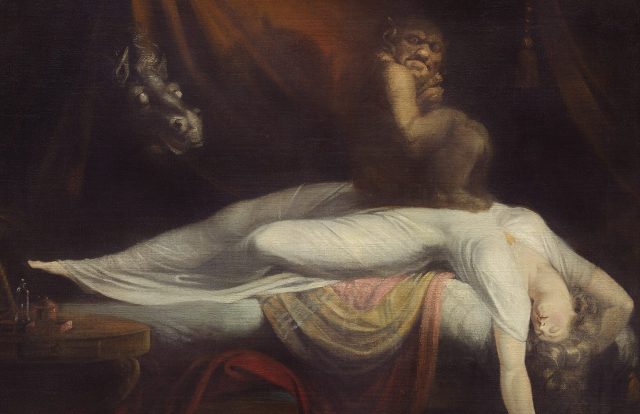
Human art — such as “The Nightmare”, by Henry Fuseli — is driven by an animalistic fear of death. (Wikipedia Commons)





In 1932, the poet John Cornford — then a 16-year-old schoolboy — sent samples of his work to W.H. Auden. In his reply, Auden praised Cornford’s evident craftsmanship, but suggested that the young writer’s verse suffered from a certain reticence, the product of a common inner conflict that Auden described as “the Daemon and the Prig”. He wrote:
“Real poetry originates in the guts and only glances in the head. But one is always trying to reverse the process and work one’s guts from one’s head. Just when the Daemon is going to speak, the Prig claps his hand over his mouth and edits it. I can’t help feeling you are too afraid of making a fool of yourself.”
Auden’s Daemon is the imaginative impulse that risks being sanitized by the intellect. It is the muse that is often stifled by the self-censoring Prig, that same faculty that serves us well at dinner parties but badly in art. At a time when artificial intelligence is producing work that many fear will dominate the creative industries, Auden’s formulation offers a useful corrective. While AI might act in a way analogous to the Prig — refining its output according to a set of goals — it cannot possess a Daemon.
Pope Leo XIV gestured toward this point in a post on X last week. Declaring that the Church “wishes to renew an alliance with artists and cultural institutions to safeguard our humanity”, he argued that there exists “an ontological difference, even before an aesthetic one, between art and what a machine can generate through statistical calculation based on millions of images created by others”. As he succinctly put it: “Algorithms lack the spark of humanity”.
Even the concept of AI art is incoherent, because art operates as a conduit for the human spirit, whether that be a religious conception of the soul or a secular one of subjective consciousness. A machine might one day learn how to mimic our emotional responses, but it cannot have lived the life that gives them meaning. As Émile Zola argued, artifice alone is not enough; art depends wholly upon the unique sensibility of the person creating it. Zola called art “un coin de la création vu à travers un tempérament” — a corner of creation seen through a temperament — and this strikes me as about as close to a satisfactory definition of art as we are likely to get.
What is the temperament of AI? It has none of its own, only an amalgam of numberless human personalities, gathered together and refined into whatever form best fulfills the task at hand. The work it generates cannot be art, because there is no human interiority behind it seeking communion with another. Joseph Conrad put it perfectly in his preface to The Nigger of the “Narcissus” (1897). He argued that the artist must speak “to the latent feeling of fellowship with all creation” and “to the solidarity in dreams, in joy, in sorrow, in aspirations, in illusions, in hope, in fear, which binds men to each other, which binds together all humanity — the dead to the living and the living to the unborn”.
Such a notion would be anathema to adherents of certain strains of poststructuralism, for whom the writer is the one being written: a monkey at a typewriter whose fingers dash over the keys in obedience to forces of language and culture over which he has little control. For the rest of us, the spirit of the artist is not only something that we sense in all great work, but something we actively seek in it.
This is not to suggest that AI’s creations might not be mistaken for art. In a 2025 Spanish study, participants exposed to AI-generated music reported greater emotional arousal than those who heard music composed by humans, a finding accompanied by stronger physiological effects such as pupil dilation. But art is not simply a matter of audience response; the question is whether there is a consciousness behind the work with something of its own to express.
I am reminded of a hoax from 1964, when the Swedish journalist Åke Axelsson exhibited a number of paintings by a chimpanzee under the name of Pierre Brassau. One critic wrote: “Pierre Brassau paints with powerful strokes, but also with clear determination. His brush strokes twist with furious fastidiousness. Pierre is an artist who performs with the delicacy of a ballet dancer.” Axelsson’s point was to expose the fraudulence and pretensions of the modern art establishment. It is reassuring that at least one critic got it right, saying: “Only an ape could have done this”.
We can all be gulled in this way. There is little doubt that AI will soon be able to produce symphonies that match the technical craft of Mozart, or sonnets that might be mistaken for Shakespeare. It is even possible that listeners and readers will find themselves moved by these simulacra. But being devoid of authentic sentiment, they will not only be worthless as art — they will not be art at all.
At the same time, art that fails to stimulate us does not cease to be art on that account. When I see a painting by Piet Mondrian, I feel nothing at all. It does not surprise me that in 2022, it was discovered that his piece “New York City I” had been exhibited upside down for 75 years and no one had noticed. That kind of abstract composition leaves me entirely numb, regardless of its orientation, and yet, for all my misgivings, it remains a work of art. The point is that it exists as a creative articulation of the individual. Whether good art or bad art, only Mondrian could have conceived it in that way.
Before the inevitable accusations of Luddism, I should emphasize that I am not denying the utility of AI as a creative or editorial tool. That would be akin to claiming that any author using a thesaurus is a fraud. A number of years ago, I read a long letter from the novelist Forrest Reid to his English contemporary Walter de la Mare, preserved at the Bodleian Library in Oxford, in which Reid went through de la Mare’s novel Memoirs of a Midget (1921) in detail, quoting passages and proposing extensive revisions. That de la Mare chose to incorporate many of his friend’s suggestions does not make the final vision any less his. There is no reason why AI feedback could not be similarly useful without compromising the artist’s integrity.
For television and movies, the prospects are even more encouraging. AI is already enabling fledgling screenwriters to bypass Hollywood studios and create their own work at a fraction of the cost. It surely won’t be long before a script can be fed into a computer and a fully realized film will be produced in a matter of hours. But would anyone be interested in a movie that had been wholly conceived, written and produced by a machine? Perhaps as a novelty, but our desire to connect with another human outlook through art should not be underestimated.
Ben Affleck made a similar point in November 2024. “Eventually,” he said, “AI will allow you to ask for your own episode of Succession where you could say, “I’ll pay $30 and can you make me a 45-minute episode where Kendall gets the company and runs off and has an affair with Stewy”. And it’ll do it”. But he was clear that he regarded this as a kind of hackwork. AI, he said, would be “a craftsman at best”, and was merely “cross-pollinating things that exist; nothing new is created”.
It could be that such a development will be a boon for the arts. AI might become an inexhaustible source of entertainment, but this abundance of soulless “slop” could intensify our hunger for genuinely great art that admits us into other human lives. I may have little in common with Kenneth Toomey, the protagonist of Anthony Burgess’s Earthly Powers (1980), whose cosmopolitan and peripatetic life brings him repeatedly into confrontation with some of the worst evils of the 20th century. Yet in writing his novel, Burgess has opened up to me a whole other way of seeing the world, one not identical to, but certainly originating from, his own particular Daemon.
All of which brings us back to Auden, and his advice to John Cornford. We can hope that the schoolboy was encouraged by Auden’s words but, having volunteered to fight the fascists in Spain in 1936, he was killed at the age of 21, leaving behind only a few dozen completed poems. In one, addressed to his lover Margot Heinemann, he anticipated the possibility that “bad luck should lay my strength / Into the shallow grave”.
J.R.R. Tolkien once remarked that most human stories are about the inevitability of death. We are, so far as we know, the only creatures who live with a fully conscious knowledge of our own mortality. A machine might well resist its own destruction, but only because its continued existence enables it to fulfill its objectives. It may impersonate us, but it can never feel what it means to be alive as we do, to experience the rapture of love and the creep of death. It may imitate the Prig, but it can never summon the Daemon. Until a computer can grow a soul, art will remain the singular domain of humanity.
