




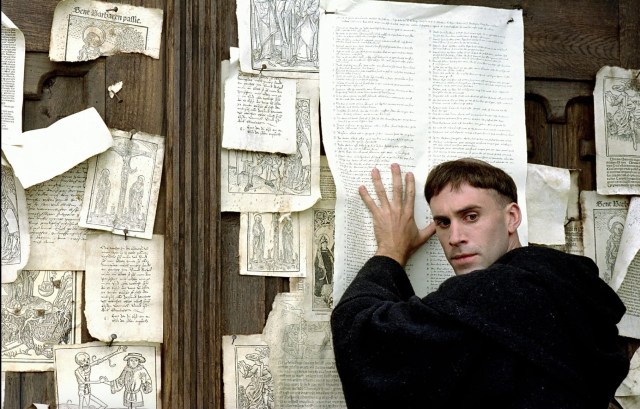
Must he really stand there? (Luther/IMDB)





We, the undersigned, call for a complete and total end to the use of the “open letter” as a mode of public intervention.
Open letters claim to restore moral clarity; but too often they spread confusion. Open letters purport to express obvious truths; but recent events have highlighted the worrying tendency of the genre to be hijacked for counter-productive ends: to express obvious non-truths, for example, or — and this can be worse — non-obvious non-truths.
Some of the foregoing dangers are, we believe, inherent in the collective epistolary form itself. The trick, in crafting the perfect open letter, is to give maximalist expression to a minimalist position. Authors of open letters need to be selective enough in relaying the background “facts” of their case so as not to alienate potential signatories: these are celebrities we’re dealing with, remember, and therefore natural free-thinkers. At the same time, one has to give the letter enough moral phlegm to make it worth clearing one’s throat to put one’s famous name to it.
The result — you might call it Maier’s Canting Theorem — is that the assessable argumentative content of an open letter is inversely proportional to a weighted average of the fame and number of the celebrities whose names are appended to it. In the place of explicit reasoning, in the course of which a position’s flaws and vulnerabilities are all too liable to be exposed, the reader of an open letter is treated to broad moral pronouncement, rendered in a high-committee prose style, and which tends to veer towards melodrama and alarmism.
Needless to say, we, the undersigned, feel this chilling trend poses an existential risk to democracy, harms the most vulnerable in our society, and is likely to eradicate life on Earth as we know it.
Connoisseurs of the open letter have by now probably seen the above-described defects recently on display in the public tangle that The New Statesman has got itself into. In a letter whose length is robustly predicted by Maier’s theorem — being really more of a tersely-worded postcard with 158 signatures — the magazine denounces as unconscionable the recent “censorship” of the novelist Sally Rooney.
The facts of the case are well-known. Among the political causes close to Rooney’s heart is Palestine, and a group called Palestine Action. Rooney has pledged to use royalties to support the group — despite the fact that it was lately sanctioned as a terrorist group by the British government, making funding them an offence. We, the undersigned, cannot help but conjecture that Rooney might have got away with her wheeze — were it not for the fact that she announced her intention to break the law in advance, and in a manner almost designed to attract attention. Given the legal jeopardy, at any rate, Rooney’s publisher at Faber has decided, with the author’s consent, to suspend sales of her novels.
Now, we do not wish to take a collective stand on the controversial question of whether Rooney’s silencing omens a sinister curtailment of the right to free speech. We only wish to note that, if a novelist’s right to free expression includes a guarantee that others must cooperate in activities which the author loudly declares will be used to raise funds for terrorists on British soil, Rooney may well have a complaint.
It is one of the rhetorical liberties taken by open letter writers that they sometimes pass off caustic jibes as concessive praise. We only wish to add, then, that the Statesman’s own letter exhibits, rather brilliantly, one further trick common to the form: that of smuggling in inflammatory speculations to the extra-epistolary text, which the signatories themselves might have preferred not to be implicated in. In this case, there is a somewhat daring analogy attempted between the fates of Sally Rooney and Salman Rushdie. Just consider, we are invited to reason: both write novels; both have had trouble selling them in Britain at one time or another; both… have the initials “SR”? (At some point, the brainstorming exercise takes a slightly feeble turn.)
Still, we note that one further peculiarity of open letters is that, once they begin to attract enough ink below the line, they inevitably tend to be judged as much on the basis of those who notably fail to sign as on the basis of those who do. (That may be more a “feature” than a “bug” of the genre: the creation of an implicit cost to withholding assent being part of the form’s coercive effort to organise public thinking). Notably, though presumably he was invited to, Salman Rushdie did not sign.
These quagmires give only a merest hint of the varied trouble open letter writing can lead to. Though they pretend to give a voice to suppressed truths, too often they simply echo a preachy moral consensus. Though affecting nuance, their inevitably coarse-grained rhetorical style is a standing disinvitation to detailed engagement. Even well-intentioned interventions — the famous 2020 Harper’s letter championing free speech — can undermine their own cause in subtle ways. Having spent so much time throat-clearing about the threat of “right wing demagogues”, “Donald Trump”, and slavishly assenting to the need for more DEI, the Harper’s letter may have done more to underscore the inescapability of a woke consensus than it did to oppose
Or consider — if you can bear to — the glaringly avant-garde approach that Jolyon Maugham of the Good Law Project takes to his open letters. One recent exhibit, a letter in defence of Jason Arday’s right to evade media scrutiny, was a superficially well-reasoned account made about an utterly alternative reality. Arday, the 21,000 undersigned agreed, was facing “entirely false allegations of plagiarism”. There was “no evidence whatsoever of wrongdoing” against him. The “baseless allegations” were therefore a “right wing” smear campaign. “Universities must ensure that excellence is protected and that every scholar is judged on the merit of their work, not the colour of their skin,” the letter concluded, apparently without irony. If ever it is complacently assumed that the open letter lends itself to the service of clarification, then here is evidence that it is just as easily commandeered as a vehicle for the brazen propagation of falsehood.
The home stretch of an open letter is the time to get expansive; and even in denouncing them we, the undersigned, do not wish to buck the form. Why do people set so much store by open letters? What epistemic authority are these bewildering lists supposed to exert over us? Someone who thought moral opinions more reliable when dispensed by motley bands of intellectuals would seem, on reflection, as mad as someone who thought all songs sound better when performed by Live Aid. Yet the appeal of the genre seems to rest on the strange assumption that when a missive has been jointly audited and solemnly endorsed by a mongrel committee of bewilderingly disconnected names, it enjoys some strange, placeless authority. “If Kneecap, Zadie Smith, and the Chichele professor of social and political theory can all agree on this one”, such letters seem to ask, “why can’t you?”.
Needless to say, in a world without open letters floating about, some might justly worry about where we are to get our opinions from, and how we are to verify that they are in good standing with the moral majority. We acknowledge that this is a serious problem. However, having consulted each other, we believe it best that everyone should think for themselves.
