




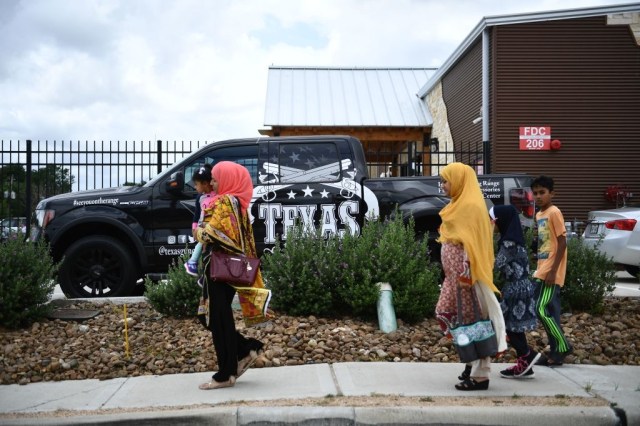
Islam in Texas is increasingly fueling a bitter culture war. Credit: Getty





As the Global War on Terror got underway at the turn of the 21st century, then-President George W. Bush sharply distinguished Islam and Islamism. Islam, in this telling, was a global faith counting more than a billion adherents, including a few million in America, the overwhelming majority of them peaceful and loyal. Islamism was the noxious ideology that inspired 9/11 and numerous other attacks of the kind. Islam meant “peace,” as Bush insisted. Islamism meant war and terror.
In the years that followed, a few cultural flashpoints brought Islam’s place in America into public contestation. Even so, Bush’s distinction more or less held. But not anymore. Today, politicians and activists from his home state of Texas are promulgating school curricula that underscore the violent dimensions of Islam, mounting fierce opposition to new mosque proposals, and objecting to recent demographic changes in overtly racial and religious terms.
The Lone Star State, in short, is emerging as the central battleground in fierce new debates about Islam, identity, and American belonging.
It’s easy to dismiss the ferment as just the latest expression of old-school Southern bigotry. And to be sure, the new Texas pushback against Islam is sometimes downright ugly. Yet those who merely wring their hands — including veterans of Texas GOP politics like outgoing Sen. John Cornyn and former Bush consigliere Karl Rove — underestimate the depth and durability of the anger, as well as its roots. By picking these fights, Texas Republicans seek to renegotiate and revise America’s modern immigration order, which dates back to the 1960s.
Consider the newly approved statewide social-studies curriculum, which requires teachers to explain early Islam in terms of “the Prophet Mohammed’s brutal military campaigns against Jewish and Christian tribes,” and to emphasize the faith’s “normalization of slavery” and “the taking of female captives as harem slaves.” The curriculum must also “describe the teachings of jihad and how these teachings led to the expansion of Islam and the conquest of Christian lands, including Jerusalem, Syria, and Egypt.” As Texas’s Muslim population grows, Republican officials are responding not with accommodation, but by asserting more forcefully the state’s own civic identity and, not so subtly, their belief that Islam is incompatible with Western culture.
Islam isn’t the only target. There was also the recent Texas Longhorns controversy, in which Bo French, a GOP nominee for the Texas Railroad Commission, posted on X a photograph of a large section of Indian-American students cheering at a University of Texas, Austin, football game with the following caption: “Social media is exposing how many Americans have been displaced by foreigners. It’s everywhere and far worse than any of us could imagine.”
While that post could be written off as one aspiring pol’s edgelording, the Islam curriculum represents a systematic push by the state GOP, with intense pushback from Muslim advocacy groups to show for it. The Texas chapter of the Council on American-Islamic Relations, which Gov. Greg Abbott has designated a foreign terrorist organization under state law, has vowed to “overturn” it and to “protect teachers and students who refuse to teach it.”
The deeper issue is immigration — legal immigration, to be precise. Border security and illegal immigration have long been top priorities of the Texas Republican agenda, of course, but the current fight is something new and addresses a slow but significant transformation of American demographics now plainly visible in Texas.
In 1965, the Hart-Celler Act abolished the national-origins quota system that had severely restricted immigration from Asia, Africa, and the Middle East. The law didn’t transform the country’s demographics overnight, but it created the conditions for much larger waves of immigration in the decades that followed. In Texas, the Asian population nearly tripled between 2000 and 2020, swelling to 5.4%, up from 2.7%. In some of the booming North Texas suburbs where these communities have concentrated, the change is even more pronounced. In the Dallas suburb of Frisco, where much of the Asian population is Indian, the broader Census category of “Asian” jumped to more than a quarter, up from 2.3%, over the same period.
For a growing faction of Texas Republican activists, these communities have made legal immigration a cultural question in a way that illegal immigration never has been. That is in part because the demographic change is unfolding in many of the same middle- and upper-middle-class suburbs where conservative voters themselves live. Many of these immigrant communities are also relatively affluent, giving them the resources to invest in permanent institutions of their own, from commercial storefronts and restaurants to mosques and Hindu temples. The result is more immediate and visible contact with people whose religious practices, dress, customs, and social norms are unfamiliar — and seem threatening — to the native population.
Legal immigration isn’t an entirely new concern in Texas. The state Republican Party had previously called for ending the H-1B program, which allows for the importation of workers whose right to remain in the United States is tied to a specific employer, rendering them particularly pliant and likely to undercut the wages and bargaining power of native workers. By 2024, Texas Republicans had adopted an unusually sweeping legal immigration agenda unlike that of any other state GOP. The platform called for immigration to be limited to levels that “facilitate assimilation,” the repeal of H-1B visas, an end to the diversity lottery and chain migration, and a moratorium on net migration. The breadth and ambition of these demands may make them easy to dismiss as so much rhetoric. But Texas conservatives have repeatedly shown that the state can be a launchpad for policies that reshape the national debate.
But the immigration debate also leads back to Islam. For some Texas Republican activists, it extends to specific religious beliefs and practices they see as difficult to reconcile with American law and culture. They argue that sufficiently large Muslim communities could develop a parallel social and legal order organized around Islamic religious law, or Sharia. The issue has therefore moved beyond the party’s older opposition to courts applying foreign law to whether Sharia could shape daily life within Muslim communities in Texas. In 2026, “Don’t Sharia Our Texas” became a formal grassroots legislative priority, calling for restrictions involving immigration, foreign funding, religious and educational institutions, and residential developments alleged to promote the application of Sharia law.
These ideas have not remained confined to the grassroots. Both state-level politicians and federal elected officials are pursuing government action to address these issues. In Austin, Gov. Greg Abbott ordered state agencies and public universities to freeze new H-1B visa petitions while his administration reviews the program. Attorney General (and US Senate hopeful) Ken Paxton has opened investigations into North Texas companies suspected of using sham businesses to sponsor foreign workers.
At the federal level, Texas Reps. Keith Self and Chip Roy founded the Sharia-Free America Caucus last year. It has since grown to more than 60 members, including more than a dozen members of the Texas congressional delegation. Their rhetoric has been unusually direct. Roy has argued that the immigration system must confront what he calls the threat posed by Sharia, while Self has described its spread as a threat to Western civilization. When a proposed mosque came before the McKinney City Council this summer, Self personally urged council members to reject it, warning that “there is no state cavalry coming to save you.” (The council ultimately approved the mosque unanimously because development complied with city ordinances.)
But even the most ambitious efforts to restrict future immigration can’t reverse the demographic change that has already taken place. Texas Republicans must contend with the state as it exists today, and with a younger generation that looks very different from the one that built the modern red state. Between the 2000 and 2020 US Censuses, non-Hispanic whites fell to 40% of the state’s population, down from 52%. Hispanics grew to 39%, up from 32%, while the Asian share nearly doubled (as already noted). The change is even more pronounced in the public schools. Of the roughly 5.5 million students enrolled today, only about a quarter are white, and more than half are Hispanic. Another 13% are black, and nearly 6% are Asian. Public-school enrollment isn’t a forecast of the future electorate, but it offers a striking picture of the generation now coming of age in Texas.
That demographic reality has raised the stakes of what Texas teaches in its public schools.
In September, the Texas State Board of Education completed its yearlong overhaul of K-12 social-studies standards. The curriculum’s new treatment of Islam has received the most media attention, having angered Muslim Americans and revived an old cultural debate over Islam and the West. But the more significant change may be what the standards say about how Texas intends to teach its own history and civic identity to an increasingly diverse generation. The standards place what the board calls a central emphasis on the foundations of Western civilization and the values that shaped the founding of Texas and the United States. Board chairman Aaron Kinsey said the goal was for students to understand the state’s republican form of government and America’s “exceptional place in the world.” The curriculum revision reflects a decades-long conservative project in Texas, in which grassroots activists scrutinized textbooks and pressed the State Board of Education to give greater emphasis to American patriotism, Christianity, and the country’s founding principles.
Underlying that effort is a larger disagreement over what civic education is supposed to accomplish. Conservatives involved in the curriculum fight argue that schools should transmit a common civic inheritance and give students the intellectual foundations for understanding why the American constitutional system developed as it did. But liberal and progressive critics argue that organizing history around Western civilization and American exceptionalism can marginalize the experiences and traditions of students whose ancestors came from elsewhere, as well as leave students unprepared to navigate a globalized world.
At the center of that disagreement is a still-deeper dispute over cultural relativism that pervades liberal and progressive thinking. The conservative critique is that a curriculum too reluctant to make distinctions between political, religious, and moral traditions eventually loses the ability to explain why the American system should command any particular loyalty. To this, the progressive response is that a common national story must teach the histories of other groups so that students can see their own communities represented in what they learn. They claim that traditional accounts of America have too often ignored or minimized the experiences of these minority populations.
But post-1965 immigration presents a challenge to this familiar progressive response. Unlike black, Native-American, and Hispanic communities, many of the immigrant populations that grew rapidly after 1965 don’t have a long-standing place in the American tradition. The tension is therefore not just simply that there is less of their history to construct and emphasize in the American story. It is also that a world-history curriculum built around Western exceptionalism necessarily makes judgments about the non-Western civilizations from which many of these students descend.
Nowhere is that conflict clearer than in the teaching of Islam. The new world-history standards require students to study Muhammad, the Quran and Hadiths, and the Five Pillars of Islam. But they also give more explicit attention to Islam’s military expansion. The instructions to study the “teachings of jihad” and how they contributed to Islamic expansion and the “conquest of Christian lands” are new, and have been contested by Muslim groups. Students will also study Muslim participation in the medieval slave trade, conflicts between Christian and Muslim powers, and the role of radical Islam in the 9/11 attacks.
Muslim organizations and some educators have objected to that framing. They argue that it disproportionately associates Islam with conquest, violence, and extremism. They also fear such teaching could contribute to Islamophobia and peer bullying. While these concerns are important, there is also no denying that the multicultural curricula that prevailed in recent decades also didn’t do justice to the truth: Islam has violent scriptures that, taken too literally, have inspired latter-day jihadists and societies that intensely repress women and religious and sexual minorities.
Texas Republicans may thus be taking on the most consequential culture-war fight they have ever attempted. Unlike earlier battles over abortion, guns, or gender, this one confronts demographic changes that Republicans see as a potential threat to their long-term political dominance in the state. Republicans are trying both to slow that transformation through efforts that restrict immigration and to ensure that an increasingly diverse generation of Texans can be taught a common understanding of the history and traditions of the state and country they share. Whether Texas can build that common civic education without taking actions that deepen the religious and cultural divisions it is trying to contain may be the real test of its current fight. A nation undergoing similar demographic transformation is watching.