




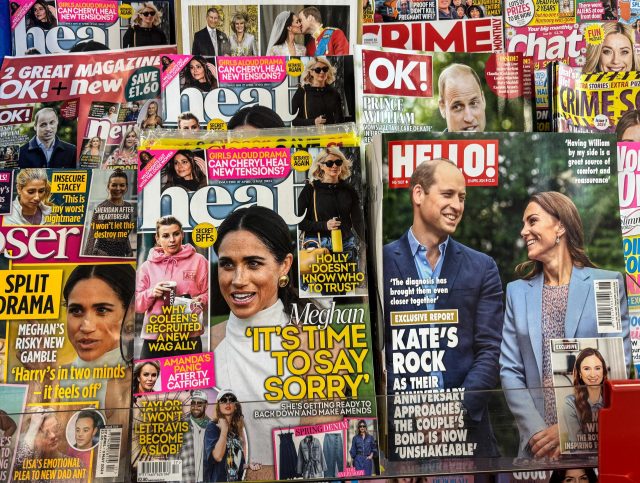
“The main difference between Hollywood movies and royalty is that the former don’t even pretend to be real.” (Matt Cardy/Getty)





As the King definitively rules out a return to The Firm, Meghan Markle must be more urgently contemplating a return to acting. Cynics might suggest that she never left it. There’s no great distance between Hollywood and the Royal Family. The latter may find the former rather vulgar, but both are fictional worlds built around aura and icon, image and spectacle. Maintaining a permanent public smile, along with a series of rapid costume changes, is a necessity for both starlets and duchesses. The main difference between Hollywood movies and royalty is that the former don’t even pretend to be real.
Going back to acting would be Meghan’s latest self-reinvention, but then self-reinvention is what actors do all the time. It’s also a distinctively American practice, which like many things in the States has its origins in Puritanism. The greatest self-reinvention of all is the crisis of spiritual conversion, after which you aren’t the same person as you were before. You turn from a sinful world to a regenerated one, and there seems no reason why this remaking shouldn’t become a perpetual way of life. When it does, it’s commonly known as postmodernism. The self is plastic, protean stuff, clay in your hands to be molded this way or that depending on how you happen to be feeling. Does Madonna even remember being part of the English squirearchy in a previous incarnation, riding her horse in the Cotswolds? The only force which binds together your various identities is the will to succeed. If that means making jam or dressing up in a giraffe costume, so be it.
In the 19th century, the world was seen as in constant flux, but there was a stable point in the midst of this mutability: the self. It was a kind of substance, rather like the body but invisible. In our own time, flux has invaded the inner sanctum of the self and scooped it out. As Oscar Wilde remarked, truth is one’s present mood. This is all very different from the traditional bourgeois idea of selfhood. One of the great revolutionary breakthroughs of the European middle classes was the notion of self-determination. You were no longer instructed what to think and do by feudalist, monarchical, autocratic regimes. Instead, you decided for yourself. You wrote your own history, rather than playing a humble role in a pre-scripted narrative. The creed of liberalism was born. It was advances of this kind which caused Marx to admire the middle classes so much, a fact of which most of them seem nowadays to be oblivious. To be free meant not just to be unshackled, but to construct your own destiny without the interference of others. What was important wasn’t simply what you did, but the fact that you did it. To that extent, it was an adolescent kind of ethics. Yet it had world-shaking political implications, not least when the idea of self-determination was applied to nations as well as individuals. The result of that was the unleashing of one of the most transformative political forces the modern world has witnessed: revolutionary nationalism.
There’s a difference, however, between self-determination and self-invention. To shape your own identity suggested that you had such a thing already. The problem was that someone else — the state, the church, the nobility — was forbidding you to be your own master. It wasn’t a matter of plucking your selfhood from thin air, but of being allowed to realize a self which was in some sense already given. Self-invention, however, is a different affair, because now the self becomes nothing more than the story of its endless refashioning, like the life-history of David Bowie. If who you are is somehow given, then this restricts what you might do, and is thus an obstacle to complete freedom. For total freedom, you need to abandon all ideas of a set identity and simply make yourself up as you go along. The result of this, however, is a freedom which is purely empty. It’s what you get when you push laissez-faire to an absolute limit.
Negative freedom of this kind wants to cut itself loose from all external determinants. Like God, it is purely self-creating. Aggressively independent of Nature, history, heredity and environment, it relies on nothing outside itself in order to be itself. This isn’t true of a lily or a can of beans. Nor is it true of an animal like a badger or a zebra, which is completely shaped by the species to which it belongs. And despite the liberals, it isn’t true of human beings either. Freedom doesn’t mean being unconditioned. It means being conditioned in a way which allows you to transform what conditions you. Take language, for example. Language molds our consciousness to its roots, but we’re not just passive effects of it. On the contrary, to be brought up in a language is to learn how to use it creatively, producing utterances we have never heard or spoken before. We start off with the alphabet and end up writing Paradise Lost. To some extent, then, we can determine whatever it is that determines us. And this is what we call freedom. It isn’t true on any significant scale for badgers or zebras. Badgers and zebras don’t have any history of their own (though they may occasionally play a role in ours) because they aren’t built to be able to reconfigure what makes them what they are. They can only be what they are, so that their life is safer than ours but probably more tedious too.
The contrast with humanity is clear. “I can be anything I want!” is one of the most mindless of postmodern mantras, not least in the United States. The problem with this vision, as the Romantics discovered a long time beforehand, is that any actual achievement or identity is automatically diminished. To act is to limit a self which is pure, infinite possibility. For this reason, true freedom would be not to act at all, and so would be purely negative. What Meghan discovered to her dismay was that even the role of princess was imprisoning — that what looked like liberty was more like a privileged form of incarceration. In a notable paradox, those at the very top of the tree, and thus (one might have thought) most free of restriction, may turn out to be the most rigorously scripted of all.
As an actor, Meghan was able to choose her parts and could always shift from one to the other. She also got to choose her role as Duchess of Sussex. The Duke of Sussex, however, had no such privilege, as he has made a point of complaining. Like most of us, large chunks of his narrative were written for him by others. Few of us are self-authoring, given that being around the place involves having parents, and having parents involves being part of a whole world without ever having been consulted on the matter. But Harry is less self-authoring than most of us and now wants to claim control over his own story.
This idea of life-as-story is a particularly fashionable notion at present. Not everyone thinks of their life as a narrative. You could see it instead as a cycle or a montage or a mosaic, not to speak of a heap of fragments. “Narrative” suggests a certain shapeliness, whereas some of us regard our lives, rather as Henry James saw the realist novel, as “loose baggy monsters”. A human life doesn’t always have the clarity and coherence of a parable. “What’s your journey?” suggests that you feel yourself to be en route to a destination, but we don’t all live with some grand goal in sight. There isn’t that much continuity in every human existence. The philosopher Galen Strawson thinks it not only true but transparently obvious that who he is now isn’t who he was at the age of 10. Besides, everyone’s narrative includes a lot of other characters who usually turn out to be hard to control, as well as spawning a whole series of sub-plots which refuse to slot neatly together. The view that everything in the world conspires with everything else to form a luminously intelligible whole is known as paranoia.
Having been scripted by others, though, Harry is now eager to script himself — or, as he would say, own or take control of his life-story. It’s revealing, however, that he thinks of his life as some kind of property, to which his relation is one of proprietorship. You don’t own your life any more than you own your body. You can’t leave it in a pub by mistake, or swap it for someone else’s. Harry and Meghan think in acquisitive terms even when it comes to their very existence. Your life is a commodity to be invested on the most profitable of terms.
Which is to say, in the current barbarous jargon, that you’re a brand, just as your hair-style or apple chutney is. And that’s where the problems begin. Because a brand is precisely something you can’t exert complete control over. It’s a relational matter, in the sense that whether it takes off depends on the public. In striking out for freedom and autonomy, then, you find yourself the puppet of forces which are entirely anonymous, just as a toothpaste manufacturer does. You can try to fend off that anonymity by writing “Love”, “Meghan” or “As ever” on your products, as though you have a fierce personal affection for every potential customer, but that won’t fool anyone. The fickleness of consumers forces you into yet more desperate or ingenious self-reinvention in order to stay in business. In an age of self-determination, you find yourself adrift in a market in which nobody can be entirely self-determining. Postmodernism marks the point at which the logic of the marketplace begins to infiltrate the ways we think and feel.
In any case, no one can shape the course of their life in isolation from others. To form one’s history collectively is known as democracy. For two people to shape their selves in and through each other is known as love. Let’s hope Harry and Meghan keep on doing that. There may not be much more left.