




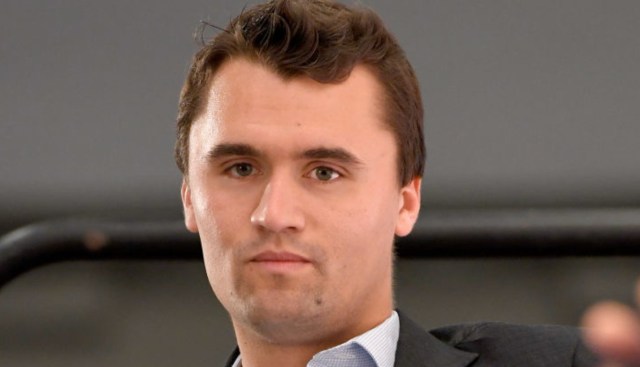
Charlie Kirk’s assassination a year ago failed to unify the Right. Credit: Getty





Tragedy has a way of unifying movements. For the Right, no recent event seemed more likely to generate such a galvanizing effect than the assassination of Charlie Kirk exactly one year ago. Kirk was the most famous conservative activist in the country, and his killing — sudden, bloody, and splashed across social media — was an act of staggering evil. Here was a man, by all accounts a decent husband and father, engaging college students in patient dialog, only to have his arguments answered by bullets.
Yet the event didn’t bring the American Right together. Rather, it triggered infighting that persists to this day. To understand why, we have to be willing to honestly reassess the legacy left behind by the departed. We must even speak ill of the dead (for if we don’t, as Christopher Hitchens asked, who will?). The truth is, Charlie Kirk helped build up the culture of conspiracism that would come to haunt his own death.
Initially, Trump administration figures like Stephen Miller and JD Vance pledged vengeance against the hard-Left militancy that inspired the murder, as well as investigations into whether anyone else was behind the deed. Yet soon, a different narrative emerged on social media and in the podcast realm. The conspiracy theories suggested that perhaps Tyler Robinson, the young man accused of murdering Kirk over his political views, wasn’t the killer at all. Maybe it was the Israelis or the Egyptian security apparatus; or Kirk’s own organization, Turning Point USA; or Kirk’s widow, Erika, who in the eyes of her critics seemed a little too eager to seek the spotlight in the aftermath.
The divisions marred even Kirk’s memorial service, which brought a reported 90,000 attendees to the State Farm Stadium in Glendale, Ariz., and overflow venues in the area, on Sept. 21, 2025. Three speeches at the event captured a split that was already emerging on the Right.
First came Stephen Miller’s theme: vengeance. “You have no idea the dragon you have awakened,” the hard-line Trump consigliere thundered. “You have no idea how determined we will be to save this civilization.” Days later, Miller would vow to deploy all the resources of the federal government to go after the Left-wing networks he held responsible for Kirk’s death.
This was followed by the Christian message of forgiveness. Speaking through her tears, Erika announced that she forgave the young man who’d taken her husband’s life and left her children fatherless. It was a stirring piece of oratory, moving even to many nonbelievers and drawing a sharp contrast with Miller’s ferocious, almost-bloody rhetoric.
Finally, there was Tucker Carlson, who brought in the spirit of conspiracy. The former Fox News host eulogized Kirk by recounting the passion of Jesus. Carlson presented the biblical narrative as a story of powerful people in Jerusalem “sitting around eating hummus,” adding that “there’s always one guy with the bright idea, and I can just hear him say, ‘I’ve got an idea. Let me just kill him.’”
While Carlson’s defenders tried to refute the notion that he was implying a Jewish hand in Kirk’s murder, even the arch-Groyper and unabashed Jew-hater Nick Fuentes was taken aback: “They say I’m the No. 1 antisemite. That was a little intense.” Carlson would, of course, go on to prove Fuentes correct and make a fool of his apologists, not for the first or last time.
Over the following weeks and months, these three forces battled it out. Yet Miller’s promise to crack down on Left-wing activists was perhaps never realistic without evidence that Tyler Robinson had acted in concert with others — and no such evidence ever came to light. The only vengeance on offer was the firing of schoolteachers and grocery clerks for being disrespectful toward Kirk’s memory or insufficiently mournful over his death. As for forgiveness, it never really had a chance in today’s MAGA climate.
It was thus the conspiracy impulse that won the hearts and minds of Right-wing audiences. The day after Kirk’s memorial, podcast host Candace Owens opened her show by mocking Erika and declaring that her husband had been “betrayed” by some within TPUSA. Owens would soon release texts from Kirk complaining about pressure from Jewish donors. In February, Owens launched a docuseries titled Bride of Charlie, in which she questioned everything from Erika’s family background to her finances, and suggested she may have been involved in human trafficking. According to a Washington Examiner count, by April 2026, Owens had devoted no fewer than 84 podcast episodes to Kirk’s killing, weaving a web that included “‘German mystical Jews,’ the CIA and Mitt Romney, Egyptian planes, and, naturally, Jeffrey Epstein.”
Not to be outdone, Carlson declared in June that Kirk “was most likely murdered for his evolving views on Israel.” This came after months of Carlson’s platforming of people promoting similar ideas, including the anti-Semitic crank Ian Carroll.
Those who preferred vengeance came to express deep frustration about the turn toward conspiracy. In December, the conservative Media Research Center released a poll showing that only 24% of likely voters identified Kirk’s killer as Left-wing, a result attributable in part to public personalities like Owens and Carlson muddying the waters.
Blake Neff, one of the current hosts of The Charlie Kirk Show, decried what was happening, charging figures like Owens with causing confusion about an issue that could have been a conservative slam-dunk. “They took something where a radical Leftist, for very legible, specific, Left-wing reasons, did something, and they have pivoted it to, ‘Actually, it was people in our own movement who did it, whom you should now distrust.’”
The far-Right writer and publisher Jonathan Keeperman, known online as l0m3z, had high hopes that something productive might come out of the tragedy of Kirk’s murder. On the day after the killing, Keeperman called for the creation of a Charlie Kirk National Park and a “Smithsonian exhibit on the Woke Era (2012–2024).” In addition to these symbolic steps, he demanded a legal crackdown against the political enemies of MAGA: “Laws will be written. Extremist organizations will be dismantled. Assets will be seized. Individuals and institutions that cultivated the conditions for this climate of violence will face criminal liability. These are necessary measures of statecraft that will in large part determine whether we get another Red reign of terror, or whether we emerge from this with our nation intact.”
The sweeping crackdown Keeperman envisioned never materialized, even though Trump did launch a federal initiative aimed at investigating and disrupting Left-wing networks and their funders. Keeperman lost the argument and later went on to vent anger at the Kirk truthers. In December, the conservative writer Scott Greer likewise lamented that Kirk’s death had “offered the promise of unifying the Right in a common cause against the Left” — an opportunity wasted by infighting over whether Tyler Robinson was actually responsible for the killing.
Why did the conspiracists win? Sadly, Kirk himself, it must finally be said, contributed not a little to the atmosphere of epistemic madness and institutional mistrust that now suffocates rational thinking on the Right.
Tucker Carlson, after all, was a regular guest at TPUSA events. Andrew Kolvet, a spokesman for TPUSA, relayed a hadith from the recently murdered Kirk: “Honestly, people telling me not to have Tucker makes me want to have Tucker” at the organization’s conferences. After Kirk’s death, Carlson guest-hosted an episode of the show alongside Neff and Kolvet, who would both later be hounded by conspiracy theorists. This was only two days before Carlson blamed “hummus eaters” for the assassination. Already at that point, Carlson had for years been pushing pro-Kremlin narratives and conspiracy theories like the claim that the Pentagon was operating secret bioweapons labs in Ukraine and the idea that Jan. 6 had been a false flag incited by federal agents.
Then, too, Kirk himself was a key promoter of the most significant political conspiracy theory of our generation: the idea that the 2020 election was stolen from President Trump. Unlike the conspiracy involving his own death, the #StoptheSteal nonsense Kirk promoted led to actual political violence and a coup attempt that could have proved catastrophic for US democracy had not a brave few — most notably, then-Vice President Mike Pence — acted against it.
In December 2020, Kirk condemned then-Majority Leader Mitch McConnell (R-Ky.) for congratulating Joe Biden on his victory, comparing it to congratulating someone who had just robbed a bank. In the topsy-turvy fantasy world Kirk had created for his followers, Biden had obviously stolen the 2020 election.
Two days before Jan. 6, Kirk announced that Turning Point Action was “honored” to be “sending 80-plus buses full of patriots to DC to fight for this president.” This tweet was later deleted. He also told his audience at the time there was “an almost guaranteed way Donald Trump serves four more years.” All it would take was for Pence to refuse to certify the results in the swing states that Trump had lost. As for those who might object on constitutional grounds, Kirk’s answer was to “make them sue.”
When called before the Jan. 6 committee to discuss his role in challenging the 2020 election results, Charlie Kirk invoked his Fifth Amendment right not to incriminate himself. And it wasn’t simply election denial; under Kirk, TPUSA events and shows became gathering points for every kind of crank the Right produced, including anti-vaxxers like RFK Jr. In May 2021, TPUSA gave a show to Jack Posobiec, a man best known for having pushed Pizzagate — the theory that Hillary Clinton and her associates operated a child-sex-trafficking ring centered on a Washington, DC, pizza restaurant.
Kirk could at times be just as conspiratorial as Carlson or Owens, with the main difference being that his theories always had a reliable partisan tilt. He claimed that Biden had deliberately allowed the Afghan government to collapse in order to import more Democratic voters. He thus compressed the peaceful transition of power or the closing of a two-decade war into MAGA-friendly conspiracy theories.
Charlie Kirk spread election denial and other kinds of conspiracy theories for the same reasons that Owens and Carlson would later spread conspiracy theories about his death: money, relevance, and playing to the audience. It was only when his family and the remnants of TPUSA became the targets of the forces Kirk had helped unleash, that those left behind began denouncing others for taking advantage of the ignorant and the misinformed.
What are the broader lessons we can draw for the future of the conservative movement? The bad news is that the human-capital problem has gotten so serious, and the media environment so poisoned, that we can no longer expect a baseline of shared reality across the political spectrum. There will always be assassinations, wars, and shocking news events. And as with Covid, the 2020 election, the Ukraine war, and the death of Charlie Kirk, wide swaths of the Right — and, to be sure, some on the Left — will fall to conspiracism.
But there is a silver lining. As figures like Greer and Keeperman have noticed, a more conspiratorial Right is a less effective one. Despite there never having been any evidence that Tyler Robinson was part of a wider network, there were demands from the moment of the shooting to indiscriminately round up Leftists, and there were certainly figures in the administration like Miller who seemed ready to implement such plans. Had the American Right remained united behind that project, the Kirk murder could have been the Trump administration’s opportunity to further turn the machinery of government against its enemies. Instead, the energy unleashed went into arguing about Egyptian planes flying around assassins.
Still, the damage is extensive. For more than a decade, Kirk taught a young audience that institutions always lie, that the official story is a cover, and that anyone telling you to stop asking questions has something to hide — while making a special exception for Donald Trump. He was the filter between the leaders of MAGA and the movement’s raging id in cyberspace. Upon his death, the audience he had developed was still primed to suspect that it wasn’t being told the full truth, and hungry for a hidden explanation.
The young activist’s very corpse became a prop that others in conservative media used in their fights to claim his audience. It’s a fitting postscript for the life of a man who helped make the Right safe for the very conspiracy theorists who would make a mockery of his death.
Richard Hanania, an UnHerd columnist, is the president of the Center for the Study of Partisanship and Ideology and blogs at Substack.
 RichardHanania