




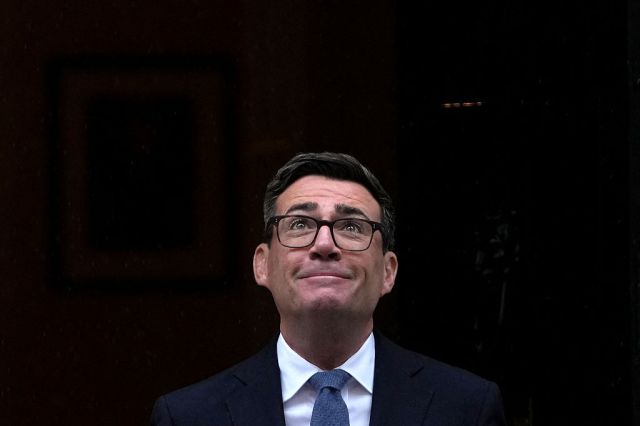
Burnham is living in a Machiavellian moment. (Carlos Jasso/AFP/Getty)





British prime ministers in the 21st century have come in several shades. Tony Blair was a modernizer, obsessed with change and attracted to anything that spoke to him of the future. Cameron, May, Sunak and Starmer, for all their differences in style and ability, were essentially managers: motivated by duty and a belief in competent leadership rather than a project or cause. Liz Truss was a disruptor — the most efficient disruptor in British history, if measured by impact per day in office. Gordon Brown and Boris Johnson are more difficult to classify, one because he was too complex, the other because he was too shallow.
Andy Burnham is something different. Based on the evidence so far, he is a kind of idealist. He is driven by a vague but deeply-held idea of what Britain should be, namely a country defined by a spirit of solidarity and rooted in a strong and protective state. This vision bears the imprint of Burnham’s upbringing in a Northern milieu infused with strong local identities, a prominent tradition of working-class politics, and Catholic notions of social justice. Its aesthetics come from football and the guitar music of the Eighties and Nineties — the last eras when the nation shared broadly the same cultural consciousness. Its highest aspiration, perhaps, is to make community something more than a euphemism for an interest group.
You can see this romantic and, in its way, rather conservative vision in most of Burnham’s stated priorities, from social care reform and public control of utilities to a defense of pubs as “working-class culture”. Bunrhamism is consistent in its enemies too: privatization, Thatcherism and the bond markets represent the undermining of state and society by the extractive forces of capital.
An idea of Britain is not the same as a credible plan, but it is welcome to see a prime minister who at least seems to grasp that a nation is a social entity held together by bonds of emotion and identity, rather than simply a receptacle for abstract values. Blair’s restless tampering with the constitution, his contempt for nationhood and enthusiastic embrace of globalization, laid the ground for many of our current crises. His managerial successors often seemed to occupy power like CEOs trying to boost a company’s stock price, or officials managing a civil service department.
There is, however, a reason that idealism has a bad name in modern politics. It was articulated by the philosopher Niccolò Machiavelli during the Renaissance. More than the calculating ruthlessness that his name is associated with, what made Machiavelli a foundational thinker of modernity was his response to a world of dramatic and frightening change. Italy in the early-16th century had become a battleground for competing European powers, plunging the region into chaos. Its leaders had become fatalistic, Machiavelli observed, due to “the great changes and variations, beyond human imagining, which we have experienced and experience every day”. His conclusion was that such upheaval had turned principled leadership into a recipe for failure; what mattered was an ability to infer what the situation demanded. “One who adapts his policy to the times prospers,” he wrote. “One man proceeds with circumspection, another impetuously; one uses violence, another stratagem; one man goes about things patiently, another does the opposite”; and yet, success ultimately depended on “nothing else except the extent to which their methods are or are not suited to the nature of the times”.
The question for Burnham, then, is this: what good is a vision for the country if it takes no account of our historical circumstances? We are living in a Machiavellian moment, a time of “great changes and variations, beyond human imagining”. The immediate challenge is a looming economic crisis, as Trump’s Iran War and wider instability in the Middle East feeds through into surging energy bills, rising inflation and high interest rates. All of this is ramping up the cost of the government’s debt, meaning that six weeks out from John Healey’s first budget, the chancellor faces a struggle just to keep his head above water.
Meanwhile, the tectonic plates of global politics are shifting around us. The unpredictable and increasingly hostile Trump administration has recently declared support for Irish unification. The EU could soon be upended by a Le Pen victory in France and the ascent of the AfD in Germany, imperiling, among other things, European support for Ukraine. Chinese technology and manufacturing power continues to steadily rewire the global economy. And that is before mentioning the wide range of transformative outcomes that could result from artificial intelligence.
In other words, Burnham may prefer to focus on homelessness and vocational training, but he does not have that luxury. However compelling his image of Britain may be, his premiership will be defined first and foremost by how he responds to the challenges thrown up by a volatile world. There are already signs that he is floundering. The Treasury has told the Financial Times that Burnham and Healey did not realize how bad the public finances were, as though the subject had not been near the center of attention for the past two years. Last week, in an apparently off-the-cuff remark in the Commons, Burnham recklessly opened the door to another Scottish independence referendum, before rushing to close it again.
The deeper issue is that Burnham’s visions of Britain as it is and Britain as it should be are seemingly impervious to historical change. His judgment that the country has suffered under “40 years of neoliberalism”, implying a political economy that has remained relatively static across decades, is alarmingly imperceptive. Beginning with New Labour’s efforts to re-engineer the Thatcherite settlement for progressive ends, Britain has moved steadily towards a hybrid model in which privatization, the plundering of national assets by foreign investors, and the decimation of government services coexists with an expansive bureaucratic state that seeks to micro-manage the economy through regulation. The second half of the equation matters as much as the first, because the ever-growing expense of regulation, including that introduced by the current Labour government, has left British businesses especially vulnerable to rising costs and higher interest rates, forcing them to cut investment, hire fewer workers and, increasingly, to give up. To give one vivid illustration of these problems, 2025 was the worst year on record for housebuilding in London, with the number of new projects collapsing by 85% in a decade. Since much of Britain’s regulation is inflationary, it is also partly responsible for the government facing higher borrowing costs than comparable nations.
In fairness to Burnham, his reductive framing of the country’s problems answers a public demand. Suspicious of politicians and beset by insecurity, voters want principled leaders and stories that explain in familiar terms what has gone wrong. As a result, the most successful communicators are those with beliefs that are both sincerely held and inadequate to the realities of the 21st century.
This does not mean, however, that an idealist is necessarily unsuited to a volatile world. Modern history has been shaped by leaders who have pursued ideological convictions in times of flux. Such figures have a paradoxical power: their rigid commitment to their vision enables them to be flexible in reaching it. Understanding Machiavelli’s insights, they see that they must work with the tools and circumstances at their disposal. They concede that realizing a vision of society will never mean achieving a Platonic ideal, but at best, an ability to guide the process of change in a particular direction.
Otto von Bismarck, the great Prussian statesman of the late-19th century, expressed this idea poetically when he spoke of “hearing God’s footsteps moving through history and walking with him some of the way”. Bismarck himself was probably the ultimate example of this type. Remembered as the master of Realpolitik, he was nonetheless a committed archconservative who worked to secure an old order for a new age. He unified Germany to buttress the power of Prussia, and he introduced universal male suffrage and the first modern welfare state to turn the masses from potential socialists into loyal subjects of the Kaiser. At the other end of the ideological spectrum, no less a doctrinaire Marxist than Vladimir Lenin proved endlessly adaptable in establishing the Soviet Union as the first Communist state.
The figure in British history who most resembles this model is surely Burnham’s great nemesis: Thatcher. Though now often characterized as a liberal, it is truer to say that she recognized in economic liberalism the means necessary, at her historical juncture, to realize her deeply-held conservative vision of society, one based on personal responsibility, property ownership, and the slashing back of an over-powerful state. As with Bismarck, this meant building a coalition among parts of the working and middle classes, and pursuing a form of populism directed not at elites, but at the institutions of organized labor.
These precedents bear the lesson that principles and convictions are of little worth unless coupled with an ability to see beyond one’s own context, recognizing that what appears fixed and inevitable now will soon be revealed as transient. Boldness and risk-taking are indispensable, but can only succeed if they are informed by a clear analysis of history and an instinctive judgment. Burnham has shown some signs of grasping the nature of the challenge: his coup against Starmer was skillfully executed, and while it remains to be seen if No. 10 North is any more than a gimmick, his ambition to loosen himself from Whitehall’s deathly grip is admirable. He has the benefit of a public that has already accepted change in some form is coming, and numerous policy ideas which have been identified by others. These include breaking the 2024 manifesto by raising income tax, so as to begin easing the burden on businesses; means-testing pensions; balancing the renewable energy drive with more domestic oil and gas in the medium-term; and reforming the Bank of England’s role to help with government financing.
These are merely a few of the avenues that Burnham could pursue towards his idea of Britain. More significant opportunities, and risks, could well emerge from domains that are still rapidly evolving, namely technology and international relations. Since any course he chooses will likely antagonize his party, and will take time to produce results for the electorate, the prime minister will need to keep his vision alive through political theater. Thatcher understood the value of a dramatic confrontation to demonstrate her principles and create sharp dividing lines with her opponents. Similarly, Burnham could seek a public showdown with the investors and creditors involved in the totemic scandal of Thames Water.
History shows that the politicians who orient themselves towards a particular idea of society — even a conservative or a moralistic one — can, with the necessary temperament, end up being more modern than the modernizers, more pragmatic than the managers, and more radical than those who set out to disrupt. Of course, history is also littered with figures — the Jimmy Carters and Jeremy Corbyns of this world — who have justified the common image of the idealist as the polar opposite of the realist. The danger for Burnham is that he owes his power to a likeable caricature he has crafted for the public. His idealism may therefore come to little more than clinging to the simple sentiments that have made him popular, until he is overwhelmed by events.
Wessie du Toit writes about culture, design and ideas. His Substack is The Pathos of Things.
 wessiedutoit