




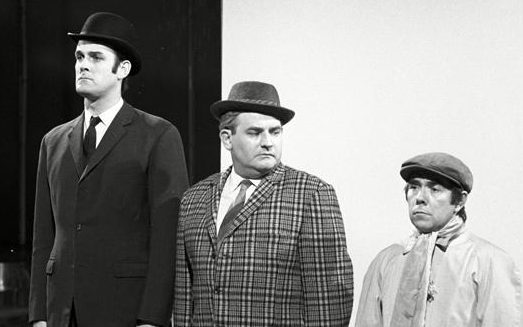
The working class will be included in Labour's bouquet of virtue. (BBC)





In January 1924, a breathless editorial in the Manchester Guardian marveled at the prospect of the first ever government run by the Labour Party. A minor miracle had transpired: Ramsay MacDonald, the bastard son of a farmhand, had been elected to lead a government “whose most prominent men are drawn from the humblest rank of society”. Even the Daily Express wrote admiringly of the collection of former foundrymen, miners and seamstresses sitting on the government benches around MacDonald. Here was “unquestionable ability, as well as new blood”.
Just over a century later, Labour — as it is still quaintly known — has begun to rediscover the concept of social class that was once the foremost reason for its existence. Earlier this week, Bridget Phillipson, Minister for Women and Equalities, announced the creation of a new “class unit” within the Office for Equality and Opportunity. “We have been squeamish about class for too long,” said Phillipson. Reporters were quick to identify the unit’s purpose as “improving outcomes for white working-class people”. The government clarified, bashfully, that the class unit would examine disparities across all ethnic groups.
Things do seem to be changing from the era when identity, rather than class, seemed to rule the Left’s moral calculus. In August, the American Democratic politician Alexandria-Ocasio Cortez admitted on ABC’s This Week that perhaps some of the new socially radical politicking that had overtaken the institutions of the Left for a generation hadn’t landed quite as intended. “Woke One was crazy!”, she said.
In truth, it was never really clear what so-called wokeness had to offer a majority of working-class people in Britain. As Woke 1.0 spread from the USA to our shores, it brought with it a moral diagnosis that resonated in America, where some states had struggled to move on from the Reconstruction era, but bore a smaller relevance to the malaise in much of the post-industrial Britain of the modern era. Prosperity and opportunity had begun to centralize in cities and vanish from Britain’s much less diverse towns and coastal regions. Social attitudes had seen huge progress. Race wasn’t the immovable roadblock in life that it once was.
My generation came to political maturity riding a wave that crested alongside Woke 1.0. We began walking into institutions equipped with a politics shaped by the 2008 banking crisis, the expansion of the EU’s migration covenant and the introduction of the Equality Act in 2010. It was an era where the moral leadership of the Left, once the de facto voice of working-class people, became dominated by people for whom “the white working class” were a distant species.
The former industrial communities of Britain’s regions were something modern politicians left behind en-route to a career in London after Oxbridge — and why wouldn’t the aspirational leave? Margaret Thatcher’s decade long war on local council democracy had left millions with little power at the ballot box. Everything meaningful was now decided in the capital.
Otherwise, the white working class were a group many of the Left had never actually met. They were to be spoken on behalf of in student meetings — the way a primatologist might talk about what was best for the gorillas in their charge at a zoo. Rather than considering the diminishing life chances and outcomes of millions of people on lower incomes as a central part of their politics, my generation were encouraged to adopt a series of niche causes under the doctrine of “intersectionality”. It was as though working-class life was a solved problem and not something collapsing around us.
For this more bourgeois iteration of the Left, the emotional pull of Woke 1.0, and maybe, dare I say it, a bit of traditional liberal guilt atonement, held an appeal that was easy to ratify just by looking out of the front door. We lived in big cities and in Britain’s most metropolitan boroughs, there really are still notable gaps between people’s prosperity that can be predicted based on their skin color. Those who might object to making these concerns the most prominent pillar of our politics could easily be presumed to only do so because of prejudice. In reality, the gaps on the doorstep weren’t nearly as wide as those between metropolitan Britain and everywhere else.
The country we maligned for its supposed backward social attitudes was quietly becoming the most regionally unequal major economy in the developed world. Large swaths of Britain had been torn to shreds by austerity not with a bang but a whimper. Traditional Labour politicians like Ellen Wilkinson or even Ramsay MacDonald would have marched the breadth of the country to do battle on issues like unemployment and closing factories. By the mid-2010s, this was an unsexy, even faintly embarrassing cause — largely forgotten, maybe a bit nostalgic. The odd episode of Benefits Street would present the collapse of working-class communities as something with a cosmic justice to it: they were always lazy, weren’t they? John Harris would conduct a Guardian-sponsored safari around the shuttered high streets of provincial England, furrowing his brow in befuddlement as people told him they were planning to vote to leave the EU, but couldn’t say exactly why.
Working-class institutions, like trade unions, had been collapsing for years. Deindustrialization, something the Left had largely given up trying to stop, had robbed unions of anyone to represent and deprived millions of working-class people of a decent job to go to after school. Culturally, the white working class were becoming unmentionable. They had been absorbed into the wider and varied “white” group by the Equality Act, their life outcomes masked by this sleight of hand.
Those who did mention the white working class — the last few political figures that had lived similar lives, like Angela Rayner, who left school, pregnant, aged 16 to become a care worker — were shushed. As education secretary Rayner spoke about the needs of white working-class boys being “pushed down the food chain” due to the focus on ethnic minorities and women, but was pilloried for her trespass. Even to mention the group seemed to risk resurrecting the ghost of Enoch Powell, like a monster from an Eighties horror movie coming back to life. It was a faux pas to mention the white working class. It could only be assumed that the speaker didn’t realize that working-class people now came in all colors.
None of this handwringing stopped the least well off white working class kids’ educational attainment utterly collapsing. White British kids on free school meals have the lowest higher education participation rate in Britain. They are less likely to spend age 19 in further education than Roma Gypsies.
As rolling the dice on higher education has become the only accepted way of creating social mobility in Britain, it isn’t hard to understand why people in these communities feel a profound loss of hope. The Social Mobility Commission — which will apparently become surplus to requirements following the creation of the Class Unit — places the least diverse former industrial and mining areas, such as the North East of England, Yorkshire and the Humber, and the West Midlands as the places least likely to allow someone to make generational progress. The Sutton Trust’s Opportunity Index shows a yawning gap in educational attainment between London and places like the North East and Cornwall.
Swaths of Britain being completely left behind has been a quietly accepted part of our national story for more than a decade. The story briefly came to a head during Brexit, only to be quickly dismissed by the political Left. The fact that the old Labour heartlands voted for Brexit in spite of what sensible people in London were telling them to do was seen simply as an inconvenience that their betters would need to muddle through. It was the spasm of a palliative patient whose bedside vigil often gave them cause to yawn and glance at their watch — a victory for the far-Right that any right-thinking person would reject.
Nevertheless, the broader political re-alignment that Brexit represented refuses to go away. In the recent Saxony-Anhalt election in Germany, the Alternative Für Deutschland [AfD] party dominated the votes of a community that looks like a facsimile of left-behind Britain: shuttered industries, a low rate of higher education, too disillusioned to bother much with politics. The AfD’s platform hoovered up and sent to the polls exactly the kind of working-class voters that have fallen off Britain’s electoral rolls over a generation of hopeless disengagement. Saxony-Anhalt was an election infused with a sense of the injustice of regional inequality too: 73% of voters there believed that East Germans are second-class citizens. The result is that Neo-Nazis, Holocaust deniers, ex-Stasi officers and Putin apologists are now more trusted to run a swath of Germany than the old parties of the working class.
Labour’s answer to the British version of this disengagement suggests that some within the party are at last waking up to the anger present in swathes of working-class Britain. However, the tools it has unveiled look much like those that have already produced unremarkable results.
For many years the moral component of modern social justice has amounted to a kind of human flower arranging. How many protected characteristics can you gather and display in your vase to prove that Britain is a caring society?
The creed of modern social justice was that Britain’s growing prosperity would be accompanied by the assurance that more of the beneficiaries would have a certain color skin, or a certain preference for other’s genitalia, or a certain bodily or mental difficulty. Now the working class will be included in this bouquet of virtue.
It isn’t yet clear exactly how big a change this could be. Perhaps new positive discrimination access schemes of the kind that have become common (and commonly gamed by middle-class climbers) will be developed. Now Britain’s social justice engineers will be encouraged to say: “Look, we have a black person, a disabled person, a gay person AND a poor person.” Where previously an applicant being white and poor only gained one virtue point, now perhaps it could gain two.
The expanding prosperity that undergirded the politics of Diversity, Equity and Inclusion is evaporating. It hasn’t existed in parts of Britain for a long, long time. DEI politics has shown that it can take the ever-more centralized wealth of Britain and divvy it up among a more diverse fortunate few. It hasn’t shown any ability to provide for the parts of Britain clinging on by their fingertips.
In 2024, the Institute for Public Policy Research published its report, “State of the North”, detailing for the umpteenth time how the Britain that was remade by industry closure during the neoliberal turn was full of sicker people with shorter lives. It showed that wealth inequality was set to grow in spite of a Labour government: there will be an average gap of £228,800 per head between the wealth of those in the South-East and the North by 2030. The authors proposed “Germany-style levels” of investment — nearly £8 billion a year for 15 years — to start closing the gap, referencing Germany’s history of “solidarity taxes” between West and East since reunification. IPPR proposed that this would be achieved by wealth taxes that mostly land on the South. But then, even that level of investment hasn’t worked to keep faith in the political system of Germany, as downward mobility leaves people hyper-vigilant, hoarding, worried about losing or being forced to share what little is theirs.
Andy Burnham came into No. 10 promising to be a prime minister for “The North”. But his previous economic advisor and Goldman Sachs chief economist Lord Jim O’Neill has already come out strongly against taxing the wealthy regions. His argument: London will need even more investment if any growth is to reach the rest of Britain. The money markets seem to agree that borrowing to restore prosperity to the once proud working-class areas of Britain should come at a punishing cost. A cost it isn’t clear anyone is willing to pay.
Will working-class voters buy into the idea that “social class” can be solved by being granted a protected diversity status? It’s not hard to wonder what someone like Ramsay MacDonald might think of such a measure; “class” was once the entire reason a Labour politician got out of bed in the morning.
But it speaks also to the mindset of the modern political class: that more unity can be created if more people can be given permission to be recognized as “in need” by their betters. The Labour of old knew that working-class people didn’t want this politics of pity: they wanted a politics of dignity. They built institutions, friendly societies, social insurance schemes, working men’s clubs and trade unions as a living demonstration of their ability to stand on their own feet, not reliant on other people to decide whether they can be given a leg up for the sake of meeting a quota.
Clearly, the working class of deindustrialized Britain will need to wait for anything that would mimic the gigantic leaps of change that Labour once provided: homes where there were once slums, work where there was once unemployment, an NHS where there was once sickness, a welfare state where there was once desperation. A New Jerusalem. In the meantime, the white working class can celebrate their induction into the world of DEI. One more flower in the bouquet.