




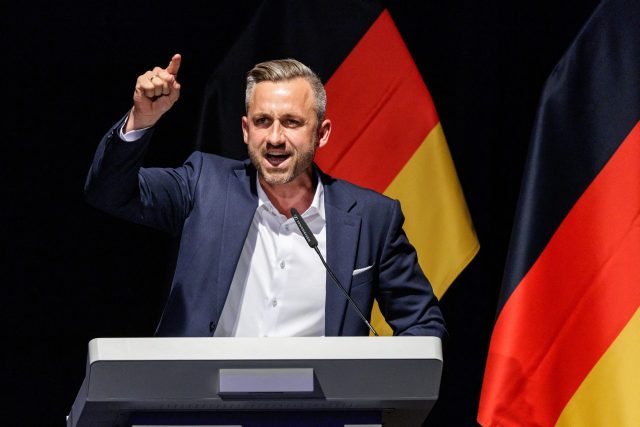
Ulrich Siegmund, the AfD's candidate in the Saxony-Anhalt state election. (Jens Schluter/Getty)





Saxony-Anhalt, in the western part of eastern Germany, is hardly the country’s most important state: it accounts for only a fraction of Germany’s GDP and is home to just two million people, half the population of Berlin. It is often described as a no-man’s-land between east and west — the flat, monotonous backdrop to the final hour-long approach to Berlin. Yet Saxony-Anhalt is poised to become the stage for one of the biggest political showdowns in recent German history.
State elections will be held there on 6 September, and the AfD is set for a sweeping victory. The party is currently polling at 43%, on track to secure an absolute majority of seats — though that outcome largely hinges on whether the parties currently polling close to the 5% threshold, primarily the Greens, make it in or not. A handful of votes could tip the outcome in the opposite direction, allowing the establishment parties to keep the AfD out of power once again, as they did in Thuringia, Saxony and Brandenburg after 2024 — if not through a full everyone-minus-the-AfD coalition, which might prove arithmetically difficult, then through a minority government.
In short, the result sits on a knife edge; little wonder that the German political establishment is in a state of panic. For the AfD to win an absolute majority would be a historic triumph and mark the definitive collapse of the “firewall” erected around the party in recent years. Not only would it be the first time the party takes power in a state, but it wouldn’t have to share that power with anyone else — a feat hitherto achieved only by the two main establishment parties, the CDU/CSU and the SPD. Meanwhile, the AfD continues to rise practically everywhere — including in Berlin, where it has doubled its support (in the polls) since 2023 and now runs level with the CDU, behind the frontrunner, the Left-progressive Linke. Berlin votes a fortnight later, as does the eastern state of Mecklenburg-Western Pomerania, where the AfD leads the polling. This makes Saxony-Anhalt all the more important, since a victory there could propel the party forward in the other two contests as well.
Crucially, because of the way Germany’s federal structure is set up, if the AfD were to take control of a state it would inevitably have to be reckoned with at the national level too — precisely what the anti-AfD firewall was designed to prevent at all costs. As state premier, one of the first responsibilities of the AfD’s candidate, Ulrich Siegmund, would be to assume the annually rotating chairmanship of the regular meetings of Germany’s 16 state premiers. The position typically entails a visit to Berlin and a joint press appearance with the chancellor.
To get an idea of the panic gripping the German political establishment, and especially its metropolitan, social-liberal wing, one need look no further than its house journal, the magazine Der Spiegel, which recently featured on its cover a mugshot-like photograph of Siegmund — a former perfume trader — with the caption “Germany’s most dangerous man”. It’s such an outlandishly exaggerated claim that the cover drew criticism even from mainstream corners. Ulf Poschardt, the former editor-in-chief of Die Welt, pointed out that such brazen and caricatural ad hominem attacks simply play into the AfD’s narrative: that they are fighting an out-of-touch political-media elite that views everyone outside their narrow political-ideological spectrum as a “threat to democracy” — including the party that is polling first across the country, well ahead of Chancellor Merz’s CDU/CSU.
Indeed, it is precisely because the establishment has lost control of the narrative — and Germany is hardly an exception in this regard — that, as Politico recently reported, it is now studying an arsenal of extraordinary measures designed, in effect, to prevent a possible AfD state government from exercising its mandate. The first scenario involves excluding Saxony-Anhalt’s representatives from meetings on sensitive matters. In addition to the gathering of state premiers that Siegmund would be expected to chair for a year, Germany’s states regularly coordinate through a network of ministerial “conferences”. Among the most important is the conference of interior ministers, where some of the country’s most pressing security and intelligence matters are discussed. Thus, as several ministers confirmed to Politico, one possibility would be to keep holding the regular meetings of the interior ministers, but also organize separate gatherings for particularly sensitive issues from which the representative from Saxony-Anhalt would be excluded. According to an emeritus professor of constitutional law, the idea is “perfectly conceivable”, though he conceded that it might be challenged by the federal courts.
A second scenario would involve raising a “wall” within shared information systems. The argument is that the AfD, given its alleged “closeness” to Russia, cannot be trusted with sensitive dossiers. The notion that the AfD would act as a pipeline of classified information to Moscow is rather ludicrous — if only because that would amount to political suicide. “We talk to everyone, whether West or East,” said a spokesperson for the AfD’s Saxony-Anhalt branch. “That doesn’t mean we’re going to hand over files. Anyone who claims otherwise is talking nonsense. If and when we get access to such information, we understand our responsibility as a party of government.” Nonetheless, a Social Democrat politician told the magazine that the AfD should be kept away from all intelligence on Right-wing extremism and espionage. In other words, an elected government would be deliberately kept in the dark about dossiers crucial to national security, rendering it effectively incapable of governing. Once again, it is claimed that this would be “legally possible”.
A third scenario, the most striking so far, would involve financially starving the AfD-led state. Saxony-Anhalt receives almost €3 billion a year from federal fiscal equalization, equal to a fifth of its budget. The threat is to reduce or suspend those funds in order to “make life harder” for a potential AfD government, “or to coerce the party to behave in ways the political establishment finds acceptable”. The finance minister of Baden-Württemberg points out that the system is anchored in the constitution, as though a single constitutional provision could disguise the political motive behind financially strangling a rebellious region.
A final scenario being contemplated is the so-called “nuclear option”: the Bundeszwang, or federal coercion. Under Article 37 of Germany’s Basic Law, the federal government, with the consent of the Bundesrat, the chamber representing the states, may take “necessary measures” to compel a state to fulfill its legal obligations. In other words, Berlin could force a state government to obey federal law, a measure that has never been applied in the history of the Federal Republic, not once since 1949.
The picture that emerges is unmistakable: the same German establishment that is constantly lecturing other countries about democracy and the rule of law is demonstrating that democracy is tolerated only so long as it produces results deemed acceptable. When democratic processes produce an unwelcome government, or risk doing so, ways are sought to circumvent it, to hollow it out or to render it harmless — all in the name of “defending democracy”, of course.
Indeed, it has become increasingly common in recent years in Germany for mainstream parties and media outlets to use the term “Unsere Demokratie” — our democracy. The meaning is clear: only those who hold the “right” positions sit within the perimeter of democracy; those outside it are not opponents within the system but threats to it. In this way, ordinary political disagreement about migration, energy, EU policy or the war in Ukraine can be reclassified as an attack on the constitutional order itself, and the ordinary remedies — debates, elections — can give way to exceptional ones.
In this regard, the German establishment has a formidable ally: the constitution itself. Germany’s postwar order is built on the doctrine of “militant democracy”: the idea, drawn directly from Weimar’s collapse, that a democracy may legitimately refuse to tolerate those who would use democratic means to abolish it. There is a basic logic to the concept, but it is clearly now being stretched to the extreme. One may agree or not with the party’s most radical policy stance, that on remigration — which the AfD itself defines as lawful measures to return foreigners already under removal orders — but that is a policy position, not a program for abolishing democracy or the constitutional order. Even critics of the party have said as much: writing on Verfassungsblog, one German constitutional scholar noted that the case against the AfD largely rests on its portrayal of German democracy as dysfunctional, and that fundamental criticism of the system is the very thing that distinguishes democracy from dictatorship. Yet the doctrine of militant democracy is no longer merely being invoked against the AfD; it is being used to justify waging war on the party by all means necessary, including extra-legal ones.
In May 2025, the domestic intelligence service formally classified the AfD — by then already the country’s largest opposition party, polling first or second nationally — as a “confirmed right-wing extremist” organization, on the strength of a 1,100-page report the public was not permitted to see, announced by the outgoing interior minister days before leaving office. The designation — which would have unlocked expanded surveillance powers and fueled mounting calls for a formal ban procedure — did not survive judicial scrutiny: in February 2026 the Cologne Administrative Court barred the agency from applying or publicizing it, finding its conditions unmet.
But the episode’s lesson cuts deeper than its outcome: it took a court to halt the state security apparatus’s attempt to brand the principal opposition party an enemy of the constitution. Nor did the judicial setback end the campaign: by summer 2026, a 1,500-page NGO legal opinion had concluded a ban application would probably succeed, and more than 1,000 lawyers, judges and prosecutors had signed an open letter urging ban proceedings. That the prohibition of the largest opposition party in Germany could be seriously entertained, to the routine applause of Brussels-aligned commentary, tells its own story.
The current geopolitical tensions provide another tool in the hands of the political establishment, in Germany and elsewhere: so long as Russia can be framed as an invisible but ever-present threat, anyone who opposes the status quo can easily be delegitimized as a “Kremlin-aligned internal enemy” — an outright national security threat. It has now become commonplace across Europe to blame virtually every unwelcome electoral outcome — including the recent Icelandic EU referendum — on Russian interference, even in the absence of any evidence. Indeed, a number of journalists and analysts, several of them German, have already been sanctioned for “spreading pro-Russian propaganda”.
No wonder the German establishment seems so intent on escalating tension with Russia. This doesn’t just serve EU-Nato geopolitical interests in Ukraine — where Germany is now leading the charge — but also serves the establishment’s domestic aim of cracking down on the opposition. As mentioned already, the AfD is regularly accused of being a tool of Russian interests, though this largely rests on the party’s programmatic positions: opposition to sanctions, to arms for Ukraine, calls to reopen Nord Stream, and dialog with Moscow — all things that one might argue would serve first and foremost in Germany’s interests. In this light, the German government’s claims that Russia is behind the failed drone attack at Leipzig/Halle airport — for which it has so far failed to provide any concrete evidence — might also be seen as aimed at putting even more pressure on the AfD. The timing of the announcement is noteworthy: four weeks after the alleged attack, but only a few days away from the election in Saxony-Anhalt. Leipzig/Halle airport, incidentally, sits directly on the Saxony-Saxony-Anhalt border, and Halle is Saxony-Anhalt’s largest city.
Finally, the German establishment can count on another formidable ally: Brussels itself. In recent years, the EU has gradually developed a playbook of electoral influence: a dense ecosystem of regulatory, financial, legal and informational instruments capable of shaping electoral conditions and outcomes, which have now been institutionalized through tools like the Digital Services Act (DSA) and the Democracy Shield, aimed at the permanent monitoring of electoral processes across all member states — continuous supranational oversight of national elections, without any basis in the Treaties. These are tools that can be — and are — regularly deployed in support of establishment-aligned parties, be they incumbent or in opposition. Though these tools are less useful in the case of state elections, one can be sure that they will be amply deployed in next year’s federal election.
Ultimately, one thing is clear: Germany’s elites are scrambling to shore up their power in the face of collapsing legitimacy and popular consensus. Support for Chancellor Friedrich Merz has plummeted to historic lows, with his personal approval rating now down to 14% — the worst figure ever recorded for any sitting chancellor. This is hardly surprising: his cabinet is presiding over the deepest industrial contraction in the Federal Republic’s history, one that falls hardest on states like Saxony-Anhalt, whose chemical and automotive employers are being squeezed by high energy prices. At the same time, Merz’s cabinet is rolling back the welfare state (such as scrapping early retirement at 63 for long-serving workers) and promoting a highly dangerous — and highly unpopular, especially in eastern Germany — escalation towards Russia, all while suppressing free speech through surveillance, intimidation and even criminal prosecution. This is ultimately what is fueling support for the AfD: not a renewed taste for “fascism”, but deep-seated hostility towards the establishment. This is particularly true in eastern Germany, or the former GDR, where a long-standing east-west economic and cultural divide has consolidated into a sharp political polarization, with the AfD capitalizing on growing “anti-western” sentiment — “western” here meaning the former West Germany as much as the West at large.
What is at stake in Saxony-Anhalt on 6 September, then, is not really the government of a small eastern state of two million people. It is whether the German establishment still believes it can beat its opponents at the ballot box or whether it has quietly concluded that it cannot, and must therefore win by other means. Every measure now being war-gamed in Berlin is an admission of that second possibility. And each of them, if deployed, would hand the AfD precisely the argument it has been making for a decade: that Germany is governed by a caste which regards the electorate as a problem to be managed, and which is prepared to trample on the most elementary principle of “their” much-vaunted liberal democracy — that whoever wins an election must be able to govern — rather than lose control. The firewall may be crumbling, but the establishment appears intent on laying the foundations for something far more impregnable.
Thomas Fazi is an UnHerd columnist and translator. His latest book is The Covid Consensus, co-authored with Toby Green.
 battleforeurope