




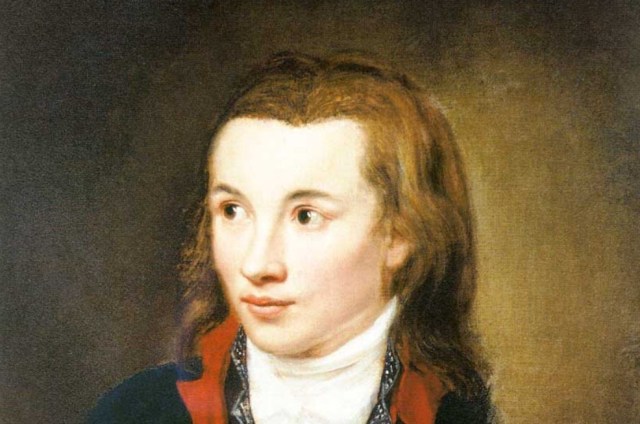
The poet Novalis yearned for the authentic life. Credit: Wikimedia Commons





The year is 2038. A ghostly, snow-swept winter in a New York City grown colder and taller. In a tendril-like high-rise, playwright M is trying to reconnect with his wife, S, an actress. The delivery drones swarm in the afternoon, keeping Ruby, the couple’s child, off the balcony. The drones are supposed to be safe, but mistakes happen, and they can “give you a nasty cut.” All three members of the family struggle with technology: Ruby is learning to play the piano with the help of Kairos, the home AI, and prefers this to working on her own. S still stubbornly insists on plying her craft without “a chip” — devices that enhance performance in the arts — though most of her contemporaries have them. M has signed a lucrative contract to digitize his creative voice but hides his off-the-books writing in a lead-lined briefcase to shield it from the all-seeing eye of Kairos. He frets about his character, his genius, his youth, and his generation, and tries to capture the flickering stuff of a life being threatened by death in all its forms.
Elsewhere, in a different novel, in present-day America, a young woman drives across the Chihuahuan Desert, after receiving a message on Telegram from George W. Bush. The former president — or, really, a man who has taken his photo as an avatar — gives her a wallet of cryptocurrency, and then makes a mysterious exit. It’s just another fleeting encounter in the life of a canceled e-girl, embarked on a desert vision quest after having been fired from her job for “edgy political opinions” and looking to “seek something tangible within the Void of my life.”
The first scene occurs in the novel Stranger Beauty, by real-life playwright (and UnHerd contributor) Matthew Gasda; the second in Desolation E-Girl, by real-life e-girl Chloé Happe, who posts to 40,000 followers on X under the avatar Bronze Age Shawty. Both books, published by small presses this month, take on the soul’s penetration by technology, Gasda’s with sophistication and elevated literary analysis, and Happe’s as more of a rough cri de coeur from a young woman in the thick of it, who knows it’s bad, but doesn’t know how to resist, or what it all means.
Both books are revealing, in their different ways, of the ills of the age. As representatives of an emerging genre, they suggest a twist on the novel, and possible explanation for its persistence as an aspirational activity for writers, even as audiences shrink and complex storytelling withers as an art form.
Happe has generated nearly 400 pages of short chapters following e-girl Maya, as she attempts to recover from internet-induced ennui. What this might mean, neither author nor protagonist seems to know. Maya is suing her former employer for wrongful dismissal, though she doesn’t know if she’s doing it “for the sake of ‘free speech’ or for the sake of becoming famous” (one does dare suspect the latter). In the meantime, she’s directionless, apathetic, has an “addiction to chaos,” and suffers from an “inability to feel.” “Being addicted to Twitter,” she says, “has completely rendered my dopamine receptors inoperable.” Her “Apollonian” roommate in the desert, who is gainfully employed and throws dinner parties, suggests a direction toward “abundance and fruitfulness,” though what this might mean is also vague. The goal, Maya tells us, is to experience “the feeling of desire.”
Like all writers who thrive on Twitter, Happe has a knack for cultural ephemera and is skilled at off-the-cuff labeling of people — the roommate is an anarcho-primitivist into seed oils; a friend has a symmetrical face and “regal intelligence and wittiness.” The novel combines feverish speculation on selfhood with ordinary events — hot springs visited; rides given; movies watched; livestreams conducted; guys met — often with amusing modulations of tone along the lines of “Great Clarity of mind has been achieved. Time for some alcohol.” The downside of the internet-brain represented by these skills is that the ideas are disjointed and undeveloped, and there are too many of them, and the characters, even the “MAIN CHARACTER” as Maya refers to herself on occasion, are also undeveloped, and there are too many of them. Welcome to social media.
Maya cycles through men. We meet an “Otter” and a “Wolf”; the latter is better than the former though we don’t know why, besides that the former tried to strangle her. She meets wise directors and meditation gurus and spews forth a salad of maybe-meaningful-sounding ideas that really aren’t. At the beginning of the book, she is “living in a self-created digital samsara hell-realm and … being eaten alive by Hungry Ghosts.” And at the end, she has realized that she wants to follow a “mysterious birth-death divinity” like a salmon. Is this an evolution, or merely an acceptance of the status quo? How does Buddhism relate to the pop-psychology “selfhood” quest, or to dopamine, or to the Beats invoked in the title? Desolation E-Girl is a riff on Kerouac’s Desolation Angels, and to embrace appetite and experience the way the Beats did isn’t a bad suggestion as a cure for the chronically online, but the MAIN CHARACTER would really have to put the phone down to achieve it, and she doesn’t.
The ending, in which Maya touches grass and achieves enlightenment during a visit home to the Midwest, is no different in tone than anything else that has transpired. Happe sees the trap, and she’s asking some of the right questions, but she has only the internet voice to speak in, and it can’t say anything new.
By contrast, Matthew Gasda’s poignant, elegantly constructed new novel, Stranger Beauty, his fifth, attempts to wrest the human from the digital by using what we might call the human technologies of authentic voice and painstaking, historically informed, craft.
Gasda writes a Substack under the name Novalis, a reference to the German Romantic poet who also provides the first epigraph for Stranger Beauty: “life must not be a novel that is given to us, but made by us.” Gasda’s choice of the Romantic period as a lodestar for our own is appropriate in the sense that the Romantics were responding to the first wave of mechanization of human society, and to the first wave of post-Christian loss of meaning. For the Romantics, these conditions inspired ennui, a condition of boredom and anhedonia — an echo of Happe’s character’s plight. The Romantics were jaded by meaningless life, and yet like her, they also yearned for it in the form of experience and sensation. (There’s also an echo of Happe’s invocation of the Beats here.) The contemporary era of terminal-velocity secularization, mechanization, meaninglessness, and despair seems analogous.
M, the playwright character in Stranger Beauty, has a bit of this ennui. He describes himself as bored of his own work, and as living “deep in the midst of things, in a civilization that has told me that none of it matters.” His form of yearning for sensation is to write a kind of “desperate, automatic writing to defeat what’s automatic in me, which at this point is almost everything. Writing to erase what doesn’t have a history and replace it with nothing but history. Scars, mishaps, fury, love.”
M is “mangled by the digital machinery.” In response, he recounts his own thoughts and feelings about making art, entwined with the tale of his relationship with S — a different, embodied form of creativity, that has resulted in a child. Much of the fragmentary material is clips from their courtship, things they’ve done together, random quiet evenings, descriptions of sex. The story pays heed to sensation, as in one lovely passage in which the narration observes that “there was still delightful, stirred up, sensual emotion in his arms and hands. In his thighs. In the muscles of his face.” And it circles around an “esoteric truth” that M says is at the center of his writing but he can’t quite name. In one line, he implies that it may be a belief in the spiritual qualities of the word, enfleshed.
These spiritual private reflections are not the only kind of words in Stranger Beauty. The book is a dossier of different types of material: third-person dated and time-stamped scenes from M’s present-day domestic life, which are dialog-heavy and immediate; first-person journals from the beginning of M’s relationship with the now-estranged S; and then, in later sections, dated-and-time stamped scenes from S’s point of view. In the final third of the book, M exits the scene, and S asks Kairos to make a movie about her and M’s early courtship, based on M’s journals, left behind in his unlocked briefcase. We see the couple’s relationship once again through new characters, “in M’s voice,” channeled by Kairos. The brilliant final section, an obvious nod to Molly Bloom’s soliloquy at the end of Ulysses, is Kairos’s account of its thoughts while writing the movie.
Gasda is not a technology doomer, as this messy intermingling of the human and the digital makes clear. Kairos’s closing monologue, a free-association that captures the tone and feeling of the couple’s relationship from previous sections, is some of the most beautiful writing in a beautiful book. For example, the passage “such terrible things (a broken heart wishes for a new punishment) you were growing wild like mint heart pressure long stresses of a future Thou made alien in the body’s longing….” feels like a God’s-eye view of falling in love, written outside of linear time.
Has Kairos immortalized M in a way the fragile, aging M himself never could have? Will a stranger beauty come from the human relationship with AI? Gasda seems open to the possibility, but then again, I’m fairly certain he wrote the Kairos chapter himself, instead of outsourcing it to AI, which suggests a deeper-level vote of no-confidence. The fury with which he throws forms of writing at the topic also suggests a more concerted resistance than he’s willing to overtly state. Scenes, dialog, journals, movie-scripts, soliloquies, the Romantics, DH Lawrence, Joyce, the Bible … all the treasures of human literary history come out as ammunition against the machines.
This feels like a genuinely new use of the novel, and one that has been slowly percolating as a genre. Reading, as we all know, is in decline, yet the human urge to write has not abated. Every book — even perhaps those written with machine assistance — is a manifestation of its creator’s soul. The writer, skilled or unskilled, has made a claim to meaning, and a statement of their own existence in the process. The more that technology eats away at this formerly stable category, the more we will feel the anguish that Novalis did, when he suggested that we must fight to write the novels of our lives — or something else will do it for us.
