




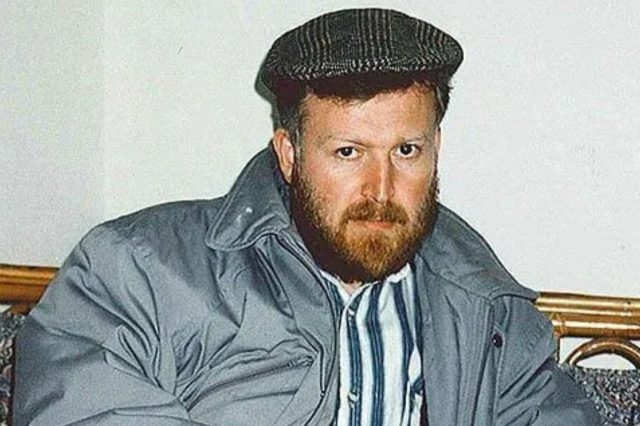
Abu Musab al-Suri (United States Attorney's Office Southern District of New York)





As we approach the 25th anniversary of 9/11, Osama bin Laden will inevitably be seen as the attack’s bloody architect. Yet if the Saudi remains a jihadi icon, the extremists that came after were far more influenced by Abu Musab al-Suri — a little-known ideologue living in the suburbs of north London.
Known in Spain as El Pelirrojo (“the Ginger”), Suri was not the sort of ginger jihadi Britain produced, the kind who chased you around Whitechapel distributing leaflets proclaiming “sharia-controlled zones”. Instead, he belonged more in a Joseph Conrad novel. Living a quiet life in Neasden, he fused Islamist ideology, Marxism and modern insurgent tactics into a worldview whose legacy has colored countless later terrorist campaigns. For while bin Laden became famous for the hierarchy of al-Qaeda, Suri quite deliberately, wanted its opposite. As such, modern violent Islamism, with its lone-wolf protagonists and random stabbings, takes from Suri, not bin Laden, even as the Syrian’s legacy continues to loom large.
Born in 1958, into a conservative Aleppan family with a strong Sufi tradition, Suri came of age as Hafez al-Assad, Bashar’s father and Syrian dictator from 1970, was tightening his grip on power — and crushing the Islamist opposition as he went. As a young man, Suri joined an offshoot of the Muslim Brotherhood known as the Fighting Vanguard, and which concluded that the only way to overthrow the regime was through armed struggle. Trained in explosives, Suri was part of a campaign of bombings and assassinations against the Assad regime, culminating in a massacre of army cadets in 1979.
The confrontation reached its climax in 1982, when the Fighting Vanguard, joined by local supporters, rose against the regime in the western Syrian city of Hama. Hafez’s brother Refaat crushed the rebellion with brutal force, effectively ending the Muslim Brotherhood as an organized force inside Syria and scattering the survivors of the Fighting Vanguard. Many, including Suri, made their way to Afghanistan to fight the USSR.
Suri found himself in Peshawar, in north-west Pakistan, alongside Abdullah Azzam, the Palestinian cleric often described as the godfather of global jihad. In the rugged mountains abutting Afghanistan, he also met a wealthy Saudi benefactor — Osama bin Laden. According to Suri’s own account, he spent three years training bin Laden and other so-called “Afghan Arabs” before traveling to Madrid, acquiring Spanish nationality by way of marriage, then eventually settling in London in 1994.
In the Nineties, London had become an unlikely haven for Islamists, to the late 20th-century Muslim world what Paris, Istanbul, Cairo and Beirut had been to political dissidents in the 19th. The city’s cosmopolitan character made it the intellectual center of the Anglophone Muslim world, teeming with bookshops, activists, Afghan war veterans and assorted other political exiles — all trying to make sense of their movement’s future.
It was in London, too, that Islamists began developing a bewildering range of political philosophies. At one end stood Tunisia’s Ennahda movement, looking to Britain’s parliamentary democracy for inspiration. At the other were those who dreamed of planting the black flag over 10 Downing Street. It was in this extraordinary milieu that Suri started turning the lessons of Syria and Afghanistan into a theory of global insurgency.
That theory marked a radical departure from the way Islam’s martial tradition had long been understood. Traditionally, anti-colonial figures in places like Algeria had conceived of jihad as a form of resistance. To them, noble means led to noble ends. The rules were simple: the enemy was the Western invader. No women. No children. No priests. Only combatants.
Suri threw those assumptions aside. Instead, he asked a wholly different set of questions, the sort that anarchists and Marxists wrestled with in the last century. Does terror achieve political aims? How should asymmetric warfare be waged? Are Muslim governments legitimate targets, as the Algerian military junta had become for Islamist militants? In many ways, Suri reimagined jihad into what the American writer Robert Taber called “war of the flea”: a strategy of guerrilla warfare, terror and asymmetry designed for the weak against the strong.
For a brief moment, following a series of terror attacks in France, Suri was noticed by MI5. But that was about it. The British security services largely turned a blind eye to Islamist activity throughout the Nineties, partly because they had yet to grasp the problem of blowback. There was also an understanding, as the infamous Abu Hamza of Finsbury Park Mosque once put it, that Islamist dissidents were free to agitate against their own governments so long as they did not bite the hand that fed them.
There was another calculation too. Some of these dissidents might one day overthrow the regimes they opposed, so it was better to keep them close than drive them underground. Indeed, some of the sons and daughters of Syrian Muslim Brotherhood exiles, who themselves grew up in London, are now advising the government in Damascus. Suri, however, always had far more global ambitions. In 1991, he attended the Popular Arab and Islamic Congress in Sudan, where he mingled with everyone from Hezbollah militants to Afghan mujahideen to Carlos the Jackal. Another attendee recalls meeting Suri there, describing him as intensely angry and confrontational.
Back in London, Suri helped publish the influential Islamist magazine Al-Ansar, publishing letters from leading jihadist figures, including al-Qaeda’s future deputy Ayman al-Zawahiri. Suri also arranged for Western journalists to travel to Afghanistan to interview bin Laden, becoming one of the unlikely intermediaries between Britain’s Islamist exile scene and the emerging leadership of al-Qaeda. Suri was also an advocate of the Taliban, and its leader Mullah Omar, encouraging bin Laden to fall in line and preserve the nascent emirate.
By the late Nineties, Suri had returned to Afghanistan, settling in the outskirts of Kabul. Talha Ahsan, a former jihadist and Dulwich College alumnus who met Suri at this time, remembers him as “one of the smartest people” he had ever encountered. His vision foreshadowed practices that later became commonplace among groups such as ISIS. As Ahsan tells me, Suri believed in recruiting criminals, men with the courage to do things that bourgeois kids like himself could not. It was precisely these sorts of men, alienated from ordinary life, who would later carry out many of the atrocities that scarred Europe during ISIS’s heyday.
Suri’s 1600-page magnum opus, The Global Islamic Resistance Call, which appeared online in 2004, was a hard-nosed articulation of what modern jihad should look like. In it, he anticipated the lone wolf and the autonomous cell, each operating without a rigid hierarchy. The destruction of the Fighting Vanguard had convinced Suri that formal organizations were too easily dismantled. Jihad, then, had to become leaderless, to exist beyond any single group. In modern parlance, he wanted the fight to go viral.
To that extent, Suri was not opposed to the objectives behind 9/11 — so much as the way al-Qaeda was organized. He well knew that charismatic leaders could be hunted down, leaving the movement in disarray. Bin Laden’s death and the subsequent decline of al-Qaeda, followed years later by ISIS’s struggles after the death of Abu Bakr al-Baghdadi, appeared to prove him right. All the while, Suri argued that jihadist organizations wasted too much energy on theological infighting, instead of concentrating on what he saw as their wider struggle against the West and its allies.
Though Suri remained in the fringes during his lifetime, his ideas nonetheless seeped into the Islamist discourse via the internet and radical preachers. There are doubts as to how far he masterminded the Madrid bombings of 2004 and 7/7, yet both attacks were certainly Suri-esque. “[In my teachings] I have mentioned vital and legitimate targets to be hit in the enemy’s countries,” he remarked later. “Among those targets that I specifically mentioned as examples was the London Underground. [Targeting this] was and still is the aim.”
Beyond outrages like 7/7, Suri’s decentralized approach helped inspire other atrocities: including Nidal Hasan’s shooting at Fort Hood, and Umar Farouk Abdulmutallab’s attempt to bring down an American airliner in 2009. The countless stabbings, vehicle attacks and small-scale acts of terror carried out over the next 15 years would become the most enduring and disturbing expressions of Suri’s ideas.
Suri himself spent his last years hiding from the Pakistani authorities, before being captured and transferred to a Syrian prison around 2005. Widely believed to have died there, he disappeared into the same system of repression that had shaped him decades earlier. But his ideas did not die with him. For if bin Laden is remembered as the face of global jihad, Suri may prove the more consequential figure in the long run, especially as warfare is becoming increasingly asymmetric and unconventional. Besides all that, the Syrian who once edited magazines in London, and took British journalists to meet bin Laden, bequeathed his successors something more durable than an organization. He left behind a method, one that continues to echo wherever individuals kill not in the name of a group — but, in vivid Conradesque fashion, in the name of an idea.
Tam Hussein is an award winning investigative journalist and writer. His work has been recognised by the Royal Television Society Awards.
 tamhussein