




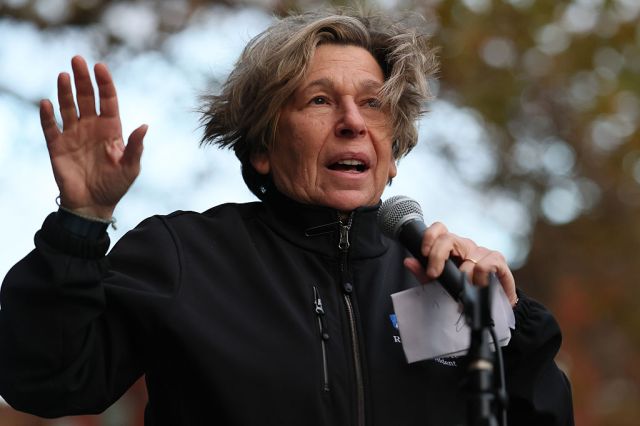
American Federation of Teachers boss Randi Weingarten. Credit: Getty





Gloria Romero tells a story about how education policy is made in California that would be funny if it weren’t so tragic.
Romero was the Democratic majority leader in the state legislature between 2005 and 2008, and known as something of a Leftist hothead. She was particularly concerned with the degraded state of K-12 education in the Golden State but found that when bills came up for discussion, her colleagues didn’t ask for expert opinion or even consult with each other about the legislation. Instead, they went on their phones, waiting for instructions — from the 2-million-strong California Teachers Association.
Now 71, Romero is running for lieutenant governor. As a Republican. She hasn’t lost her passion for improving education, particularly for minority students. But she is more convinced than ever that the unions and their Democratic allies only have only three priorities: more union jobs, higher salaries, and even richer pensions. “I could have played the game with the unions,” she recalls, looking back on her time as a Democrat, “but I couldn’t stand it. We have to make a pivot if we don’t want the schools to get worse.”
The educational market suggests the failure of the union model. By 2041, union hotbeds like New York, Illinois, and California are projected to lose nearly a third of their high-school students. Big-city school districts like New York City, Los Angeles, and Chicago already are losing students at rapid rates. Yet whenever possible, they still want to hire more staff; while losing 130,000 students so far in this decade, the Los Angeles Unified School District has managed to add 11,000 employees.
This isn’t primarily an issue of money. California’s system — the largest system in the country serving nearly 5.9 million public-school children — burns through nearly $20,000 per pupil. The results? Two out of three California students didn’t meet state math standards, and more than half didn’t meet English standards on state assessments.
The failures seem even greater when we compare the Golden State’s performance to that of other states, especially for Latino children. California Latino students perform worse in both English and math than their counterparts in similarly diverse states like Florida and Texas; in fourth-grade reading, the state ranks behind longtime laggard Mississippi. By contrast, Texas spends about $13,000 per public student, and Florida spends about $10,000. Florida’s fourth-graders scored nine points above the national average, according to “the Nation’s Report Card,” put out by the National Assessment of Educational Progress; California’s came in two points below the average. In the Golden State, moreover, where Latino students account for more than 56% of all public-school students, only 36% met standards for English language, and just 23% for math.
California’s performance has been so bad that even The New York Times editorialized about how some new enrollees at the once-elite University of California now don’t even know algebra.“Most dispiriting,” the paper found, is the “betrayal of California’s glorious history” as an educational leader.
Similar failures can be seen on the national level. The most recent national assessment found that barely around a quarter of California’s students are proficient in reading, and they perform even more poorly in math, geography, and US history. American eighth-graders are performing worse not only than over-achieving East-Asian countries, but also than such places as Poland, the UK, South Africa, Turkey, and Sweden.
The lobby at war with learning
A recent federal survey suggests the share of Americans at the lowest levels of literacy has now reached 28%, up from 19% a decade ago. With the support of the unions, many schools have abandoned phonics and tried-and-tested approaches for teaching literacy in favor of “whole -language” and other trendy theories; 60% of American fourth-graders are poor readers. As the usually true-blue Atlantic put it, “declining standards and low expectations are destroying American education.”
The biggest losers here tend to be minorities. Recent California testing results show that only a third of Latino students meet or exceed English-language standards, and fewer than one in four exceeds the standards for math. Nearly 70% of black students failed to meet state standards for English Language Arts in the 2021-2022 school year, while about 84% didn’t meet math standards. It can’t be the press of too many students that’s causing this decline; California is expected to lose 1 million more students in the next five years.
The scandal-plagued LA district is a case in point. Its superintendent, Alberto Carvalho, recently resigned due to alleged conflicts of interest involving educational-tech procurements. But the district replaced him with an official who also reportedly has conflicts of interest, in the form of senior teachers-union leaders in his own family. Recently, the district, threatened with a strike, gave away some $1.2 billion in raises for teachers and other school staff in a district on the road to bankruptcy.
The overwhelmingly Latino district has been dominated by far-Left union activists for more than a decade and it consistently underperforms state, regional, and national averages. Besides losing students, the district also suffers chronic absenteeism and high levels of violence.
New York City schools tell a similar tale of losing students and suffering poor test results, even as soaring salaries now consume roughly a third of the city’s budget. Barely 3% of New Yorkers think the district, once a model, should keep going as is.
Illinois, another union bastion, also fits the bill. Under the state’s ultra-rich governor, JB Pritzker, himself a product of expensive private schools, Illinois has dismantled much of its fledgling charter program — publicly funded schools that aren’t bound by union contracts and thus can drive student achievement more aggressively. And the results? The Land of Lincoln boasts 53 schools in which not one student can do grade-level math and 30 in which none can achieve this in English. Despite major increases in spending per student in recent years, there has been extraordinarily little apparent improvement in results.
As in LA, failure seems to have little consequence for the Chicago Teachers Union. The teachers have won large raises and even managed to elect one of their former organizers, Brandon Johnson, as the Windy City’s mayor. In keeping with his far-Left identity, Johnson has sought to allow Chicago students to celebrate May Day as “an opportunity to elevate the consciousness of our civic responsibility.” That’s a pompous way to describe a blanket permission slip to skip class to attend protests, without consulting parents.
The great irony is that as schools continue to fail, the increasingly radical teachers unions are achieving remarkable political success. Since 1990, the American Federation of Teachers and the National Education Association, the two largest teachers unions, have regularly been among the top-10 contributors to federal electoral campaigns, expending an estimated $1 billion for political purposes over the past decade, overwhelmingly steered to Democrats. It is almost impossible to imagine a successful Democratic presidential candidate winning the party’s nomination without genuflecting in their direction.
But perhaps the most malicious powers are those exercised at the local level. In much of the country, union political operations ensure school boards are dominated by union-backed candidates, winning 70% of races — and a remarkable 90% in New York.
One critical priority for the teachers unions is crushing the aforementioned public charter schools. They do this despite charters’ superior academic performance. School choice, including charters, is one reason why the most rapid advances in test scores have come from unlikely places, such as Tennessee and, most amazingly, Mississippi, where union power is weaker.
Instead of driving educational improvement, the unions increasingly seek to control curricula in schools in favor of their radical politics. They have been a key force driving curricula that focus on race, gender, the evils of Western civilization, and climate catastrophism. In the United States, this starts at the top, with the AFT’s boss, Randi Weingarten, an unabashed progressive and critical powerbroker in the Democratic Party. She is even trying to integrate DEI-friendly artificial intelligence into classrooms.
Weingarten, who has written a book titled Why Fascists Fear Teachers: Public Education and the Future of Democracy, dismisses any criticism of her 2-million-member union. The enemy of education is not poor education, she insists, but the proliferation of screens, as well as President Trump and his team of know-nothings.
Instead of improving results, union members now do such things as inform on the movements of ICE agents — activism that the head of the United Teachers of Los Angeles described as “really beautiful.”
The lobby at war with learning
The scale of radicalization seems to have few bounds. As the anniversary of the 9/1l attack approached, both the AFT and the NEA embraced teaching that all but elided the jihadist motives of the attackers, suggesting that the worst impact of the slaughter was a rise in “Islamophobia” and “Right-wing extremism.” In some lesson plans, it was America, not Islamist terror, that was to blame. Such indoctrination is found even in New York public schools, a horror to anyone who saw the devastation at the World Trade Center.
A similar orientation can be seen on issues regarding transgenderism. In California, unions like the California Teachers Union have backed efforts to make it illegal to inform parents of their own kids’ gender issues. Similar actions have been taken by Minnesota schools.
Perhaps the most obvious ideological push comes on issues of race, and its related theology of “settler colonialism.” In schools in California, the ethnic-studies program backed by the California Teachers Association generally sees Western culture as a victimizer, with a particular animus for the annoying Jewish state. In one far-from-unusual case, a northern California school district’s ethnic studies curriculum teaches that Israeli “settler colonialism” led to Palestinian “dispossession.”
But it is not just the social sciences that are being warped. Union-backed progressive indoctrination has little interest in promoting broad knowledge of the past, or even the basics of science or mathematics. California, in fact, has rejiggered its math curricula to emphasize not high achievement but “social justice,” something akin to the kind of education perfected in Stalin’s Russia.
Ultimately, the real issue is not politics, but the kids. America’s future relies on having an educated population, trained not in ideology but in critical thinking and knowledge. Instead of pushing this goal, the teachers’ representatives seem more concerned with their own agenda. Turning this around will be difficult, particularly in teachers-union dominated blue states. It will take not just one Gloria Romero, but many of them, running not just statewide but also at the local level.
Romero admits that it will be an uphill climb. But, she says, “I am not doing this for my health or mental state, but because I believe California is a place where dreams still happen.” She hopes that eventually parents and employers will join her to demand change.
Joel Kotkin is a Presidential Fellow in Urban Futures at Chapman University and a Senior Research Fellow at the Civitas Institute, the University of Texas at Austin.
 joelkotkin