




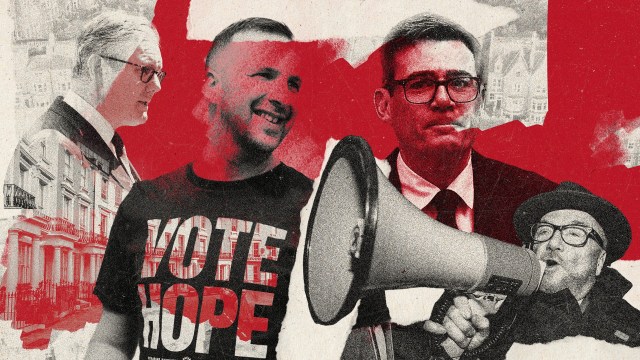
Which way will the Left go? (JG Fox/Getty)





In many ways, the British Left was made in Holborn and St Pancras. Marx wrote Capital in the reading rooms of the British Museum, and the Left-liberal intellectuals of the Bloomsbury Set loved in triangles and lived in its leafy squares. A group of middle-class reformers founded the Fabian Society a stone’s throw from Regent’s Park, while Lenin rented cheap rooms in Tavistock Place to write Materialism and Empirio-Criticism. It feels wholly appropriate, then, that the by-election taking place here in three weeks’ time will define the Left’s future.
On 8 October, the voters of this North London constituency will judge whether today’s Labour Party, a now tired vehicle born of Edwardian Britain, Methodism and industrial trade unionism, is still worth a punt against the siren calls of the radical Greens, who are offering “eco-populism”, festival aesthetics, youthful vigor and politics-by-meme. The result is likely to set the contours of Burnhamism over the years ahead, shaping the malleable politics of the new PM.
It marks a pivotal moment for both Burnham and his rival Zack Polanski: a contest over the viability of the Labour Party and its traditional hegemony over Left politics. It is freighted with expectations. Can Burnham reunite the Left’s broken voter coalition and reverse the precipitous decline stewarded by Starmer? Or will Polanski prove that his party’s poll surge can be translated into parliamentary seats, a first step on his path to “replace Labour” as the dominant Left force in British politics. Failure for either would be a humiliation: whatever the result, one man’s whole political raison d’etre will be deeply undermined, their respective coalitions left more fragile than ever.
For all his painfully awkward dilettantism, Zack Polanski has managed to turn the Greens from a kooky fringe outfit into a viable electoral force. Party membership has more than tripled to over 200,000 over the past year. As much as the march of Farageism across northern England saw off Starmer’s premiership, the Greens’ success in Gorton and Denton signaled to Labour MPs that his entire project was done for. It had failed to win back the disaffected postindustrial working class, and birthed a heightened national-populist insurgency — while simultaneously taking a sledgehammer to the Left coalition that won Starmer the 2024 election.
Part of that coalition found shelter in the warm embrace of the Greens, which briefly overtook Labour in the polls earlier this year, before settling more recently in the low double figures. That ceiling may well be down to Polanski himself and his enthusiasm for social media stunts. He has retweeted posts questioning the use of non-lethal force against an armed Islamist, mid-rampage in Golders Green, and reposted an image suggesting Nigel Farage should be guillotined. Nor is it easy to forget — or forgive — his mortifying history of promising to hypnotize women’s breasts bigger.
Still, news of Polanskism’s early demise is greatly exaggerated, principally expressed as wishful thinking, and crucially missing the point: the Greens don’t need to appeal to the median voter, nor do they need to assemble a broad cross-class union of disparate social and cultural-political forces. Rather, their purpose is to energize, articulate and represent the interests of that small but significant portion of voters for whom Polanski’s Bluesky musings are not beyond the pale, but signifiers of superior virtue. Done well, that could be enough to wreck Labour’s prospects of being re-elected.
Altogether, the Green showing in Holborn will confirm whether Labour’s pains are principally superficial — the result of years of uniquely inept leadership under Keir — or structural. A Polanski victory would assert the latter narrative: if even Labour’s most popular politician is powerless in the face of the macro trend, then hope is surely lost. Perhaps, even under new leadership, the rot cannot be stopped; Labour’s decline is the terminal result of tectonic and sociological shifts that have plagued the movement since the decline of Fordist manufacturing. In this reading, Polanskism will flourish in a climate in which broad-based, rooted political projects have given way to mutually suspicious tribal bubbles.
But there is a paradox at the heart of this reading of defeat. For while losing his first by-election would doubtless embarrass Burnham, it would also temper the instinct for a more managerial, orthodox politics. His coalition problem cuts both ways: he needs the Green-curious metropolitan Left just as he does the Reform-curious disaffected working class. Defeat in Holborn would make this conundrum harder, not easier, to manage.
After all, efforts to mitigate the Green surge in North London could require a Leftward shift in all manner of tricky policy areas: not only on Mahmood’s immigration and asylum reforms, but also on North Sea drilling, wealth taxes, and Israel-Palestine. The seat has a decent share of Muslim voters (one in five), as well as stressed young renters in over-priced houseshares and thousands of students: all receptive to the central Green messages of inchoate anti-capitalism and Labour betrayal. The conflict in the Near East, in particular, has become a totemic struggle for the radical Left, the fulcrum upon which all social justice struggles now somehow hinge. For the fresh graduate class, the willingness to eagerly and interminably utter the word “genocide” has become the ultimate political axiom (simply “war crimes” or even “ethnic cleansing” won’t do). So Labour has been smart to select a hijab-wearing former child refugee as its candidate, a welcome reassurance for the Green-curious, for whom these markers of apparent oppressed minority bona fides really do matter. Not that Sagal Abdi-Wali is some tokenistic appointment. She has already been leader of Camden council, and has spent three decades as a well-known “community activist”.
Of course, Holborn is more complicated than just Camden, and not as straightforwardly Green as Hackney. As in much of London, there are pockets of urban deprivation, but the seat’s boundaries stretch to the smart facades of Doughty Street (home to Starmer’s former chambers) and includes the King’s Cross headquarters of Google as well as the homes of established liberal professionals in the Georgian terraces of Kentish Town. This seat is Rest is Politics, but it is also Novara Media. If that causes headaches for both Burnham and Polanski, George Galloway’s Workers’ Party candidature does too, proving attractive to conservative Muslims hoping to give Labour a bloody nose, and to those repelled by the vibes and coding of a party of hyper-liberal urban cool kids (the Greens’ cringeworthy efforts to appeal to Urdu speakers notwithstanding).
It is certainly true that running a party leader with an energetic local campaign might well turn the usual by-election distortions into massive swings. But even in May’s local elections, the absolute nadir of Starmerism, the Greens found themselves nine points behind Labour, and they will, according to the bookmakers, be relegated to second place in October too.
Still, even second place is no mean feat. Before 2024, the Greens were confined to a single electoral citadel: Brighton. Positioning itself rather smugly as a bastion of middle-class progressives, hedonistic students and New-Age crusties, the Sussex seaside town was practically synonymous with the old Greens. Then, at the last election, the party expanded its seat haul to four: Brighton, of course, and a similarly off-kilter hipster seat in Bristol, but also two true-blue rural constituencies concerned with over-development and nature conservation. This created a strange two-tier Green bloc. On the one hand, the party was for laptop-sticker postgrads; on the other for Countryfile-watching former Tories.
Needless to say, that is a shaky, contradictory political coalition, not unlike Labour’s own. And, under Polanski, the Greens have only looked to add further elements to the mix: northern mill-town biraderi networks, and Islamic migrant communities collectively appalled by Gaza. But Holborn doesn’t fit neatly into the new Green Party’s cultural-political triad: what you might call the Greta-Gaza-Gardener alliance. It is a seat where the Green coalition’s internal contradictions are hard to hide: a constituency of students, renters and professionals for whom Gaza is important, gardens are largely irrelevant, and where clan politics holds less purchase than elsewhere.
Even if Polanski cannot forge his Greta-Gaza-Gardener alliance into a winning vote here, his leadership of the Greens will continue. As long as his loss is respectable, it may even be read as portentous, further eating into Labour’s temporarily rescued Left hegemony. A Labour victory, however, will hand Burnham the argument that his party’s malaise was mainly Starmer’s: and that a mildly Leftward, pub-friendly patter and anti-Thatcher schtick is enough to reunite the Left bloc and hold off Balkanization.
Once in this North London seat, Marx sat at his desk, with Lenin a few years and miles away, and the Fabians busily drafting the machinery of a welfare state that did not yet exist. Today, we have a former hypnotist who can’t stay off his phone, going up against a Labour candidate whose task it is to prove that having a nice-guy leader is enough to stave off secular decline. That this will be enough for one of the candidates to succeed is perhaps the biggest indictment of the politics of our era.
Jonny Ball is a Contributing Editor at UnHerd. He formerly wrote under the name Despotic Inroad.
 DespoticInroad