




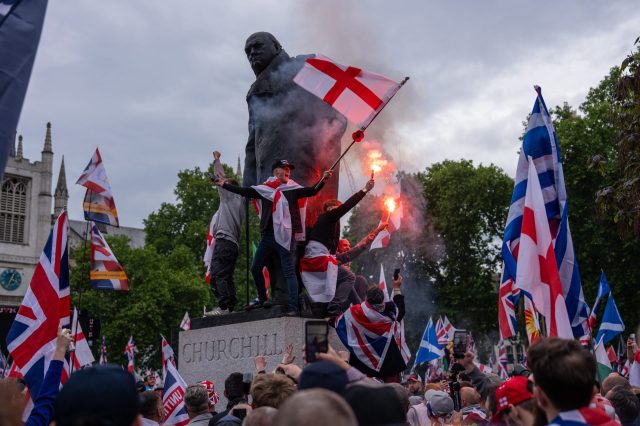
We are all stuck with the English Question. (Carl Court/Getty)





There is a famous sketch from the Nineties TV satire Brass Eye in which an older man is shown a series of photographs of women, immediately judging whether or not he would have sex with them. (This was, of course, long before Tinder). With Britain’s finest political minds now on at least their second iteration of debating Rishi Sunak’s Englishness, part of a regularly rotating carousel of public figures, the sketch looks a template for England’s new national neurosis. We should expect this debate, in all its misused terminology and willful misunderstandings, to grind on, exhaustingly, for the foreseeable future: the Westminster state has managed to produce an ethnic nationalism where one previously did not exist.
This late-flowering, politicized ethnogenesis among the English people is obviously the direct product of mass immigration, which has had the effect of rapidly diminishing the English population share within their own titular country. It was also obvious, and long-predicted, that the parallel growth and confidence of Scottish, Irish and Welsh nationalism would, in turn, midwife an English equivalent. When we add to this volatile mix the obsession, in recent decades, of Britain’s political and cultural class with aping essentialist American rhetoric on racial and ethnic difference, valorizing minority identities while actively seeking to suppress and undermine (or “dismantle” and “de-center”, if you prefer) majority ones, then we see the perfect Molotov cocktail our elites have managed to assemble for us in the coming decades.
Is Rishi Sunak English? The question is so poisonous because it elides multiple distinct but partly overlapping concepts — ethnicity, culture, political identity — and is further obscured by late 20th-century British taboos and anxieties over race. One can be culturally English (as, for good or ill, I am) without belonging to the English ethnic group (to which I do not, being of mixed Greek and Irish origin). Like my suburban Northwest London contemporary Suella Braverman, I have my own ethnic identities, which I have inherited and been socialized in, and do not wish to give up, instead passing them on to my children. This is not a question of race — both Greek and Irish are European ethnic groups — but of ethnicity. I do not feel aggrieved or despondent that I am not a member of the English ethnic group, just as I do not pine to be Japanese or Basque or Hutu. But framing the question, as parochial commentators seem compelled to, as “can non-white people be English?” has, whether through well-meaning ignorance or willful obtuseness, led to the absurd situation where the very existence of the English as an ethnic group, as well as a cultural identity, is either denied or actively suppressed as a barrier to racial harmony. Indeed, for New Labour apparatchik John McTernan — proud possessor of Irish identity and citizenship through descent — “the concept of ethnic English is truly evil”.
At the same time, elements of the online Right are indeed objectively racist, denying English ethnicity to people of part-English origin by virtue of their mixed race. One of their victims, the MP Ben Obese-Jecty, who is half-English and half-Ghanaian, is clearly more English than me, ethnically, because I am not at all English. Given that a significant proportion of the new ethnonationalist Right often do not have to look back far to find non-English ancestors, then a preference for people of European but non-English heritage over non-white people with some English descent clearly shows a focus on racial identity over ethnicity or ancestry — another conceptual matter entirely. If some level of physical descent from ancestors from England were the central factor, then the vast majority of the Caribbean, or even African-Americans, would have a greater claim on Englishness or Britishness than the non-ethnically English descendants of European immigrants, though I have never seen today’s genetic purists make this claim. The racial aspect, on both sides of this debate, then, overwhelmingly obscures the matter supposedly at hand, that of Englishness as an ethnic identity, which is to say the existence of the English as a people, distinct from the Welsh, or the Tibetans, or the Iroquois, or any other of the world’s ethnic groups which are universally agreed to exist.
Perhaps the online debate revolves around whether prominent non-white personalities can be definitively called English precisely because the question feels more loaded, and thus more dangerous to comfortably discuss. The existence, or otherwise, of the English as an ethnic group has become, politically, a sub-problem of the continued viability of a tolerant multiracial society within the context of vastly expanded mass Third World immigration. Without the policy choices creating this situation, this entire conversation would not be happening, and these neurotic, increasingly casuistical debates would simply not be taking place. The progressive claim that the English, alone among human societies, do not exist as an ethnic group is so absurd as to be unworthy of discussion: it is simply a means of evading the question of what political importance should be attached to being of English ancestry in the very land named after their ethnic group. If the reasoning is that the path to racial harmony lies in removing the English, alone, from the long list of the world’s ethnic groups, against the will of those who both are and believe themselves to be such, then permit me the adopted English understatement of saying that the outcome will not be positive.
To disentangle, as our purposefully obtuse commentators choose not to, the distinct issues of race and ethnicity, it is more useful here not to ask whether Rishi Sunak is English, but whether Andy Burnham is. Proud of his Irish descent (on his father’s side Irish Protestant from Drogheda, so we must assume of English settler origin), Burnham has made it explicitly clear that of the various regional and national — even pan-continental — identities he holds, Englishness comes last. As Tom McTague observed in his profile interview with the Prime Minister, “it is Burnham’s Irish roots that help explain his British identity”, fueling “his insistence that he is British first rather than English”, an identity which “allows him to keep all the ‘layers’ of his identity intact: British first, north-west second, Liverpool third, and English fourth”. With his Derbyshire surname, vanishingly rare in Ireland, no one can reasonably doubt that should he have wished, Andy Burnham could have chosen to assimilate into an English political, cultural, or even ethnic identity. For the most part, it seems he has chosen not to. Politically, he is British (and incidentally is strikingly more Unionist in dealing with Sinn Féin than his recent predecessors). Culturally, his Englishness is regional, urban and Northwestern rather than national: it is perhaps more difficult to imagine him bedecking No. 10 North with England flags in support of the national team than Starmer chose for the British state’s previous London regional office. Ethnically, should he even think in these terms, we must assume it is his “Irish roots” that dominate.
Indeed, when hosting Irish Taoiseach Micheál Martin at Makerfield’s Brian Boru club last week, Burnham observed that “I certainly am proud of the Irish heritage that I have in my family. And I was with the Prime Minister of Canada at the new Everton stadium this week… Another Irishman, it wasn’t unnoticed, a Mayo man, I think.” Carney certainly is, or was — he relinquished the Irish citizenship he held from the 1980s on becoming Canada’s Prime Minister — “another Irishman” and “a Mayo man”. On the official Irish Department of Foreign Affairs website, one can find the lovingly-produced document “Aughagower to Canada: A commemorative history of the Carney and Moran families”, a masterpiece of sentimental old country soft power, tracing Carney’s forebears back to their peasant smallholdings, published “on the auspicious occasion of your visit to your ancestral home”. Carney acquired his third, British citizenship through necessity, as is mandatory on becoming Governor of the Bank of England (there is of course no English citizenship to acquire for what is, despite its name, a British role). What makes Carney “another” Irishman to Burnham? Is it citizenship? He is no longer an Irish citizen. Culture? Perhaps, though it is difficult to see exactly how this manifests.
More obviously, the answer is in descent, and the very idea of having “an ancestral home” in the first place. Such descent is a category recognized by the Irish state, like the majority of European states, for citizenship purposes, in a way the British state does not recognize its own British, or even English diaspora, in America, Canada, Australia, or other distant outcrops of the great historic wave of British transcontinental migration. But there is, still, an element of personal choice here: though less Irish, by ancestry, than either Burnham or Carney, that descendant of stout Hampshire yeomen, Joe Biden, chose to identify as Irish, in a distinctively bombastic Irish-American way.
Comparing Irishness to Englishness, then, we see that ancestry is a factor in the Irish case; citizenship another factor (though neither Biden nor Burnham are or ever were Irish citizens); and choice — the subjective matter of personal identity construction, itself a product of socialization from within and without the cultural in-group — the third. It is not any one of these things in isolation, but an interplay of all of them. If British progressives, trying to suppress a politically toxic, and, it is not difficult to foresee, potentially tragic outcome that they have themselves created, now find themselves denying the very existence of the English as an ethnic group, it must be said that much of the newly ethnonationalist Right exists in a similar state of confusion about the subjective element of choice in ethnic affiliation. If ancestry alone were the operative factor, that son of a Birmingham stonemason, Patrick Pearse (who incidentally blamed his “cold nature” and social awkwardness on his “English blood”), would be only partly acceptable as Irish, yet you cannot find even the most extreme neo-Gaelic nationalist online claiming so. When the London-born Englishman John Stephens changed his name to Seán Mac Stíofáin and led the Provisional IRA at the start of the Troubles, it was surely a triumph of will over ancestry, and yet he was nevertheless accepted as Irish by the most zealous Irish nationalists then available. Admittedly, spearheading armed rebellions may be a stiff benchmark for successful assimilation, but the Irish case — so geographically close and culturally similar to England, compared with the vastness of the surrounding world, yet so utterly dissimilar nevertheless — remains, as always, a useful foil to English certainties.
No one, at least until Irish progressives belatedly acquired once-fashionable Anglo-American opinions, doubted the existence of the Irish as a people distinct from others in the world, or that the Irish people, as such, are distinct from the English. Even the latter claim is, at least, still vestigially held by the Irish progressive class as the last remnant of Irish nationalism. Indeed, hapless Ed Sheeran has recently, by virtue of his disinclination to publicly condemn Israel, been stripped of his inherited Irishness by prominent Irish progressives, and presumably condemned to mere Englishness for his sins. This element of politicized cultural negotiation, from within and without the in-group, is neither an English nor a Right-wing peculiarity but an inherent feature of ambiguous cases in what is, by its nature, a socially constructed category. Ancestry, ethnicity, political identity: these are partially overlapping but distinct concepts, for Englishness as well as Irishness.
Yet the fact that many Irish people can claim English ancestry, like Gerry Adams, or Scottish, like Mary Lou McDonald or Conor McGregor, does not negate the existence of an Irish ethnic group, which both partially overlaps with British populations in terms of descent, but is also held in jealous contradistinction as a matter of identity formation. Indeed it is in Northern Ireland, where Irish and British ancestry is most closely intertwined in most families, that the cultural boundaries between them are most rigidly enforced. As the anthropologist Fredrik Barth observed in his influential book Ethnic Groups and Boundaries, it is the very existence of cultural boundaries themselves rather than the “cultural stuff” they are commonly held to contain, that makes the distinction between ethnic groups. The ability of individuals, in very particular and mutually negotiated ways, to slip between them, rather than deconstructing ethnic groups, reifies them as culturally meaningful categories. Ancestry, real or fictive, is an element, even a large element, in the existence of ethnic groups, but the two terms do not overlap entirely. Both sides in this interminable debate are conflating related but distinct concepts, and poisoning a debate that will result in serious real-world consequences for millions of people.
So when Jacob Rees-Mogg can claim, to online outrage, that the English are a “mongrel people”, then this is something that can be said of every ethnic group on earth outside uncontacted Amazon tribes or Andaman Islanders, it is not particularly meaningful. Even Winston Churchill, in his popular work A History of the English-Speaking Peoples, took great pleasure in ascribing different temperamental characteristics of the English “race”, the common late-Victorian usage for what we would today term “ethnicity”, to the various ancestral strains in its makeup. Churchill, who was half-American of English descent, certainly did not intend to deny the existence of an English ethnic group: indeed, his work was intended to explain what he predicted as its domination of the earth, or at least justify the handover of power he oversaw from its mother country to its New World successor empire. It is sadly ironic that the man who sacrificed the British empire to defeat Hitler spent a large part of his life writing a multi-volume epic glorifying his own ethnic group, from its island birthplace to its vast new lands across the globe, that would now itself be considered tantamount to Nazi race science by the standards of British politicians in 2026. What a muddle these people have found themselves in, and what a sad and needless predicament for the English themselves. These are nuanced and complex terms, hedged with ambiguities at the edges, but at the same time, you should not need a DPhil in Anthropology to know whether you exist.
Where does all of this leave us? The observable fact that membership of one ethnic group or another, is in certain circumstances, and within certain cultural contact zones, mutable or negotiable, is less politically relevant than the fact that for the majority population of England, such circumstances have not existed since the early Middle Ages. The English were, until relatively recently, disinclined to center themselves as an ethnic group at home precisely because they were one of the very first in the world to form a nation-state, in which this identity was unchallenged. Later, when other European societies were undergoing the wave of explicit identity-formation that led to modern nation-states, the English had happily subsumed themselves into an imperial British identity, which no longer exists — except perhaps vestigially in Whitehall. But, just as the modern experience of mass immigration leads to complex and ambiguous identities in the descendants of immigrants, whether inherited or consciously maintained like Burnham or Carney’s layers of Irishness, at its current scale, it has now caused the English to adopt the same introspective anxieties and acts of conscious identity formation.
We may say that the creation of hyphenated English identities have suddenly transmuted unhyphenated Englishness from an assumed cultural norm into a politicized identity. English demographic decline in England itself, with all the rapidly eroding taboos around its open discussion, is the central fact driving all of this discourse, around which everything else is displacement activity. It is the direct result of mass immigration since the Nineties that these questions of identity and ancestry and meaning, the stereotypical immigrant neuroses, have now come to overshadow the English themselves, who in their homeland have no other identities to play with, or assume, or explore.
Like any child of immigrants, I have made choices, rational or romantic or some combination of the above, and for good or ill others have been made for me, or inherited. Like Mark Carney, I have “an ancestral home” in Ireland, and have chosen to “return” to it. If Jacob Rees-Mogg thrusts Englishness upon me, I must therefore politely decline. Yet for those whose ancestral home is England, there is no escaping the problem. Some have chosen self-assertion; others have chosen self-negation: but there can be no real imminent resolution when what was once unspoken and merely assumed has, for the first time in many centuries, become a matter of political dispute and negotiation. Yet it is doubtful that either current position, maximalist or minimalist, on who gets to call themselves English has yet reached its final form, but should instead be seen like the first haggling at a bazaar. There is, presumably, a middle-ground between claiming that the entire world is composed of temporarily embarrassed Englishmen, and determining belonging solely by 23andme results.
In Greece, which went through this process in the 19th century, despite the strong ideology of shared ethnic identity and physical descent from the ancient Greeks driving the modern state, some groups, like Romanian-speaking Vlachs or Albanian-speaking Orthodox Arvanites, were adopted as fictive Hellenes, while others found less happy outcomes. In Ireland, the descendants of English settlers were twice absorbed into the Irish ethnic group, as Catholics in the 17th century, and as Southern Protestants only definitively after independence (the assimilation of Ulster Protestants into Irishness is, we may say, a distinctly unfinished project). But modern English political ethnogenesis is only beginning, and it is impossible to predict its final form, should there ever be one. It is very plausible that an accepted compromise will retain more of imperial Britishness than the current discourse would imply. The relationship between Englishness and Britishness is also politically unstable, and one possible route out, or deferral, of English angst over identity could be a revivified unionism, which indeed appears to be Burnham’s response. But the stakes, for those of ambiguous Englishness, are increasingly high, as the once uncomplicated English begin to argue among themselves. We may as well get used to these endless and increasingly sterile online debates, and the shadow they threaten to cast over our offline lives. All of us, English or not, are now stuck with the English Question.
