









September 14 2026 - 7:15am
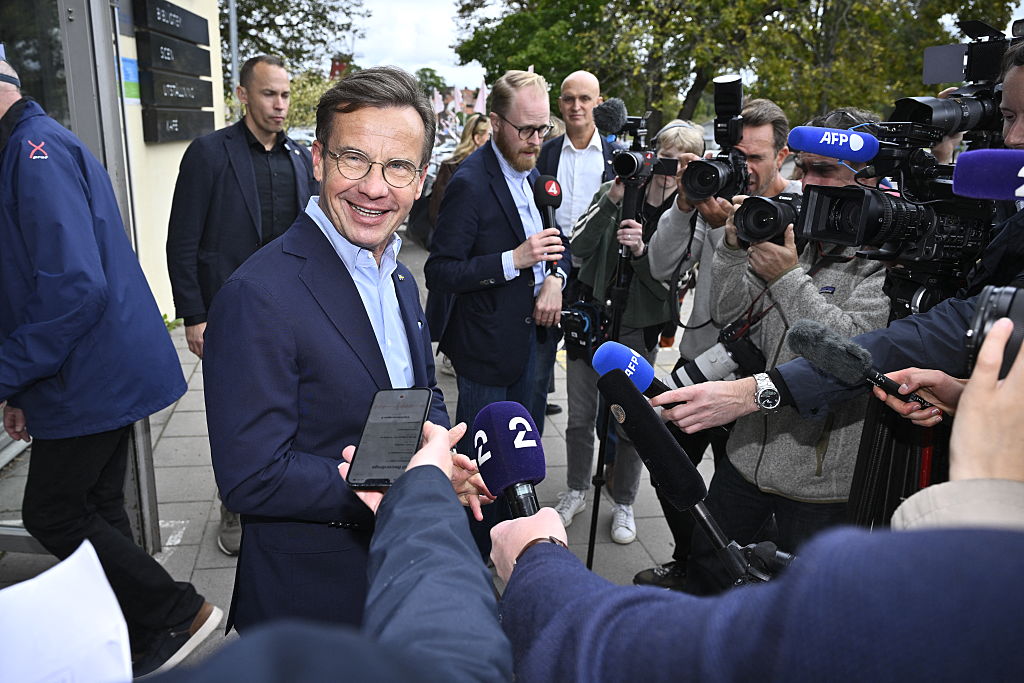
Swedish elections have not always earned live blogs from the Guardian, but this year is different. Under a center-right government, the country has joined Nato and successfully beaten back a significant crime wave driven by mass immigration. Yet as the razor-close results came in on Sunday evening, voters stopped short of handing the government an outright victory. The four-party bloc, which includes the nationalist Sweden Democrats, has fallen short of a majority by just a few tens of thousands of votes, leaving the formation of the next government uncertain.
Voters’ lack of enthusiasm for a government that has presided over a dramatic reduction in Sweden’s gun violence may seem surprising. Shootings have fallen from a peak of 391 in 2022 to just 48 in the first eight months of this year. In Gothenburg, Sweden’s second-largest city, there has not been a single fatal shooting in the past year.
Yet the underwhelming result is entirely in keeping with Swedish political tradition. For an electorate that remains fundamentally social-democratic, the role of the center-right is to act as a corrective when the Left has gone too far. Leading up to 1976, when a center-right coalition finally ended 44 consecutive years of Social Democratic rule, the governing party had become deeply entrenched in the machinery of the Swedish state. In 2006, after another 12 years in government, the Social Democrats were again defeated by a resurgent center-right. Four years later, they campaigned alongside the Greens and the Left Party, the successor to Sweden’s former communist party, in an alliance that would have brought the latter into government. When the Social Democrats returned to power in 2014, they presided over eight years in which mass immigration continued and gang violence escalated.
This year, the Social Democrats had learned their lesson. The party had more or less embraced the center-right’s policies on crime and immigration, including a restrictive asylum policy and tougher sentences, while becoming perhaps even more flag-waving than the Right-wing Sweden Democrats. This reflects the Social Democrats’ historic talent for aligning themselves with the popular will, even when that means pragmatically embracing deeply conservative sentiments in order to win power.
In that sense, the Social Democrats are better understood as a governing machine than as an ideological movement. Still, it may not have been enough. Voters do not seem to be convinced that Sweden’s restoration is complete, or that the Social Democrats can yet be fully trusted again. Despite keeping their distance in public, the perception that they would ultimately have to rely on the former Communists — this time tainted by their association with antisemitic, Hamas-aligned elements and bolstered by the immigrant vote — may explain why, if they form a new government, they will be limping into it.
Meanwhile, Prime Minister Ulf Kristersson’s party, the traditionally conservative Moderates, can take satisfaction, whether it remains in power or not, from having kept the insurgent nationalist Sweden Democrats at bay. The latter is retreating from second to third place, strengthening the Moderates’ claim to the leadership of the Swedish Right with a lead of nearly three percentage points.
The result offers a lesson to the Moderates’ European conservative counterparts: the legacy Right can still contain anti-establishment parties, even from within government. One key has likely been the Moderates’ command of the issues, particularly criminal policy. Competent statecraft may yet prove a winning issue for the Right.
Johan Wennström is a Research Fellow at the Swedish Defence University and author of the The Stay Behinds: Sweden’s Cold War Guardians.
 johanwennstrom