




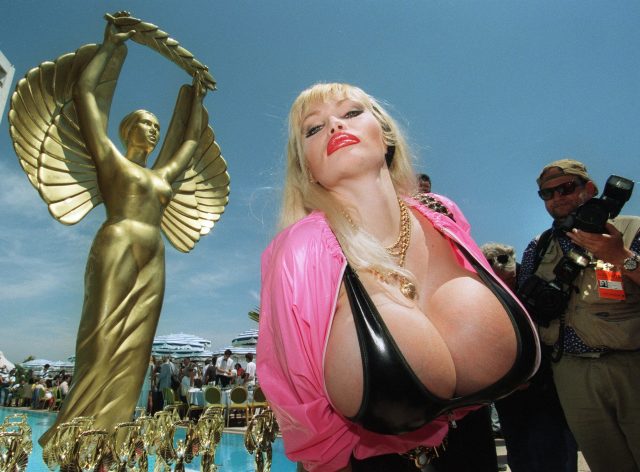
In the 2000s, big boobs were big business, confirmed by the cultural impact of Lolo Ferrari. (Patrick Hertzog/Getty)





Boobs, tits, melons, jugs, norks, funbags, hooters… There are hundreds of words for breasts in English, which tells you something about our obsession with them. There isn’t a period of history when they haven’t been a subject of fascination and disrespect. They’re hypnotic and occasionally hypnotized. Women have never quite managed to reclaim them from the men who name and stare at them.
Then came a grim reminder of what happens when people entrusted with our breasts fail to regard them first and foremost as parts of our biology. An NHS trust in north-East England admitted that at least 20 women had undergone unnecessary mastectomies in its care. Hundreds of patients suffered harm while being treated at the breast unit of County Durham and Darlington Foundation Trust (CDDFT). One patient is known to have died.
When I read the story, my reaction was not shock or horror but resigned familiarity. This has happened before, and it will happen again. I know, because it happened to me.
I eschew the word “victim”, although medically and legally that is what I am. I prefer “patient”, to give the horror story its proper context. In 2006, I was operated on by Ian Paterson, a charming, reassuring surgeon who had examined what he claimed was a rare type of potentially cancerous lump in my breast when I was 30. He wanted to operate urgently, and I believed that, by doing so, he had saved my life. It was all lies. I was never actually at risk of breast cancer: the lump was just a swollen lymph node, and I should never have gone under the knife. I was one of hundreds, if not thousands, of women who had unnecessary surgery at his hands, and consider myself one of the luckier ones to leave with just a small scar on one breast. Many of Paterson’s patients had mastectomies that they simply did not need.
The “butcher surgeon” — a media sobriquet I hate for its sensationalism, and respect for its honesty — was sentenced to a 20-year prison sentence in 2017 for botched and unnecessary surgery. As well as undertaking needless operations in both the NHS and the private sector, Paterson was found to have carried out “cleavage-sparing mastectomies”, leaving tissue behind instead of a flat chest wall so that a woman still “looked good in a bikini”. But this meant that the cancer could return — and for hundreds it did. Of his 1,206 mastectomy patients, 675 died. There was an inescapable assumption buried inside Paterson’s actions. Even when a woman was lying on an operating table with her life in the balance, she was treated with less humanity and dignity for reasons explicitly related to her femaleness. The breast was an object for the man to do with what he wished.
Women learn young that breasts do not wholly belong to them. Even toddlers are put in two-piece bikinis, and by about the age of seven, little girls are expected to cover their flat chests for reasons everyone knows but no one will articulate. Well before puberty, I was aware that my chest was different from that of my male peers. During our Eighties sex education lessons, in between incredibly graphic videos of childbirth and awkward explanations of primitive period products, we were taught that the primary function of our developing “secondary sex characteristics” would eventually be to breastfeed. It wasn’t long before boys disabused me of this idea with crude comments and staring. Girls were taught that breasts exist to feed babies, but boys believed their primary function is to feed the male gaze.
I know where they learned this. I grew up in the era of Page 3 “girls”, David Sullivan’s “Countdown to 16” in the Sunday Sport, Benny Hill and Carry On. Prime time comedy was dominated by men who leaned heavily on boobs-as-punchline in lieu of actual jokes. The breast message was clear: you could be either hot — or funny.
As young women in the Nineties, while Pamela Anderson was running into the Baywatch surf, we were sold lies, lingerie, and boob jobs. There was Eva Herzigova’s “hello boys” Wonderbra — designed not for comfort or convenience, but for maximum cleavage, delivering precisely what men want — and the “balconette” bra, a romantic lace balcony from which our mammary Juliets could be courted. In the 2000s, bigger boobs were even bigger business, confirmed by the cultural impact of Hooters, Katie Price and the tragic Lolo (French slang for breasts) Ferrari. Breast implant surgery was surging. Then, in 2004, Janet Jackson’s right breast changed the world forever after Justin Timberlake exposed it to 90 million viewers at a Super Bowl halftime show.
“Nipplegate” led to the creation of YouTube, because a man wanted to share the clip. Two days after the live event, Jackson’s breast became the most searched-for image in internet history, even beating “9/11” for the record of most searches in a 24-hour period. The entire world was lusting after and laughing at a single boob. While Jackson was vilified, shamed and punished, Timberlake suffered no consequences and even performed at the same Grammys from which Jackson was blacklisted.
This was the cultural background against which the NHS produced its 2004 report into potential wrongdoing by Paterson. But that report resulted in no meaningful action, nor did another in 2008 in which consultant and investigator Rex Polson described Paterson as performing these “bikini-friendly” surgeries because he wanted to achieve “an improved cosmetic result”. Whistleblowers were left feeling stonewalled and patients — mostly women — continued to be harmed.
As Deborah Douglas, campaigner and patient of the surgeon, writes in her 2026 book The Cost of Trust: “We live in a society that wants women’s bodies to be a certain way; to have a nice cleavage and flat stomach, to look good in a bikini…The operation that Paterson sold me also prioritized looks. This seemed like a win-win.” Douglas was given a mastectomy with reconstruction and chemotherapy. None of it was necessary.
Few women would choose to have a more aesthetically appealing operation if it meant their cancer could return, but Paterson’s victims were not given the choice. He simply assumed that any woman would prefer some sort of natural cleavage to none at all — the male gaze was more important than a safe outcome.
This was certainly the case for Marie Pinfield, who in 2006 was diagnosed with cancer in one breast. She asked Paterson for a double mastectomy as a precautionary measure, but he said he wouldn’t remove a healthy breast unless she underwent a psychological evaluation. Against her wishes, he performed his signature “cleavage-sparing” mastectomy and Pinfield woke to discover she still had a lot of breast tissue, reduced from a G-cup to a D-cup. She demanded a revision operation, which Paterson angrily agreed to — but even then he would not give her a flat chest wall. It was too late anyway. Her cancer had returned and in 2008 she died, aged 49. Her case is one of hundreds of deaths linked to Paterson currently being investigated by the Birmingham coroner in the largest inquest since Hillsborough. Paterson fought hard not to give evidence to the inquests, causing even further distress to bereaved families, but was eventually forced by the court. He now appears regularly at the inquests from prison via video link, and continues to deny wrongdoing. He will be released from prison in 2027 while the inquests are still ongoing.
The NHS and private sector wanted us to believe that Paterson was a lone actor, a rogue in an otherwise healthy system, but that is not true. In The Cost of Trust, Douglas warns that “He is a symptom of a system that not only allowed him to carry out his crimes but actively helped to cover them up.” The NHS knew for years that Paterson was doing incomplete mastectomies and prioritizing looks over patient safety, but he was getting the waiting lists down and was seemingly protected by the old boys’ network that has long dogged the field of medicine.
In the cases of both Paterson and the CDDFT breast unit, there are of course multiple factors at play, including the role of the profit motive in the private sector, and the push to reduce NHS waiting lists at any cost. But casting a shadow across all of this — and indeed across much of women’s experiences of healthcare — is something that is now labeled “medical misogyny”: the fact that the entire field of medicine has historically defaulted to male anatomy, neglected research into female medical conditions, and ignored women’s complaints.
The medical establishment is slow to acknowledge this. The British Medical Association produced a report on sexism in medicine in 2021, but it was only concerned with the treatment of female medics rather than patients. The General Medical Council acknowledges a culture of sexism, but again its focus has been on female doctors. Earlier this year, now-former Health Secretary Wes Streeting announced plans to tackle some of the issues. He has since been replaced by Yvette Cooper, whose office did not reply when I asked whether she is committed to those same plans.
It’s a start. But as all women know, misogyny isn’t born in hospitals. Outside the ward doors is a culture — and a media — happier to obsess over the virtues of Sydney Sweeney’s breasts than address the fact that girls are growing up bombarded with targeted ads for breast augmentation (now payable in installments or at a bargain price in Turkey). The key to taking women’s health seriously is to understand the assumptions projected onto our bodies before we even enter the waiting room.