




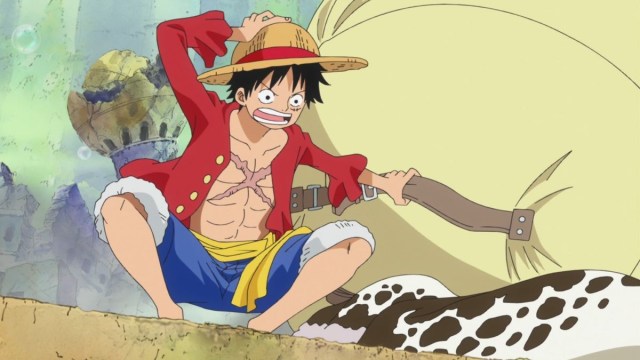
Monkey D. Luffy, also known as Straw Hat Luffy, is the protagonist of One Piece. (Shueisha)





Earlier this year, a pressure-resistant glass orb was placed on the seabed somewhere off the coast of Japan. Inside was a tiny wooden chest. And, inside that, written on a scrap of paper, was a secret that millions of people would dearly love to discover: the true nature of the world’s greatest treasure, the “one piece”.
The scrap was written by the Japanese artist Eiichiro Oda, creator of One Piece: the bestselling manga of all time. For nearly 30 years, fans have followed Oda’s rascally pirate, Monkey D. Luffy, as he and his friends sail the seas in search of the fabled treasure that gives the series its name. Some enthusiasts have wondered, of late, whether Luffy would ever find it, or even whether Oda himself knows what or where it might be. In celebration of an astonishing 600 million copies of his manga circulating worldwide — and perhaps to mollify his fans — Oda committed the answer to paper and placed it in that orb. The truth, he promises, will surface when the manga finally finishes.
You may never have heard of Luffy. But you’ve probably seen him. A skinny young man in a straw hat, red waistcoat and blue shorts, he adorns children’s clothing from London to LA. There are trading cards and Lego sets. Shops like HMV are crammed with franchise memorabilia, and where manga fans once had to seek out specialist bookshops or trawl the internet to feed their fix, mainstream retailers now devote enormous amounts of shelf-space to Japanese manga in general — and to One Piece in particular. For their part, Netflix subscribers will be familiar with the One Piece anime and live-action series, due to be joined at the end of this month by LEGO One Piece. The anime series has run for 26 years, racking up some 1,180 episodes and counting. It is now broadcast in around 80 countries across the world.
Why has One Piece become so ubiquitous? And, as we reach peak Luffy, are we also reaching peak “Japan” as a global brand? Oda himself doesn’t offer many answers. Reportedly very sociable in private, he has always sought to avoid a public profile. In part, that’s because he doesn’t have the time or energy. Brutal deadlines from his publisher have sometimes obliged Oda to sleep for less than three hours a night. And where most top manga artists pen their main characters and then — like the Old Masters — delegate much of the rest to assistants, Oda claims to draw anything that moves: crowds, animals, smoke, even the sea.
But Oda doesn’t appear interested in becoming a public intellectual, like some manga artists. He grew up on rollicking adventures like Dragon Ball and the German-Japanese animation Vicky the Viking: the latter, like One Piece, revolving around a plucky boy and his crew roaming the high seas. Oda is also partial to a good yakuza film or period drama, and as a history fan seems attracted to the enterprise and audacity of the Age of Discovery and the Golden Age of Piracy. His driving question in drawing One Piece is simple: would his 15-year-old self enjoy this?
The result is a main character, Luffy, who wants what most 15-year-olds want: fun; freedom from interference or consequences; fairness from people in authority; an endless supply of food, and — ideally — superpowers. After eating a mystical fruit as a child, Luffy is able to deploy stretchy, rubbery limbs against his foes. He’s also blunt, ambitious, and willing to battle the “World Government”, whose cruel will is enforced by thick-set gym bunnies in the Marines. Luffy is also devoted to his friends: Roronoa Zoro, a muscular, laconic swordsman; Nami the navigator, who brings brains and a bit of business acumen to Luffy’s Straw Hat Crew; Sanji the chain-smoking chef; and Usopp, a coward and compulsive liar — complete with Pinocchio nose — who gives the series surprising emotional depth.
Yet the characters alone don’t account for One Piece’s outsized popularity. There’s also its unique art style — charmingly ragged, where many of its rivals employ a samey precision — plus its ever-compounding status as the recommended starting point for anyone wanting to get into manga and anime. Alongside all this runs Oda’s gift, shared with other internationally successful Japanese creatives, for finding the universal in the particular: drawing out, from Japanese life, values, sentiments and dilemmas, ideas that possess broad human appeal.
On and off down the centuries, some in Japan have prided themselves on taking the collective good — family, neighborhood, company, nation — more seriously than wealthy rivals like the UK and the US. The result is a rich artistic legacy, which dramatizes the tensions involved in trying to live this way. An individualist can stick two fingers up, and walk away. There’s romance in that, perhaps, but not much real drama. On the other hand, to remain committed to the welfare of a group or a whole society, while mourning serious and possibly intractable failings, is difficult and painful. It’s also truer to the way most people live.
These are the very waters in which Luffy and his friends sail. There’s Princess Vivi, for instance, drawn to the life of the Straw Hat Crew but who chooses to stay behind in her war-torn kingdom. We see her standing on the shore, tears streaming down her face as Luffy and his friends sail away without looking back. Have they forgotten her already? In fact, they can’t answer her, because it might put her in danger from the watching Marines. But, as one, the crew all raise their fists in the air, an “X” marked on each of their arms in covert salute to a friend. It is one of the most poignant scenes in the series.
Pirate yarn though it is, then, One Piece can be read as a conservative tour de force, championing age-old values like freedom, solidarity, justice, hard work, self-sacrifice and ninkyō: a chivalrous spirit, oriented towards helping the weak and fighting the strong. It is associations like these that have Gen Z protestors flying the Straw Hat Jolly Roger at marches in Indonesia and Nepal, illustrating their opposition to what they regard as corrupt and authoritarian governments. The Jolly Roger has the additional virtue of being politically ambiguous, and thereby complicated for governments to ban without reinforcing the critique that they are indeed repressive. And yet trouble may be looming on the horizon, for the Straw Hat Crew and the wider world they represent.
Oda recalls discovering as a small boy that you could draw manga for a living, realizing in that moment that he might never have to work a day in his life. Quite a few people in Japan have felt the same way, feeding the rise of one of the country’s great postwar export industries — but also contributing to infamously demanding work conditions, as an over-supply of manga artists meets tight profit margins, quick turnaround times, and a publishing culture in which low polling among readers quickly places a manga at risk of being dropped.
An already under-pressure industry now has to contend with AI hoovering up its output and creating rival content at lightning speed. Japanese manga also faces competition from Korean manhwa and Chinese manhua, which often take web novels as their source material and use assembly-line production to create full-color panels. Readers find themselves drawn into a primarily online revenue system, one geared towards mobile phone reading and tie-in purchases.
Alongside East Asian competition runs East Asian history. One of the greatest achievements of artists such as Osamu Tezuka and Studio Ghibli’s Hayao Miyazaki was the refurbishing of Japan’s international reputation after the Second World War. They replaced the militarists and colonizers of old, if not quite burying them, with animated adventures that were variously funny, consoling, saccharine-sweet, techno-futuristic and deeply dystopian. Hopes ran high that young Chinese and South Koreans brought up on Japanese manga and anime would be inclined to reject as outdated and irrelevant dark tales told by their parents or teachers about Japanese imperialism. Yet survey evidence suggests that, for South Korea’s young, it is possible to regard Japan both as a place that produces great food and fiction and where the events of the past have yet to be sufficiently atoned for. So too in China, where a patriotic school education tends to cast Japan as the main villain (closely followed by the British), and where the government has shown its willingness to filter Japanese manga, films and music, and sometimes to ban them outright.
Compounding this problem is Japan’s recent policy of beefing up its military and intelligence operations, while also seeking to strengthen the constitutional position of its armed forces and crack down on foreign espionage. Advocates argue that all these measures are necessary, even overdue. But scholars equally note that Japan’s creative output travels well when it is, as the sociologist Koichi Iwabuchi puts it, “culturally odorless”. A few years ago, a row broke out in South Korea when fans noticed that red-and-white earrings worn by one of the characters in Demon Slayer resembled Japan’s wartime Rising Sun flag. Inevitably, then, the future reception for manga and anime in East Asia, and indeed further afield, will be shaped by perceptions of how Japan’s politics and social attitudes are changing.
When One Piece first launched, back in 1997, Japanese manga was subject to restrictions imposed by South Korean authorities who feared a repeat of the cultural colonization of the past. Luffy’s 30-year odyssey has unfolded alongside Japan’s rise to become Asia’s cultural superpower. Whether that reputation survives until his journey ends is likely to be decided less by Oda than by politicians in Tokyo, Washington, Seoul and Beijing. By the time the One Piece finale arrives, and Oda’s treasure chest is opened, the most interesting secret of all may be what the world has come to think of Japan.
 drchrisharding