









September 10 2026 - 7:00am
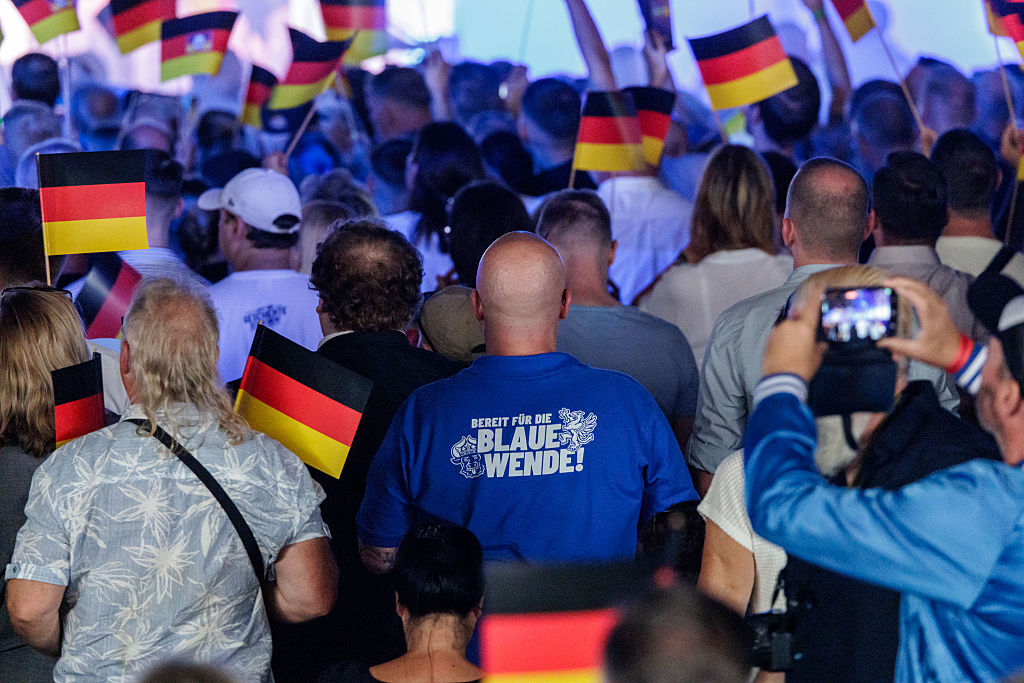
It took Germany’s conservative political establishment two days to come up with what it thought was the resounding answer to the AfD’s victory in Saxony-Anhalt on Sunday night. Hendrik Wüst, the state premier of North Rhine-Westphalia and the man most likely to succeed Friedrich Merz as Christian Democratic Union leader and chancellor, has now joined a chorus of center-left politicians by calling for a ban on the AfD. He hid behind the usual procedural language with his demand for a commission to investigate the Right-wing party. The CDU, and Merz himself, have so far rejected the idea, arguing instead that they have to defeat the AfD politically.
What is happening here is that the German center-right is panicking. The chance of a ban is close to 0%, as this is something only the constitutional court can do and the hurdles for any such action are high. The legal precedent for this was the failed attempt a decade ago to ban the National Democratic Party (now The Homeland), a genuinely neo-Nazi group. The AfD leadership has gone to extremes to comply with the constitutionally mandated requirements, implementing procedures to weed out neo-Nazis. When 44% of an electorate supports a party, a rarity in modern, fragmented politics, they’re not likely to all be extremists.
Persistent discussion of a ban, together with the political firewall, is part of the reason why the AfD is expanding so quickly. The party’s main voter base consists of workers, young people and business professionals — in other words, some of the most economically active sections of the population. To dismiss the AfD as an extremist group misjudges what is going on in German politics.
Nonetheless, rival parties keep making the same mistakes. Another potential error is the debate around Wüst as the potential savior of the CDU. While he’s more popular than Merz, Wüst is on the liberal wing of the party previously spearheaded by Angela Merkel. With him as CDU leader, the AfD would credibly occupy a huge stretch of the political spectrum from the center to the Right, exactly the space occupied by much of the silent majority. The Free Democratic Party used to occupy some of that space, but its reboot under a new leader has failed. Merz is a conservative who has trapped himself in a coalition where he cannot implement his Right-of-center views. If he is the problem, it’s hard to understand how Wüst would solve it.
If Wüst were chancellor, the AfD’s national electoral ceiling could be closer to 40% than 30%. Germany is now experiencing the real political consequences of a failing economic model. The country’s biggest dependence was not on Russian gas or American weapons, but instead on its manufacturing industry staying competitive forever despite a lack of investment.
People talk about immigration when their real incomes are declining, and they are becoming pessimistic about their future. The AfD has no answers, either, but the present firewall allows the party to appear sufficiently different. Alternative is a good word in politics right now. Democratic politics can be understood as a permanent search by voters. If something does not work, they try something else.
This is an edited version of an article that first appeared in the Eurointelligence newsletter.
