




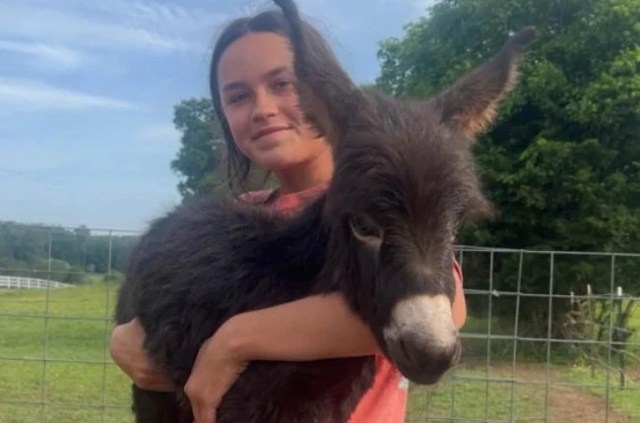
“I for one look forward to seeing the great works of the HeeHaw Foundation.” (Elsberry Riding and Farm/ Facebook)





In Polk County, Georgia, there lived a one-year-old miniature donkey called HeeHaw. He had been raised and bottle-fed by his owner, a woman called Hannah Israel. In the early hours of Sunday 30 August, HeeHaw was minding his business when a squad of police officers approached his field looking for a missing child. Officer Trenton Garner claimed the donkey “charged” at him, so he Tasered it. When that didn’t work, he pulled out his Glock 17 and blew HeeHaw to the great big haystack in the sky. Israel said her donkey was “very well socialized”, a regular at petting zoos and nursing homes; “he was not, like, an attack donkey”. In words I challenge you not to be moved by, she added: “HeeHaw thought people were his family and he was our family.”
Officer Garner has been placed on administrative leave while an investigation takes place, but the court of public opinion has already handed down its judgment. Its medium of choice: GoFundMe, the fundraising platform which has in many ways become the purest expression of direct democracy. The tragic tale of HeeHaw has sparked online outrage on a scale reminiscent of some of America’s recent human police-brutality scandals; it is hard not to be appalled by the apparently senseless assassination of a small and harmless donkey. Israel’s fund, which set a target of $30,000 to care for Elsberry Riding and Farm’s other animals and set up a “HeeHaw Foundation”, has at the time of writing raised $155,000. Among the named donors are “Justice for Heehaw Solana”, an apparently California-based campaign collective which has made 14 contributions amounting to more than $75,000 and whose profile picture is a drawing of the donkey in heaven, complete with a halo. Another, who stumped up $5, has set their username to “Trenton Garner is a coward”. Many of the donors have sent hundreds of dollars. The page’s main image is of the dead donkey, eyes glassy, a distraught Hannah leaning over his body.
GoFundMe, which was set up in San Diego by two tech founders in 2010, has raised more than $30 billion so far for a multitude of causes. Anybody can set up a fundraiser, which has a target attached and is shared across social-media sites for friends and strangers to donate to. More than 150 million people have donated over the years. The causes are as richly varied as pots for weddings and funerals, cancer treatment, boob jobs, sex-change surgery, rent and helping Chelsea Manning pay court fines during the Assange trial. Whatever the story, the language is often identical: the deserving subject is portrayed as a weeping contestant backstage at the X-Factor auditions, pitifully relating their life’s hardships. Subconsciously or otherwise, they repackage their plea as an eminently shareable focus for sympathy, a flurry of vulnerability and gratitude with smiling or teary pics attached. Queasy though it may be, this approach has a cash value.
The stakes are sometimes comically low — unbelievably, some shameless people ask for money so they can go on holiday without even bothering with a sob story; sometimes, though, they could not be greater. Many of the site’s most famous appeals have served as political statements. In 2015 GoFundMe pulled a crowdfunder for Sweet Cakes by Melissa, an Oregon bakery which refused to make a wedding cake for a gay couple. Conversely, after the Pulse nightclub shooting in Florida in 2016, the platform waived all transaction fees and donated $100,000 to the fundraiser for victims and their families. The site is ostensibly a neutral platform for universal kindliness — but the causes it promotes or pulls reveals the handprints of gatekeeping just behind the curtain. In some cases, the appeals it hosts have national or global significance; just one week after George Floyd was killed in May 2020, his brother’s fund to cover a memorial and legal fees had raised $7 million. By the time it closed, it had made $14.5 million. Since 2022, a fund called Stand with Ukraine set up by the married actors Mila Kunis and Ashton Kutcher has raised more than $37 million.
Then there are the swindlers. The site has hosted fictitious stories several times over the years. In 2017, AP reported the heartwarming story of a homeless veteran in New Jersey who, after lending a woman his last 20 bucks, received $400,000 when her GoFundMe page to “pay it forward” went viral. Kate McClure and her boyfriend Mark D’Amico, who masterminded the scheme, were sued by the homeless man, Johnny Bobbitt, when they pocketed and splurged most of the money. It turned out the trio had made up the story — and all three were convicted of theft by deception. Police found texts sent by McClure which read: “I had to make something up to make people feel bad.” The site has an investigations unit, and will police fraud when prompted — but this is not a charity doling out grants; it is a platform for financial transactions between strangers.
GoFundMe has become an unlikely organ through which the public can intervene, in real time, in tragedies, scandals and amusing or moving stories. While official institutions like the police and the courts take years to grind out justice, crowdfunding provides instant satisfaction. In a sense, donations function like votes. In a time of mass disaffection with politics and politicians, GoFundMe gives people an unprecedented sense of control, a way of making their solidarity, sympathy or horror known. News cycles may seem increasingly senseless and frightening — think of those boy-racer crashes last month, which injured a family in Ireland and killed two police officers in Middlesbrough. Inquests in both cases could involve years of feet-shuffling; crowdfunders for the victims in both cases have now raised €750,000 and £1 million respectively. These donations have an immediate purpose — to help the wronged — but they also work as decrees. They say “I believe you”; “we are on the good side”; “I am repulsed too”.
Take the case of Lindsay Clancy. The torrid trial over her killing of her three children — an act her lawyers do not dispute, but claim she was not criminally responsible for on grounds of mental ill-health — may have collapsed, but on GoFundMe the emotional verdict has already been announced. A fundraiser for her parents is illustrated by a drawing of Clancy in her wheelchair surrounded by hundreds of women holding hands in solidarity. So far more than $1.2 million has been raised to “give [Mike and Paula Musgrove] back some of the financial stability they have lost” supporting their daughter’s court battle.
Brandee Mulligan, herself a mother of three who vlogs on TikTok and who set up the appeal, wrote on the site: “This fundraiser is not asking anyone to agree on Lindsay, her case, or what the outcome of her trial should be.” But of course it is a referendum on Clancy’s case. The debate over her postpartum psychosis has riven America and the world along sex lines; a look through this appeal’s list of donors suggests almost all (who are not anonymous) are women. The site only allows you to comment if you give; those who have are not bashful about their support for Clancy.
The Clancy case is a particularly extreme flashpoint — but crowdfunding culture has transformed society in other ways. GoFundMe’s most common cause, making up a third of appeals, is for medical fundraising. In America the site has become an ersatz public-healthcare system, powered not by taxes but by good will. There is, of course, nothing sinister about these campaigns themselves — the success of fundraisers for the thousands of suffering adults and children on the site is a rare perk of the internet. But that people should have to rely on GoFundMe at all — and that they must narrate their struggles to optimize them for virality to do it — is bleak.
Other causes on the site reveal a particularly despicable quality of the modern internet: the firm conviction that your own problems are others’ responsibility to fix. So it is that the platform is littered with whingeing appeals to “save me from homelessness” or “help me through unemployment” set off by unconvincing tales of persecution by evil housemates or evil bosses. In many cases, the person rattling the begging bowl looks rather like they’re asking others to compensate for their own laziness or irresponsibility. GoFundMe culture has created a sense of victimized entitlement in people who see themselves not as agents in their own futures, but as “causes”, personal brands navigating broken systems.
At its best, the site is an apparatus for democracy, empowering the public to correct institutional failures or register their disgust. At worst, it teaches us that every grievance has a price tag. I for one look forward to seeing the great works of the HeeHaw Foundation, which if nothing else will provide catharsis; in other matters, though, I remain a skeptic. It seems we live in a world where a single mother’s desire for a BBL warrants mutual aid. In a saner time, you’d get off that flat ass and work for it; today every news story, personal tragedy and vain desire has a “donate” button attached.
