




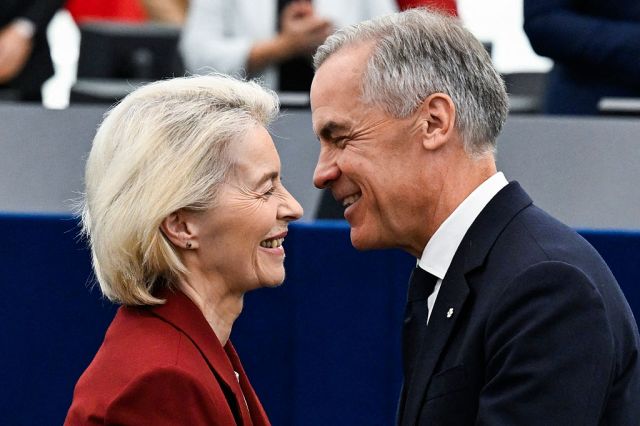
Characters without qualities. (Jean-Christophe Verhaegen/AFP/Getty)





One of the greatest works of Central European literature is The Man Without Qualities. Set in the lead up to the First World War, Robert Musil’s unfinished novel depicts a society sleepwalking into catastrophe. The main character is Ulrich, who became involved in what Musil called the “Parallel Campaign”: a doomed pre-war initiative to plan the Austrian Emperor Franz Josef’s 70th jubilee, scheduled for 1918. The campaign gathered intellectuals and aristocrats engaged in deep discussions about culture, philosophy and national glory — but history intruded on their plans. Austria-Hungary was about to enter a war it was eager to fight, but for which it was not prepared. Franz Josef died in 1916, and the First World War ended with the break-up of his ancient empire.
In Musil’s writings, I see parallels with today’s Europe. Our time, too, might one day be known as a pre-war era. After all, if Germany was the up-and-coming power in 1914, China is today. The UK was then the biggest global power, like the US today. The equivalent of the Austro-Hungarian Empire in 2026 is Russia: a once-great power in terminal decline. In hindsight, one of the omens of the First World War was the emergence of political and military alliances that were intended to protect but which ended up becoming conduits of war — such as Germany’s alliance with Austria, Russia’s with Serbia, and France’s with Russia.
The alliance between the EU and Canada — which was strengthened last week, when the EU proposed that Canada somehow become its first “associate member” — is militarily not as consequential as those that led Europe to the killing fields. Yet it has something of their essence. It has a certain Musil-like quality too — just another parallel campaign in a world soon to be extinguished.
Mark Carney likes giving spine-stiffening speeches in defense of the passing multilateral order, while Ursula von der Leyen, president of the European Commission, poses for as many photos with Volodymyr Zelensky as possible. But surely, like Musil’s dreamers, both Carney and von der Leyen have more important things to do? For the EU is not a global power, but something much more down to earth: a customs union and a single market, plus a monetary union among most of its members. These three functions are the only ones that ever mattered. Yet instead of focusing on the EU’s core economic problems, where she has the power to bring about change, von der Leyen is engaged in a performative dance with Carney.
The Canadian prime minister, too, has unresolved problems at home. Canada’s biggest trade barrier is not the one with the US, but its own internal system. Canadian provinces are like medieval European fiefdoms, imposing trade barriers against each other. It is a vast country, but it is not a single market. Why not solve that problem first?
So the issue with the EU-Canada pact is not so much that it is wrong, but that it is vacuous, or, as, Musil would put it, without qualities. In 2014, the EU and Canada signed a trade deal, the Comprehensive Economic and Trade Agreement, or Ceta, which took provisional effect in 2016. Ten years later, this treaty is still not formally approved, because 10 EU countries, including France and Italy, have refused to ratify it. If you are really interested in solidifying the EU-Canada relationship, would you not start there? My theory is that von der Leyen and other politicians are simply bored with the single market, and find a G7 or G20-type set up far more glamorous.
The UK-based European Council on Foreign Relations, together with the Netherlands-based European Cultural Foundation, recently published a poll that found 70% of Europeans were euroskeptic. I was not in the least surprised by this result, but it came as a shock to the authors, who subsequently recommended that the EU engage in even more performative stunts. They wrote that to foster pro-European attitudes, Brussels should harness “the power of future nostalgia, or a longing for a time when a better future seemed within reach”. In other words: keep your eyes off the ball for a little while longer, while appealing to our glorious past.
The stunt with Canada is about exactly that — nostalgia for the age of globalization that has now vanished. Canada and the EU entered the new era of globalization as second-rate powers, led by third-rate politicians, but they ended up being the big winners. I still recall the uncritical British deference to Carney when he arrived as governor of the Bank of England. He was the highest-paid central banker in the world at the time: apparently he needed the money to send his children to a private school. This all happened in 2012, an age when non-doms, now an extinct species, roamed the streets of Mayfair. This is the world Carney wants to return to — the world he knows.
The obvious problem with Canada’s aspiration to become an “associate member” of the EU is that no such membership exists. Veterans of the Brexit debates may recall that the EU only offers a fixed number of external relationships — and Canada currently has the same deal as the UK (except with more maple syrup).
Nor is full Canadian EU membership possible, since membership is limited to European countries only. The 10 member states that refused to ratify the Ceta trade deal will almost certainly not ratify that EU-Canada association agreement. So what are Carney and von der Leyen even discussing?
There are ironies here too. I found it deeply comic when I recently heard Carney speaking about sending a special envoy to the EU to discuss co-operation on areas including AI and defense. There is practically no AI work going on in Europe — except for lots of people hyperventilating about US tech companies. Besides, Nato, the defense alliance that ties Canada and most EU countries together, already exists. In other words, there is absolutely nothing in this hot-air balloon of a “pact” that could not be had down here on Earth. (And no, you don’t need an alliance to relax restrictions on freedom of movement.)
If the EU and Canada were really serious about safeguarding their waning global influence, perhaps they should start by addressing their joint dependencies on the US in a more strategic way. Canada and Europe both run large and sustained current-account surpluses against the US. The two nations have built industrial structures on the assumption that the Americans would forever tolerate the trade deficit and global imbalances that sustain them. Even in the highly unlikely scenario that Canada were to gain full EU membership, this would not reduce its dependence on the US for imported goods.
On my list of the 10 most important initiatives the EU needs to take right now, in other words, a closer relationship with Canada doesn’t even feature. Instead, my top suggestions would be for the EU to reopen the closed diplomatic channels with Moscow to ensure that it plays a role in the governance of post-war Ukraine; to recognize the dangers of a financial crisis that over-indebted European countries like France have exposed themselves to; to ditch the anti-tech regulation and many other bureaucratic hurdles the EU has imposed on business in the last decade; and to create a fledgling capital-market union, so that Europe’s large pool of savings are channeled into domestic investments. I can think of many more ambitious things, but that would be a good start.
Besides Canada’s “associate membership”, fast-tracking Ukrainian EU membership is the other delusion of European politics. The EU does not have the money for it. And Ukraine is moving further away from meeting the formal criteria for joining, sinking deeper and deeper into corruption. Neither von der Leyen nor Zelensky are doing the work to change things. Instead, they are content merely to act upon the world stage. And that’s what this is really about: acting. If only Musil were alive today: he would have a lot of fun with these characters without qualities, and their mystifying parallel universes.
