




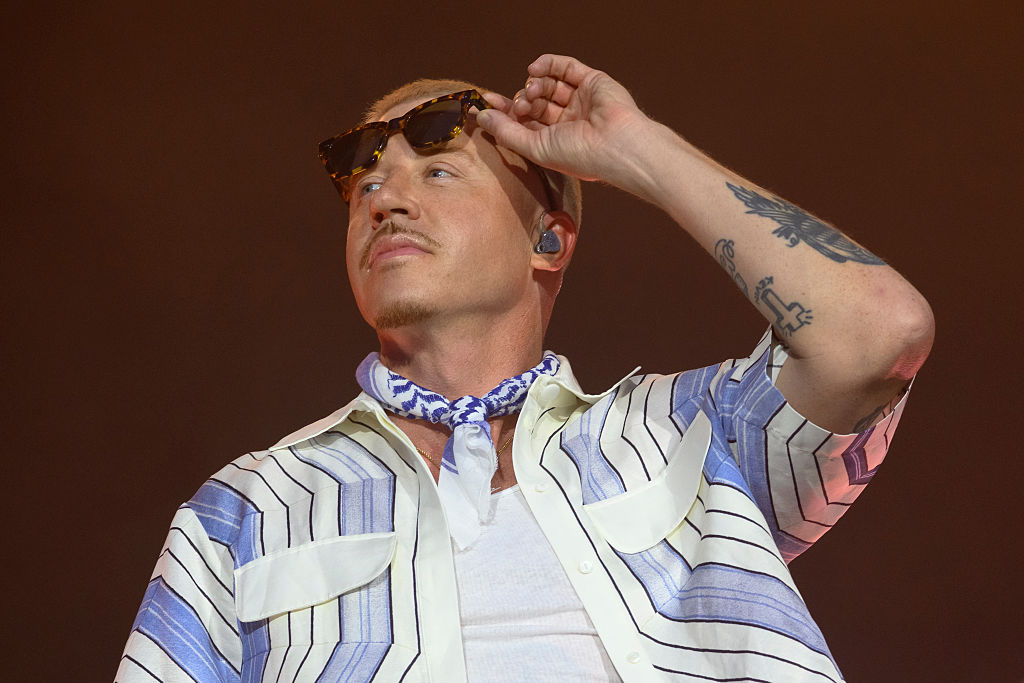





September 15 2026 - 1:00pm
Yesterday, the rapper Macklemore announced via Instagram that he had been dropped from Ed Sheeran’s US tour over pro-Palestine remarks onstage. He had previously performed his 2024 song “Hind’s Hall” — a tribute to Hind Rajab, a five-year-old Palestinian girl killed by Israeli forces in Gaza that same year — and expressed solidarity with inhabitants of the occupied West Bank.
Following those comments, groups such as the Israeli-American Council called for Macklemore to be removed from the Sheeran tour. Last week, the singer Pink responded by invoking her own Jewish identity and criticizing Macklemore’s rhetoric, while also drawing attention to a 2014 performance in which he dressed as a caricature of a Jew. The episode was blatantly antisemitic, much as appearing in blackface would be deeply offensive. While the rapper apologized at the time, and the Anti-Defamation League accepted this apology, it’s interesting that a little over a decade ago there was no comparable campaign to have his appearances canceled.
Macklemore argues that his pro-Palestine stance is not political, only humanitarian. But he plainly is taking a political position — just as his pro-Israel critics clearly have their own political aims. Does that mean it’s fair to kick him off Sheeran’s tour?
Critics are right to point to Kanye West’s ongoing US tour. Some of the venues, such as the Raymond James Stadium in Tampa, objected to Macklemore’s involvement despite only a few months earlier hosting West, who has threatened to “go death con 3 on Jewish people” and praised Adolf Hitler in the past. Naturally, this invites the charge of hypocrisy, and bolsters the view that objections to Macklemore’s statements aren’t about anti-semitism or Jews in general but instead about the state of Israel.
On the one hand, support for Palestine has long been a near-default position in progressive circles, a trend supercharged by Israeli military action in Gaza following the October 7 attacks three years ago. Yet in the ostensibly Left-wing industries of music and the arts, being vocally pro-Palestine still makes individuals vulnerable to professional punishment. For example, the Mexican actress Melissa Barrera was fired from Scream 7 in 2023 for a series of Instagram posts that compared Gaza to a concentration camp. Last month, the actor Mark Ruffalo was accused of antisemitism after criticizing David Ellison’s support for Israel and accusing Oracle of helping facilitate what Ruffalo called “genocide”.
This reveals the difference between public opinion and institutional power. Cultural spaces also function as commercial enterprises with investors, sponsors, donors and billionaire owners. This makes them vulnerable to pressure campaigns if the bottom line is affected by politicized controversies. Ironically, Macklemore’s removal from the Sheeran tour arguably lends him more political bona fides than if he had simply performed his set and shouted “Free Palestine”. The cancellation itself becomes evidence for his argument that there is a meaningful cost to expressing Palestinian solidarity within mainstream cultural spaces.
This isn’t just limited to the threat of “cancellation”. The Israeli government has this month threatened to revoke the citizenship of filmmakers Yuval Abraham and Rachel Szor for “committing treason”. The trigger for this is the pair’s new documentary NAZA, which is based on interviews with dozens of Israeli soldiers and intelligence officers and alleges that the Israeli military has deliberately targeted Palestinian civilians.
Taken together, these cases do not put Israel’s advocates in a good light. It becomes easy to accuse them of attempting to stigmatize moral and political opposition to the Israeli military, something done in the name of combating antisemitism but which can also serve to protect the reputation of the state of Israel. Without meaning to, they make free speech martyrs out of the likes of Macklemore.
Ralph Leonard is a British-Nigerian writer on international politics, religion, culture and humanism.
 buffsoldier_96