




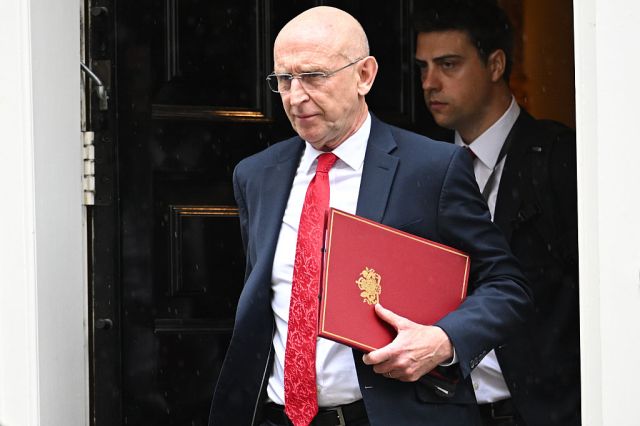
Healey has committed to those totemic fiscal rules, under which Britain, uniquely among advanced economies, has imposed an IMF-style program on itself. (Photo by Leon Neal/Getty Images)





Another week, another depressing update on the state of Britain’s debt, with public-sector borrowing rising to an eye-watering £18.3 billion in August. Little wonder that Kristalina Georgieva, head of the International Monetary Fund (IMF), now proclaims that politicians must make cuts with courage — and that John Healey and Andy Burnham have adopted equally robust language around “responsibility” and “discipline”. Just yesterday, the prime minister conceded that the country was in urgent need of a far more “streamlined, productive” state.
About time. For Britain now lies close to a full-blown fiscal crisis, as public debt has been ratcheted up in several giant steps since the 2008 crash. Whatever Burnham’s fine words now, indeed, successive governments have long demonstrated remarkable degree of fiscal incontinence, whether that’s bailing out RBS or spending £70 billion on pandemic-era furlough. The result has driven up long-term borrowing costs — at 5.3%, 10-year rates are at their highest in nearly 30 years — crowding out the fiscal space for necessary public investment. Interest payments on UK debt alone are now approaching 4% of GDP.
How did we get here? The Chancellor is not wrong when he says that the UK used to be famous for getting “its house back in order when things go wrong”. The last example of an actual government default was back in 1672, when King Charles II suspended payments on debts owed to English goldsmiths as the kingdom’s profligacy began hampering the public finances. With war against France heating up, and a financial crisis in full swing, the Bank of England was established in 1694 to reform the state’s monetary system and support the management of government debt and borrowing costs.
Admittedly, British public debt was regularly racked up in wartime, when resources needed to be mobilized quickly. But an awareness of the need to borrow in future meant that after each splurge — in other words when peace was agreed — the Exchequer worked to move public finances into surplus: whether by spending cuts, or tax rises, or both. This ongoing commitment to stable finances, or “sound money”, underpinned Britain’s access to debt markets and nurtured low borrowing rates for centuries.
This fiscal orthodoxy wouldn’t survive the 20th century. A sequence of fiscal deficits in the Seventies led to the September 1976 crisis, when James Callaghan’s Labour government was forced to apply for a $3.9 billion loan from the IMF (some $23 billion in today’s money), with long-lived consequences for the country’s financial reputation. Though overall debt was considerably lower in 1976 — at just under 50% of GDP, compared to 94% now — interest payments on that debt were nonetheless approaching that magic number of 4% of GDP. Thankfully, a sustained debt consolidation followed, with the debt-to-GDP ratio duly falling to around 30% by the turn of the century.
Over more recent times, however, and encouraged by the seemingly blank check that years of ultra-low interest rates implied, governments have come to the rescue of banks, bond markets and households to the tune of billions of pounds. Public debt is unsurprisingly expected to hit the £3.5 trillion mark by 2030, representing around 95% of GDP. Worse still, these interventions have not kick-started the economy, or indeed provided the services and infrastructure needed for a modern country to prosper. To that extent, Britain’s addiction to debt has acted less like a springboard and more like a somnambulant pillow.
Little wonder that the bond markets have become so concerned about Britain’s ability to manage the public purse, further pushing up borrowing costs in the face of global shocks and our own domestic maelstrom. Whatever the complaints from people like Burnham — who, despite now softening his tone, has previously claimed that the vigilantes are undemocratic arbiters of the nation’s fate — any excess market sensitivity simply mirrors Britain’s fiscal woes. If the Government’s economic position were more credible, the vigilantes would cut us some slack.
Nor has Britain helped itself when it comes to more specific policies. With the establishment of the Office of Budget Responsibility (OBR), after all, the Treasury seems to have become little more than the Government’s policy cheerleader — vacating its former role as a “critical friend” seeking to correct policy errors and nurture growth. Not unrelated, Whitehall’s relaxed attitude to raising debt means the Treasury has an incentive to see inflation as the way out of our fiscal mess. Yet if that reduces the value of Britain’s elephantine debt, it soon sparks other challenges, not least in the weekly supermarket bills of millions of ordinary people.
The Burnham government must take its share of the blame as well. The prime minister’s commitment to Labour’s 2024 manifesto, precluding changes to income tax or VAT, has been an ongoing sore, especially as spending commitments never seem to be matched by spending cuts (the pension triple lock, for one, looks as immovable as ever). That’s even as Healey has committed to those totemic fiscal rules, under which Britain, uniquely among advanced economies, has imposed an IMF-style program on itself, precluding room for economic maneuver let alone a substantive discussion about the appropriate objectives for fiscal policy.
The bitter irony, here, is that, for all its theoretical sternness, the OBR has done little to steady the economic ship in practice. Changing countless times since the Coalition founded the Office in 2010 — leaving the bond market to merely guess at what comes next — the fiscal rules have in any case obviously been “honor’d more in the breach than the observance”.
For instance, the rules currently impose an expected reduction in public debt over the next three years. But that does little to constrain debt in earlier years, while acting to squeeze the policy debate into one arbitrary and imaginary number. Basing everything on forecasts has also increased the incentives for political game-playing: why would a Chancellor worry about their accuracy today when they may not be in post tomorrow? The result is a painfully short-termist policy environment, one where managerial KPIs are lauded over the fundamentals of building state capacity and encouraging a more stable financial climate for private investors.
How then do we get ourselves out of this self-imposed mess? It won’t be easy, but there’s plenty Healey and Burnham could do. The working principles for any government should first mean committing, over the course of a parliament, to a level of debt that falls materially relative to GDP. Next, debt service payments must be sustained at much less than 4% of GDP, with the aim of giving Whitehall more room for fiscal maneuver.
In practice, of course, that means finally cutting welfare; tackling the triple lock; increasing public-sector productivity; and cutting its workforce. As far as possible, meanwhile, measures to control and reduce public debt should become “timeless” political facts, followed and accepted by any government, allowing future Chancellors to be judged on the same standard as their predecessors. That equally means sticking to the analysis of actual fiscal outcomes, and scrapping those shifting and capricious OBR projections. Let’s be clear about our tax-and-spend priorities, and phase debt reduction accordingly — rather than focusing on “headroom” to the exclusion of sensible policy initiatives.
It would also help if Britain stopped relying on foreign assessments of the economy. Every year, the IMF in Washington DC and the Organisation for Economic Co-operation and Development (OECD) in Paris produce two each. Just this week, indeed, the OECD warned that the UK would grow slightly less than expected next year, piling ever more pressure on Healey as his first Budget looms. Unfortunately, and whatever the justification for the unease of people like Georgieva, both bodies are arguably stymied by their limited and inexperienced staff knowledge of the UK. Certainly, developing its own home-based independent public assessments, perhaps drafted by a research institute in conjunction with market and industry experts, would allow Britain a more rounded and authoritative assessment of the state of the economy.
That, in turn, might finally allow more thoughtful public discussion of the big economic questions of our time. What, for example, might happen if debt continues to remain high over the course of this Parliament? How much could things be improved by bolstering productivity? How can we create more stable demand for UK bonds? Getting some answers feels more urgent than ever. After all, the markets don’t have infinite patience, and the day is coming when government failure to cut debt leads to a fully-fledged fiscal crisis — one where a “sudden stop” limits Britain’s ability to roll over debt or access market funds. That would be disastrous for the Government’s fiscal reputation, let alone the countless public services kept afloat on cheap debt.
The way things are going, an emergency of this sort may be the only thing to shake the politicians from their stupor. Either way, we’ll wish we listened to the bond vigilantes far, far sooner.