




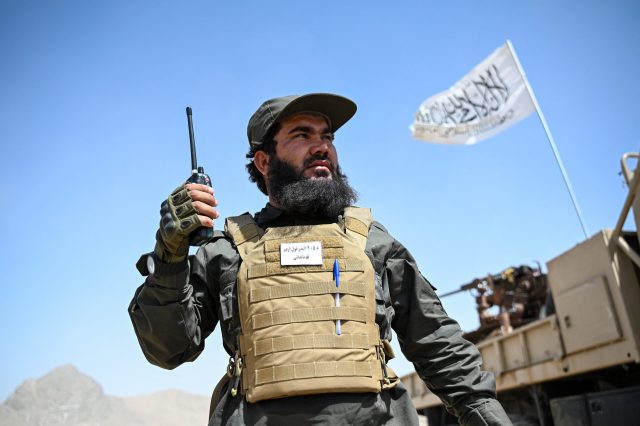
“The Taliban learned from America without becoming American.” (Sanaullah Seiam/Getty)





“Ban, ban, Ca-Caliban! / Has a new master. Get a new man.”
Whenever I see the word “Taliban” I always think of The Tempest. Caliban sings those lines after Stephano gets him drunk and persuades him that exchanging Prospero for another master amounts to liberation. The rhyme may be accidental, but rhymes are rarely innocent once they lodge themselves in the mind. Cognitive psychologists Matthew McGlone and Jessica Tofighbakhsh have identified a “rhyme-as-reason” effect: formulations that rhyme are processed more fluently and can consequently acquire a spurious sense of truth or fitness. Sound, in other words, can tempt the mind into looking for a connection in meaning. The resemblance between the words “Caliban” and “Taliban” proves nothing logically. But it suggests a track where the echo may lead.
Shakespeare’s Caliban — savage, slave, poet and dispossessed islander — offers an unsettling way of thinking about the movement that returned to Kabul five years ago, 20 years after America invaded Afghanistan in response to 9/11. At first sight, rhyme apart, the two names belong in radically different registers. The Taliban — literally translated as “students” — emerged around Kandahar, Afghanistan’s second largest city, in 1994 from predominantly Pashtun religious students and former mujahideen, many formed in the Deobandi madrassas of Pakistan’s Afghan refugee belt. Led by Mullah Muhammad Omar, they exploited popular disgust with the predatory warlords who had divided Afghanistan after the Soviet withdrawal, promising order, Islamic justice and disarmament. With substantial Pakistani assistance they captured Kandahar, swept northwards and took Kabul in 1996, establishing the Islamic Emirate that would shelter Osama bin Laden until its overthrow after 9/11.
Caliban, by contrast, is Shakespeare’s fish-smelling monster who claims the island as his inheritance and succumbs to alcohol in a manner later generations could readily associate with dispossessed peoples in America and Australia. He carries utterly different baggage — indeed, he has been made to carry almost every political burden imaginable. The dramatist Trevor Griffiths, surveying stage interpretations from William Charles Macready’s 1838 revival to the postcolonial productions of the Seventies, finds him successively represented as an “underdeveloped native”, revolutionary republican, Darwinian missing link, black slave and oppressed aboriginal. The retreat of the British Empire transformed the relationship again: Prospero increasingly became the colonizer and Caliban the colonized. Yet Shakespeare scholar Meredith Anne Skura, warning against doctrinaire versions of this reading, insists that the play is too slippery to be reduced to a tract about colonialism. Its very slipperiness is its strength.
Shakespeare does not allow Caliban to remain just a monster. He is certainly capable of monstrosity: his attempted rape of Miranda, with the intention of peopling the island with his own kind, cannot be wished away. Yet while the supposedly civilized characters routinely describe him in terms that diminish his humanity, Caliban himself possesses the most intimate knowledge of the island — its springs, berries, pignuts and hidden resources. A 20th-century Stratford program put the matter bluntly: the island belongs to Caliban “both by inheritance and by right”, because it is he who knows its terrain.
His political claim is equally uncompromising: “This island’s mine, by Sycorax my mother, / Which thou tak’st from me.” By 1904 the radical journalist W. T. Stead could hear in those lines “the whole case of the aboriginal against aggressive civilization”, comparing Prospero’s blandishments to those used by Cecil Rhodes’s chartered company in southern Africa. Over the centuries, the analogy has kept on changing because Caliban himself will not settle comfortably into either category, savage or victim.
Nor does his language. Prospero and Miranda teach him words, expecting linguistic instruction to be part of civilization. Caliban discovers that language can also be an instrument of resistance: “You taught me language; and my profit on’t / Is, I know how to curse.” Yet the same creature who curses Prospero as a tyrant hears music where his supposed superiors hear nothing: “Be not afeard; the isle is full of noises, / Sounds and sweet airs, that give delight and hurt not.” The “savage” is aesthetically receptive to his world in a way that complicates the cultivated ducal exile’s account of him.
Actors throughout the 19th and 20th centuries repeatedly discovered this complexity. One critic insisted that however debased Caliban might be, he possessed “human feelings” and could win an audience’s sympathy. A 1974 production visually divided him between monster and noble savage, while his cry of “freedom” carried more passion than anything else in the performance. Derek Jarman’s wonderfully mannered 1979 film foregrounds this ambiguity through Jack Birkett’s compelling, grotesquely vulnerable Caliban. The repertoire of performances shows how much political meaning can gather around Caliban without being settled.
The rhyme linking “Caliban” and “Taliban” may offer only an acoustic bridge, but the ambiguity is salient. In 2001 the Taliban were expelled from Kabul with astonishing speed. Mullah Omar fled Kandahar on a motorbike. Osama bin Laden escaped into the mountains of Tora Bora. Into the space they left arrived Prospero’s government, and with it came international recognition, constitutions, elections, NGOs, consultants, development targets and, behind them all, overwhelming American military power.
Then there was Ariel. Shakespeare’s sprite is invisible, airborne and astonishingly mobile; when Prospero wishes, he becomes visible to no one but his master. The American version consisted of satellites, drones, special forces, biometric databases and the communications systems through which an immensely sophisticated external power believed it could see and control Afghanistan. Twenty years before Kabul fell, Western forces possessed virtually every technological advantage imaginable.
What they did not possess was Caliban’s intimate knowledge. The Taliban survived in villages, valleys, madrassas, clan networks and cross-border sanctuaries. They understood relationships that could not easily be entered onto spreadsheets: which district commander had quarreled with which governor, which family grievance might be mobilized, which local notable could be frightened, bought or reconciled, when to fight and when simply to wait. They could be brutally coercive, but they were also indigenous to the political ecology in which they operated.
The contrast with America’s Prospero, Ashraf Ghani, was painful. Ghani was among Afghanistan’s most intellectually accomplished citizens: anthropologist, former World Bank official, author of a book on rebuilding failed states. When I met him briefly at a conference in New York, he struck me as one of the most quick-thinking and brilliantly articulate people I had ever encountered. For myself, and many others, he represented the dream that Afghanistan might be reconstructed through expertise, institutions and international capital. Yet the republic over which he presided depended upon foreign money, foreign military power and administrative structures whose authority weakened drastically beyond Kabul.
When the Americans finally left, Ariel vanished with them. Or, to be more precise, Ariel ceased to serve Prospero. Some of his magic changed masters. The Taliban now carry American rifles, fly American helicopters and use Western smartphones.
Yet another Shakespearean echo resonates here. Prospero’s power is inseparable from his books. Cast out of Milan, he remembers Gonzalo furnishing him from his library with volumes “that I prize above my dukedom”. Caliban has learnt the same lesson from below. Plotting Prospero’s murder, he tells Stephano that the first thing to do is seize the books: “for without them / He’s but a sot, as I am.” Then comes the blunt instruction: “Burn but his books! He had brave utensils — so he calls them — which, when he has a house, he’ll deck withal.” Caliban sees that the “brave utensils” are only the outward trappings of power; the real instrument of Prospero’s rule is the knowledge contained in his books. Destroy its source and the magic collapses.
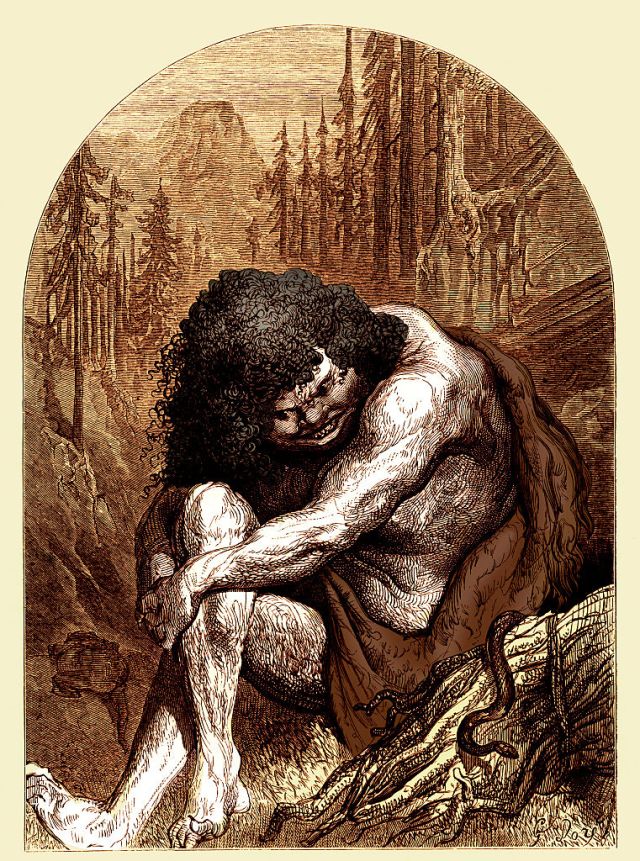
Afghanistan has produced an ironic reversal. The Taliban have seized much of Prospero’s utensils without burning them: rifles, helicopters, smartphones, ministries, uniforms, even some administrative habits. But they have not accepted the assumptions that were supposed to come bundled with the machinery. Prospero’s library is not ornamental: it is the source of the magic that allows an exiled duke to command the island. For the Taliban, ultimate sovereignty belongs to the Qur’an and to the Sharia drawn from it. The discarded utensils of the American imperium may be useful, even indispensable. But the Taliban remain subordinate to a holy Book whose authority the occupiers never displaced.
Washington assumed that modernization would inexorably produce Westernization: that roads, schools, internet connections and elections would carry liberal values. Instead, the Taliban learned from America without becoming American. Caliban has learned to operate Prospero’s machinery while declining Prospero’s metaphysics.
The image should not be pushed too far. The Qur’an is not a magic manual, and Sharia is not reducible to a single book. The Taliban’s jurisprudence also draws on hadith, Hanafi law, Deobandi scholarship, clerical authority and Afghan custom. But as a Shakespearean echo, the contrast matters. Prospero knows that books make rule possible; the Taliban know that technologies can be borrowed without surrendering the textual authority by which rule is justified.
After the American withdrawal five years ago, the Afghan security forces, expensively trained and equipped, dissolved with extraordinary speed. Provincial capitals fell almost without resistance. Ghani fled Kabul for exile in Dubai. Twenty years after being driven into the wilderness, the supposedly defeated barbarian returned to Prospero’s island.
Yet the moral of The Tempest cannot simply be that Caliban was right all along. The play is more conflicted, and Afghanistan more tragic. The Taliban’s claim to indigenous legitimacy does not absolve them of what they have done with victory. Since 2021, they have progressively excluded Afghan women and girls from secondary and university education. They have sought to erase women from large areas of public life, restricted their employment and curtailed their freedom of movement. Meanwhile, Hazaras and other minorities remain exposed to discrimination and violence. Caliban, once restored to his island, may himself become Prospero.
Nor has restoration resulted in prosperity. A recent Afghanistan Analysts Network report describes an economy that contracted calamitously after the Islamic Emirate returned, followed by a recovery so fragile that GDP per head continues to fall. Behind those figures lie families exhausting one survival mechanism after another: savings disappear, possessions are sold, boys leave school, sons are dispatched on dangerous journeys to Iran. Women and children undertake poorly paid work at home or on the streets; the Taliban restrictions on women’s education and employment have denied them escape routes they might otherwise have used.
The result is a grim inversion of development. Families survive today by consuming tomorrow: schooling, assets and earning capacity are sacrificed to the immediate necessity of food and shelter. Yet the report reveals something that is easily missed from Kabul, Washington or London. Afghans do not simply wait upon the state. The social contract of reciprocal help — relatives lending money, neighbors supporting neighbors, families taking responsibility for one another — still operates, though poverty is placing it under severe strain.
Another recent AAN account catches this side of Afghanistan almost microscopically. A 40-year-old Kabul office worker with a slipped disc cannot afford the operation his surgeon recommends. He moves through several worlds simultaneously. He consults modern doctors and has MRI scans; visits hakims who bleed him and prescribe herbal powders; travels to a shrine in Paktia where a mullah ties a tawiz, an amulet containing sacred writing, to his arm; and finally returns to surgery when the pain becomes intolerable.
The story could be treated as an illustration of medical backwardness, but it is more revealing than that. It shows a society whose institutions overlap rather than replace one another: MRI scanner and shrine, surgeon and hakim, religious belief and modern medicine. Most strikingly, when the operation finally becomes unavoidable, formal provision does not rescue him. A friend unexpectedly repays a debt of 200,000 afghanis, enabling him to meet the hospital costs. After surgery he cannot afford physiotherapy, so another friend abroad sends him exercises to perform at home. Afghanistan is full of noises: some of them cacophonous, some of them sweet. This is what Caliban’s knowledge of the island may mean in less romantic language: knowing not merely mountains and pathways but the dense networks through which people actually survive.
Meanwhile the Emir, Hibatullah Akhundzada, governs in Kandahar from something like Prospero’s cell: rarely seen, surrounded by clerical advisers, issuing commands whose authority rests ultimately on sacred texts rather than social or political consent. His Afghanistan is a landlocked “island”. His staff may not be magical, but has the weight of religious legitimacy. The symbolism is not invented by outsiders. At Kandahar’s Khirka Sharif, lines of Qur’anic calligraphy run through the decoration around the shrine that houses the Prophet’s cloak. In April 1996, Mullah Omar carried that cloak onto the roof of the main mosque before thousands of ulema and fighters. The assembled scholars acclaimed him Amir al-Mu’minin, Commander of the Faithful. Sacred text, sacred relic and political sovereignty were made to reinforce one another. A few months later, the Taliban captured Kabul.
Yet while decrees issued from Kandahar have religious authority, they are far from absolute. In reality they encounter the messy density of Afghan society. Families improvise around them; religious practice intersects with custom; money circulates through networks of debt and obligation; people move between official and unofficial institutions according to necessity. The Afghan state may prohibit, prescribe and punish, but it does not exercise a totalitarian type of control. That is another lesson the West was slow to learn: power in Afghanistan has rarely been identical with government. The state may issue decrees, but villages, families, ulema, businessmen, elders and local authorities determine the extent to which they become reality.
Those networks now extend far beyond Afghanistan. For some young men, the escape route leads westwards through a clandestine economy that has become increasingly sophisticated. An Afghanistan Analysts Network investigation found young Afghans traveling through Turkey, Bulgaria, Serbia and onwards towards Italy, France, Germany, Ireland — and Britain. Journeys are arranged through professionalized smuggling networks using GPS, encrypted messaging, TikTok advertising and hawala, the informal money-transfer system built around personal knowledge and trust, that functions here as a kind of escrow account. A passage from Turkey to Italy can cost €6,000 to €8,000; some networks have graduated from facilitation to extortion, kidnapping and violence.
For British readers accustomed to encountering Afghans at the other end of this journey — in debates over small boats and “illegal migration” — the connection is worth making. Europe’s harder borders have not abolished the traffic. In parts of the Balkans they have helped turn what was once a loose diasporic network of guides and fixers into a profitable criminal industry. The young man crossing the Channel may be the final visible link in a chain beginning with the economic and political constriction of Taliban Afghanistan.
And this takes us back to the Bard. The deep ambiguities in The Tempest lie not in deciding whether Prospero or Caliban are good or bad guys. They involve the much more difficult questions about who possesses the right to rule the island, who possesses the knowledge required to rule it, and what happens when supposedly superior outsiders mistake magical or technological mastery for political legitimacy.
Skura’s caution is helpful. She argues that the colonial interpretation can itself become reductive when every difference between Shakespeare’s island and colonial history is treated as irrelevant and every contradiction as further evidence of domination. Caliban lacks many of the stereotypical attributes Europeans assigned to New World peoples, and Shakespeare repeatedly complicates any straightforward identification. Skura’s larger point is that the personal and political cannot finally be separated. Prospero comes to the island as the victim of Antonio’s usurpation, but responds by becoming master over Caliban: the exile who has lost his dukedom recreates hierarchy in miniature. Caliban becomes a screen onto which Prospero projects the appetite and disorder he disowns; mastering him allows Prospero to rehearse the recovery of authority.
The Afghan story reflects a similar pattern of replication. To explain why the Taliban defeated the republic is not to endorse their theocracy. Their rootedness may confer a kind of authenticity without conferring virtue. Conversely, the ideals proclaimed by the international intervention — education, women’s rights, constitutional government — do not become worthless because the political structure erected to protect them proved catastrophically fragile. Nor should “indigenous” be confused with humane. The restored Caliban may now be the ruler, but his regime has deliberately deprived half the island’s population of opportunities that might make their lives less desperate.
The rhyme, then, can still trigger meaningful perspectives. Shakespeare refuses the comforting choice between enlightened Prospero and the uncouth monster. The native claimant may indeed be brutal, lustful and dangerous; he may also know his island better than the civilizer who has taken possession of it. The civilizer may bring books, knowledge and extraordinary powers; he may also mistake possession for legitimacy. And books themselves can serve more than one sovereignty.
At the end of The Tempest, Prospero says something Western policy rarely admitted in Afghanistan. Looking at the creature he has repeatedly called slave, monster and devil, he declares: “This thing of darkness I acknowledge mine.” Even that line refuses a simple interpretation. Does Prospero mean that Caliban belongs to him — the last assertion of colonial possession? Or is he recognizing something of himself in the figure he has spent the play defining as Other? Skura points out that critics have argued both ways: the acknowledgment can be dismissed as another act of appropriation, yet its poetry reaches beyond Prospero’s behavior and momentarily destabilizes the distinction between civilization and darkness.
Twenty-five years after 9/11, Afghanistan leaves us with much the same discomfort. The Taliban are not simply medieval intruders who somehow captured a modern state. They arose from Afghan history, from war, religion and social structures — but also from the violence, alliances and unintended consequences of outside intervention. And the Afghanistan they now rule is not simply “Taliban Afghanistan”. Beneath the Emir’s decrees lies a deeper and denser reality: women sewing for pennies, boys abandoning school for work, migrants sending money home, relatives lending to relatives, doctors scanning spines, hakims mixing mountain herbs and mullahs tying amulets beside ancient shrines. Some of its young men are also moving through Balkan forests, climbing fences or waiting for boats across the Channel. It is battered, improvisatory and profoundly local — yet connected to us in ways British politics notices only when those connections wash up on a Kentish beach.
Ban, ban, Ca-Caliban. Ban, ban, Taliban.
The rhyme itself proves nothing. But perhaps that is why it lingers. It connects two figures whom powerful outsiders prefer to define as barbarous, and asks the disturbing question Shakespeare leaves hanging over his enchanted island: whose island was it in the first place — and what does its owner do with it once he gets it back?