




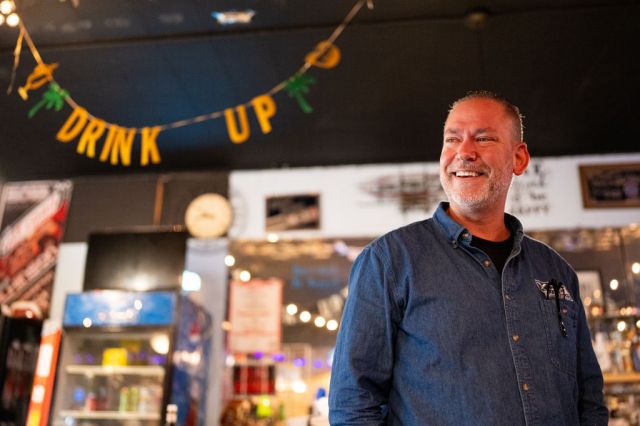
Dan Osborn's recently surfaced comments on the border show a disconnect with working-class voters.





For the better part of a decade, progressive Democrats have desperately sought to recruit working-class candidates able to win back a crucial constituency: blue-collar voters, particularly men. Such potential leaders aren’t that hard to find. The trouble is that the Left — more specifically, a complex of donors, media outlets, consultants, and organizations — can’t actually tolerate working-class values when it comes to cultural questions like immigration, race, and gender.
Call it Progress, Inc.: a machine for advancing full-spectrum progressivism, using working-class aesthetics as a sort of skinsuit, if need be. What the party — and the nation — end up with are politicians who certainly look the part — sometimes connected to the traditional labor movement, comfortable in plaid, tossing a football or drinking beer — but whose substantive views are indistinguishable from those that prevail in places like Brooklyn and San Francisco.
Consider Dan Osborn. Last week, Osborn, the former industrial mechanic and union leader running as an independent for the Senate from Nebraska, was caught on tape calling President Trump’s border wall “a symbol of racism,” and admitting that he only claimed to support it to woo Republican voters. This, needless to say, will likely hinder his ability to lure back the working class and create a path to victory.
Osborn has been promoting himself as antiwar, pro-union, and for breaking up health care monopolies. At the same time, he has sought to portray himself as not woke and aligned with the working class on immigration (which is to say, in favor of restrictionism). He thus fits right into the sweet spot of politics these days: Left on economics, but moderate or conservative on culture and immigration. But if an independent running in Nebraska holds the same views on the border as the mainstream Democratic Party — can he really call himself an independent?
It turns out, those behind Osborn are the same people behind Graham Platner, Abdul El-Sayed, Zohran Mamdani, and many other Lefty and socialist candidates this cycle. All of these candidates are products of Progress, Inc. I once worked inside Progress, Inc. as a leading fundraiser for it before taking the measure of its disconnect with what working- and lower-middle-class Americans actually want.
These behind-the-scenes operatives want to find people with “working-class costumes,” and “masculine images” — not leaders with actual working-class views. Graham Platner was the most obvious example. Before he was #MeToo’d out of the Maine Senate race, the scion of a prominent family checked all the right “image” boxes: bearded, tattooed, with a stint in the Marines under his belt. Another is El-Sayed, whose “bro energy,” his backers believe, is enough to attract disaffected men who’ve left the Democratic Party, with no need to change position on the actual issues that alienate men. Both, however, hold standard-issue ultra-progressive views when it comes to divisive identity politics, among other hot-button issues.
Working-class voters can see through the act. In Maine, Trumpy areas with factory economies tended to support his moderate Democratic opponent, Gov. Janet Mills, while Platner mainly won over the gentry Left. Likewise, El-Sayed has struggled with working-class black Americans, delivering his best performances in places like Ann Arbor, home to the University of Michigan.
These candidates’ views on the economy, to be sure, recall those of the old labor Left and the New Deal coalition. But they come laden with the cultural excesses of the modern Left. So far, they’ve mostly been unable to moderate Leftist positions on trans athletes in girls’ sports, immigration, and law and order, turning off working-class voters of all races.
New York’s Mayor Zohran Mamdani is the rare exception. He reversed his previous #defund position on policing, retaining Gotham’s tough incumbent police commissioner and giving the NYPD a relatively wide berth to do its job. Most progressive candidates aren’t nearly as nimble. El-Sayed appeared on Fox News in August and stood firm on his unpopular cultural stances — trans sports, gender-affirming care for minors, slavery reparations. It was a missed opportunity to highlight his subtly socially conservative positions on widespread weed legalization, online porn, and gambling.
Those who do dissent, like Amy Acton, a Democrat running for Ohio governor, face backlash from the Left. In any case, the dissenters tend to be Democrats in reddish or swing states who are establishment figures, wedded to the economic status quo, and thus facing their own flavor of electability crisis: they are unwilling to run on the bold populist economics that progressives embrace and that appeal to the working class, like universal health care.
Both wings of the party desperately need to compromise, but on different points. The progressives need to rein in cultural excesses, whereas the establishment needs to stop representing the wealthy donors who prevent it from holding populist positions.
Progress, Inc.’s mentality is not to compromise, but to push ideas into the mainstream until “they become popular.” This is what I was told firsthand by some colleagues while working inside progressive politics. The playbook, as I learned, is to go hard in midterm elections, then use that energy to get every presidential candidate in 2028 to run on Leftist causes. The strategy was learned from Rep. Alexandria Ocasio-Cortez in 2018, when she used her popularity and the energy behind her victory to push the Green New Deal, leading a whopping 10 democratic presidential candidates to embrace the idea in 2020.
What groups make up Progress, Inc.? The Democratic Socialists of America have received the most attention, because they have the scary word “socialist” in their organization’s name. But there are many more players at work. For instance, there’s the Justice Democrats, a political group whose main focus over the past decade has been backing insurgent primary challengers. The group endorsed 13 candidates this cycle — and eight of them won their primaries. Former Justice Democrats operatives worked on the victorious campaign to elect Darializa Avila Chevalier as the Democratic nominee for New York’s 13th Congressional District. The organization’s executive director, Alex Rojas, described how she recruited Chevalier to run for Congress during a podcast episode hosted by another Progress, Inc. group called Way to Win, a donor collective that boosts progressive candidates. Outside money unquestionably propels these candidates.
Then there’s the group that advised Platner’s campaign: Daniel Moraff (who recruited both Platner and Osborn to run for US Senate) and Rebecca Katz and Morris Katz, co-founders of Fight Agency, all of whom are emblematic of Progress, Inc. Moraff is the grandson of the founder of Toys ’R’ Us, and Morris Katz, raised in New York’s Tribeca neighborhood, is the son of a screenwriter father and children’s-book-author mother. When I was inside Progress, Inc., I worked with Rebecca Katz on a New York City district-attorney race. A fundraising firm where I served as a director worked with Morris Katz on a race in North Carolina in 2022. There’s also Left Rising, a fundraising firm, where I worked as a director, and Middle Seat, a huge small-dollar fundraising firm that has worked with nearly every Progress, Inc. candidate this cycle, among many others. What I saw was a total disconnect between those now steering the direction of the Democratic Party and the people it once stood for.
How ‘Progress, Inc.’ neuters the working class
Before Platner’s campaign imploded in July, Morris Katz was documented speaking to donors at the home of Tory Burch, where he was “holding court with roughly two dozen prominent guests about what he cast as a repeatable solution for Democrats,” according to Politico. He told the crowd, “We found a model here to win over working-class voters … a guy that looks like he’s a union working-class guy.”
This line of thinking was one of the main reasons I became exasperated with many of the people I knew when I worked inside Progress, Inc.
Since 2019, I’ve witnessed this as the prevailing strategy, which I believe was born out of AOC’s upset win in 2018 and the creation of The Squad. Identity politics is such a deep, pathological undercurrent in the way they see themselves and the world; it would never occur to them to find candidates with actual working-class views.
To be fair, I probably did the same thing when I was working in progressive politics. When you are inside of Progress, Inc., it is hard to see outside of it. You begin to parrot the people around you, thinking that it is you and your friends against the world. At times, I still sympathize with them. I have always supported people willing to challenge power structures, which, to the progressives’ credit, they do often.
Still, the movement’s thinking is fundamentally flawed. As I wrote in my recent book, Nothing Left, I first realized it over lunch at the “Dems Club” in DC, a private restaurant for Democratic politicians and their staff, where I was dining with two new co-workers. I believed we were there to represent working-class voters like my own mother and grandmother in Missouri. My co-workers wore Tory Burch dresses and talked about vacationing in Europe and Hawaii, while giggling about fighting for student-loan forgiveness on Capitol Hill. I felt profoundly alienated.
Many of the consultants inside Progress, Inc. are highly competent and talented people, including Morris Katz. They are a big part of the reason the Left is now so strong. But they are also part of the reason the Democratic Party won’t reconnect with working-class voters. The establishment has its own problems and is equally out of touch, but shouldn’t the anti-establishment be the solution to this problem, not adding to it?
Which brings us back to Osborn’s border crisis: I thought he represented the unique mix that could become the Democratic Party’s North Star — a bold outsider who leads on populist economics, while eschewing woke themes. While leading a union strike at Kellogg’s in 2022, Osborn even allegedly helped alert ICE when undocumented workers were being used as scabs. But winning back the working class, like Osborn’s candidacy seeks to do, can only be done by offering ideas that appeal to them — and that means championing their views on issues like immigration.
Neither wing of the Democratic Party is giving working-class voters what they really want. That leaves a huge constituency without a political home. Trump’s current doldrums may suffice to clinch the midterms for the Democrats. But that won’t resolve the party’s deeper contradictions.
Evan Barker is a former Democratic campaign operative and the author of the New York Times best-selling book Nothing Left.
 evanwch