




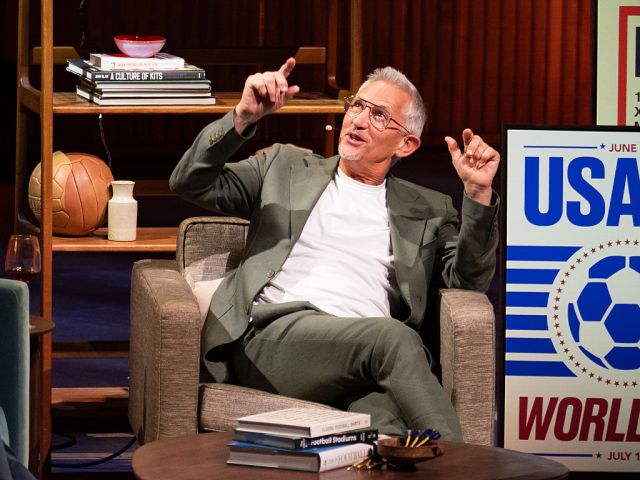
Gary Lineker believes in good manners. (James Klug/Getty)





The Southbank Center has hosted many great cultural events over the years. In 1951, the Festival of Britain almost single-handedly dragged British art out of its postwar slump. In 1958, Ravi Shankar gave the British classical music scene its first taste of non-Western composition. Pink Floyd played here in 1967; so too, in 2002, did David Bowie. But seldom in the Southbank Center’s history can it claim to have captured a cultural turning point as completely as it did last weekend. By the time I arrived on Sunday morning, the place was already overrun: thousands of visitors, hushed and expectant, streamed in from Charing Cross and Waterloo stations, like pilgrims on some kind of home-counties Hajj. They had not come to encounter the work of some feted new contemporary artist, or vaunted new writer, or hot new musician. They had come to listen to podcasts.
“The Rest is Fest” is a three-day live podcasting event organized by Goalhanger, the media company co-founded by Gary Lineker in 2014 that is currently the largest producer of podcasts in the UK. Its most popular podcast — The Rest is History, in which co-hosts Dominic Sandbrook and Tom Holland chattily extemporize their way through some genuinely fascinating material, from the Costa Rican Civil War, to the truth behind the lost city of Atlantis, to history’s “Top Ten Eunuchs” — boasts nearly 20 million downloads per month. Close behind is The Rest is Politics, hosted by Alastair Campbell and Rory Stewart, with over 10 million; and even the least popular shows in the Goalhanger stable have listener-counts comfortably in the millions. Last year, Goalhanger turned over nearly £38 million, making it the UK’s fastest-growing private company. All in all, its podcasts were listened to three quarters of a billion times.
Who, exactly, are these listeners? Before attending, I had naïvely assumed that most of the patrons of The Rest is Fest would be people with a huge, insatiable interest in one specific thing, for whom Goalhanger was simply catering to a pre-existing need: men in anoraks for The Rest is History; culture vultures for The Rest is Entertainment; super fans for The Rest is Football. But in fact, most of my fellow audience members seemed to view Goalhanger as something more akin to the heir to mainstream mass entertainment, navigating instinctively to any podcast with “The Rest is…” in its title in the same, thoughtless way people once flicked on BBC One. One woman I spoke to claimed to listen to all the Goalhanger offerings: “I barely listen to music at all these days,” she said proudly. Several others admitted that they barely even bothered with non-fiction books any more — which one suspects might have something to do with the fact that last year, non-fiction sales reached their lowest levels since 2014.
How concerned should we be about this transition? Most of the listeners I spoke to were pretty confident in the mind-sharpening power of their podcasts. One gentleman explained to me that his days used to be filled with “dead time”, whereas now he could spend every minute of every day learning — most recently via a five-part The Rest is History special about the Troubles in Northern Ireland. When I asked him what he had learned from his eight or nine hours’ immersion, he gave me a panicked look. He couldn’t remember too much, he admitted. But Dominic Sandbrook did do a very funny impression of Ian Paisley.
I suspect this episode might be more revealing than the attendees of the Rest is Fest would like to admit. Podcasts are, as a form, curiously Lethean: you can sit through hour after hour of some “deep-dive” on the battles between the Scythians and the Persians, and still end up with no idea where the Scythians were from, or when the Persians lived, and what they were even fighting about anyway. Walter Ong, the great theorist of the differences between oral and literate cultures, gave a useful description of what might be happening: in oral forms, certain prominent features of written narrative — detailed chronologies, scientific facts, complex causal relationships — are difficult to transmit. What the listener tends to take away from oral forms, instead, are intangible convictions of character and vibe. Modern historiography becomes great-man history; political science gives way to slogans and formulas. In the land of the podcast, simplicity reigns.
Massive simplification and sloganeering was certainly the order of the day at the Rest is Fest. In the case of the live recording of The Rest is Politics: US, hosted by the US-based journalist Katty Kay and Donald Trump’s notoriously short-lived communications director Anthony Scaramucci, this made for rather good fun. Scaramucci was on fine form, flitting between CNN-style Trump-bashing and winning self-deprecation (“my hair is what they refer to as ‘Latin-American-dictator-brown’”). Kay, meanwhile, gamely fielded the questions the audience had submitted via the massive QR code that loomed above the stage — “Kiss, marry, kill: Vance, Rubio, Trump?” — to all kinds of happy braying from the audience. But by the time I got to the live recording of Empire: World History, a kind of orientalist spinoff of The Rest is History hosted by Anita Anand and the kurta-clad William Dalrymple, things were more fractious. At one point, when the discussion turned to the Iranian Shah’s son Reza Pahlavi, a woman near the front got up and started screaming: “He’s our only hope! Our only hope!” Soon, the word “Israel” had been mentioned, and the whole room had descended into boos and hisses, and any hope of “disagreeing agreeably”, as The Rest is Politics’s own self-congratulatory slogan has it, was lost.
In fact, the more time I spent at the Rest is Fest, the more I began to wonder whether there might not be something slightly paradoxical about the whole Goalhanger project. On the one hand, the podcast as a form obviously favors a certain, simplified, vibes-based conception of the world, that turns all manner of technical disputes into highly personal confrontations. The Rest is Politics interview format, for instance, encourages its listeners to ascribe every policy proposal to a nice, relatable human face. This has some value: political discourse in the UK can tend towards the bloodless and the pedantic, and if the ultimate consequence of companies like Goalhanger is to bring a bit of antagonism back into the political and intellectual discourse of this country, to induce more people to stand up and shout at the mandarins in front of them, to remind people that the rules and procedures by which they are governed might depend on acts of human will, then they can be considered, at least in some ways, a success.
Except, of course, antagonism and truculence are the very things that the Goalhanger project claims to be trying to expunge from the discourse. After all, if there is one feature that unites the Goalhanger brand, it is a stated commitment to politeness and civility — a conviction that however strenuously people might disagree with each other, they can always adhere to the rules of bourgeois etiquette while doing so. Lineker has actually singled out this dogged commitment to good manners as the reason for the company’s success on several occasions: “There is so much tribalism and division,” he said in a 2023 interview, “it feels as if those who shout loudest get the attention.” His co-founder, Tony Pastor, agreed: “We don’t have people shouting at each other from different positions. We always try to maintain a civility of tone: our phrase is, ‘We disagree agreeably.’” Which, of course, begs a question: if the podcast as a form favors one mode of expression, and the founders of Goalhanger favor another mode of expression, then which of them will win the eventual tussle?
By the time I settled in my seat for my final stop of the day — the live performance of The Rest is Politics in the Royal Festival Hall that was to cap off the Rest is Fest weekend — it had begun to dawn on me that the real reason why the “Rest is…” brand seems to work so well is because what its partisans tend to refer to as “agreeable disagreement” is actually something else entirely. Up on the stage, the hosts chattered on predictably for a while: Rory Stewart apparently angling for some kind of Nick-Clegg-style Silicon Valley sinecure; Alastair Campbell unable to resist a little barb at the media about their hounding of Jason Arday, apparently forgetting some of the media-hounding he had partaken of himself. But it soon became clear that the real excitement was to be supplied by two very special guests: one Israeli and one Palestinian, who had, despite their bereavements, collaborated together to form an NGO.
Together, the guests mounted the stage and embraced Campbell and Stewart warmly, to a smattering of cheers up in the circle. Then they embraced each other: there were howls of approbation now, filling the hall, from the orchestra pit to the concrete rafters. One of them was passed a microphone; he said something about “working together”, I think, though I could barely hear through the tsunami of applause. The microphone went to the other speaker: he said something about “building bridges”, but it was drowned out by a hoot behind me. The atmosphere was far from “agreeable” now, the audience climbing to their feet, whooping and hollering like they were at a pantomime. But this wasn’t exactly “disagreeable disagreement” either. How could it be, when everyone in that hall, everyone at the festival, everyone listening remotely over the airwaves, everyone in the entire Goalhanger family, agreed with each other already?