




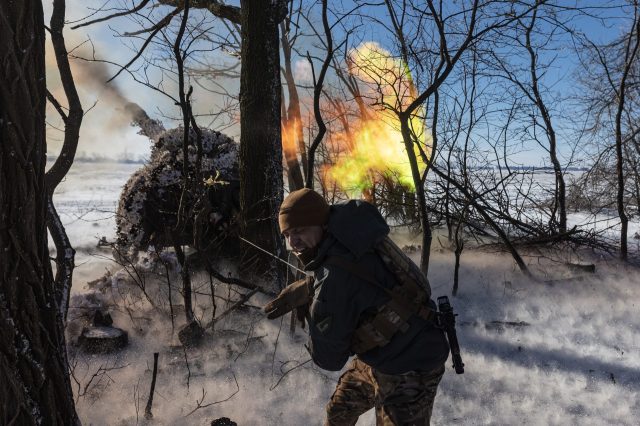
Soldiers don't win wars. (Anadolu/Getty)





They’re everywhere, those retired generals and grand officials who keep on briefing about Ukrainian advances and successes in the current conflict. Mark Rutte was at it only last week: “Putin is in a bad place,” he said. “He is not winning the war.” And yet, just the other day, Denmark warned Europe to prepare for an imminent Russian attack. It’s like they can’t wait for the great war to finally kick off.
Certainly, Radoslaw Sikorski, the Polish foreign minister, is prepping for it. “I have stocks of rice, I have a hand pump at home, and I have also made preserves from fruit from my own garden,” he told the Polish magazine Fakt last week.
It is easy to mock Sikorski and his jam. But he does have a point. In times of war, nobody cares about the percentage of GDP that their country is spending on defense: they care about food and water. Not that our military leaders and planners will listen, though; soldiers like to talk about battles and gear, not rice and jam.
Tales of heroic battlefield victories are far more persuasive, after all, than those of supply chains. And yet, defeat often comes because of weakness elsewhere. A few years before Napoleon lost his famous battle at Waterloo, he had launched a disastrous attempt to invade Russia. Although the brutal winter contributed to his failure, Napoleon had struggled to keep his troops fed and healthy. Hunger and disease took a terrible toll. As much as the enemy, it was his supply chains that thwarted him.
Likewise, when the German high command unveiled its master plan to invade France in August 1914, the generals hadn’t factored in an unexpected heatwave. The right wing of the German army was to invade France from the north and encircle Paris. But the soldiers were marching in thick woolen uniforms and carrying heavy backpacks in 30-degree heat. As the men advanced, the supply lines fractured leaving the troops exhausted, hungry and weakened.
Meanwhile the Allied naval blockade of 1914 triggered food shortages in Germany which escalated over the years into a full-blown humanitarian catastrophe. Germany and Austria did not lose the First World War on the battlefield alone, they also lost it in the warehouse and the kitchen. The people starved.
The food situation was better during the Second World War, but this time the critical shortage was of oil. Back then, the US produced over 60% of the world’s oil and together, the Allied powers controlled most of the global oil supply. But the German generals were heavily reliant on machinery that used diesel and the chronic shortage of oil was why Hitler diverted his troops from the outskirts of Moscow to the south of Russia: to capture the oil fields in Azerbaijan and the Caucasus. En route, they became trapped in Stalingrad and suffered their worst defeat of the Second World War.
The battlefield perspective of history, then, critically underestimates the importance of supply chains. The stories of Europe’s wars are understood much better in terms of logistics than in tales of battles.
And nothing has changed. One of the consequences of the Iran war is the fluctuating cost of crude oil. But that is only part of the story. As the Ukraine war has led to critical shortages of diesel and kerosene on global markets, the price of European diesel has gone through the roof. In a display of his classic short-termism, Donald Trump suggested that the US should stop supplying Europeans with diesel. He almost certainly did not think this through. If the US were to carry out his plan, Europe would suffer an immediate supply emergency. And we need only look at the vast number of diesel-powered lorries on European motorways to realize how critically reliant we are on the fuel. The economy would grind to a halt. It might be a smart idea if our leaders addressed that situation before heading into battle with the Russians.
But it’s not just diesel. The other shortage is natural gas. Iranian attacks have taken out 17% of liquid natural gas (LNG) production in Qatar, the world’s second largest LNG producer after America. Russia is the fourth — but Europeans have imposed an import ban on their gas. That’s why Europe is currently assessing whether it has enough fuel to get through the winter. And remember, this is still peacetime.
On the other side of the ledger is Russia. It, too, suffered from a diesel shortage last spring after Ukrainian attacks on its energy infrastructure. But Moscow immediately increased production in the east and halted exports of diesel to stabilize the situation. By doing so, Putin reduced the globally available supply of diesel and contributed to the rise in prices.
Russia’s food supply is also secure. This year, it had a bumper crop of grains, the wheat crop is forecast to be one of the best on record and oilseed production is also better than usual. Is this the “bad position” Rutte was talking about?
And let’s not forget those other vital commodities: good, old-fashioned money and debt. Russia is practically debt-free. It runs a small fiscal deficit because of the Ukraine war, but nothing compared with the crippling deficits of the US, France, and nowadays also Germany.
As a consequence, the West is vulnerable to a potentially crippling financial crisis. Last week, the interest rate on 10-year US Treasury bonds, the most important financial security on earth, rose to a 21-year high of 5.2%. Ordinary investors such as pension funds are dumping their US bond holdings because they are no longer secure following Joe Biden and Donald Trump outbidding each other in terms of fiscal irresponsibility.
All the while, the war in Ukraine drags on. And could get much worse this winter. The peace process is effectively dead; Putin gave up on it after Ukraine rejected his demand for the entirety of the Donbas region and is now determined to achieve his military goals by war alone. Ukraine is running short of interceptor missiles and so is more vulnerable to attacks on critical infrastructure. And there is no sign of Ukraine’s western supporters stepping up military supplies — if only because they need what they have for themselves. Exacerbating the situation in Europe are the attacks, possibly orchestrated by Russia, on western supply infrastructure for Ukraine within Germany and Poland.
So this is how the Ukraine war risks escalating. Consider if Russia shoots down a plane over Nato territory carrying supplies to Ukraine. If Nato were to retaliate with a strike on Russia, we would be at war. Over the past few months, my assessment of this scenario has shifted from small but non-trivial, to one with a significant probability.
We should be under no illusion about a war with Russia. We are absolutely not in a position to win. Whose bond markets are going to be blown up first? Who is going to run out of interceptor missiles first? Thanks to the much maligned Common Agricultural Policy, Europe is not going to run out of food. But on every other count — military, energy, finance — Europe is at a disadvantage.
That’s not all. There is a relatively plausible scenario in which Ukraine and Iran merge into a single West Eurasian war — and become the ultimate proxy conflict between the US and China. The love-in between Trump and President Xi Jinping of China notwithstanding, the rivalry between the US and China is and will remain the dominant geopolitical story of our time.
Trump’s war against Iran and Putin’s war against Ukraine have demonstrated how difficult it is even for a larger power to impose its will on a smaller adversary. Putin may have the advantage over Ukraine, but his struggles there suggest that war against Nato wouldn’t produce a quick or decisive victory.
More likely, it would be the kind of war where, in the end, nobody would care who won and who lost. You might as well stock up with jam.
