




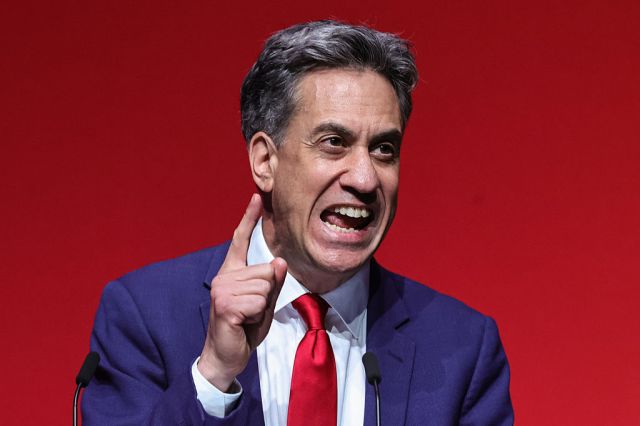
“The world order needs rebuilding anew”, Miliband told Labour conference. (Photo by Mark Cosgrove/News Images/NurPhoto via Getty Images)





“I’m like the British Marco Rubio.” Those words, offered by Ed Miliband to an American influencer for an online video last week, were taken by the Foreign Secretary’s critics as another addition to his now-bulging file of embarrassing media appearances — the bacon sandwich, the “fruity vegan flapjack”, the Ed Stone, that time he hung out with Russell Brand. Really, though, far from being an FCDO satrap, Miliband may prove the most influential Labour politician to hold the office since Robin Cook. Where his predecessors Yvette Cooper and David Lammy largely ran the department as an offshoot of 10 Downing Street, Miliband is shaping up to be that rare thing: a foreign secretary with real power.
Andy Burnham has, thus far, been an avowedly domestic prime minister, with his focus on devolution, housing and social care allowing Miliband more control over foreign affairs. And until now, the role has in some ways suited Miliband well. On the eve of this week’s Labour Party conference, murmurs abounded of Cabinet splits over the economy and immigration. A shift in foreign policy, however, has been more warmly received within the party. Earlier this month, Miliband announced a series of sanctions on illegal Israeli settlements in the occupied West Bank. He has integrated elements of his old brief at the Energy Department to push for “climate diplomacy”, and has been more explicit in his advocacy for European reintegration than either of the previous two office holders. This all provides easy ammunition for rival parties and for the British press, but it’s catnip for party members.
During his Conference speech in Liverpool on Monday morning, Miliband hit all these notes and provided a clearer view of what his foreign policy will look like. “The world order needs rebuilding anew,” he said, arguing that his approach would be one of “resilient idealism”. He had made the same points at a corporate reception the previous evening, where business leaders uninterestedly chatted and chewed. In front of Labour delegates on Monday, however, he was more at home. The crowd thunderously cheered his labeling of Israeli settlers as “terrorists”, and his declaration that “our future lies in a stronger, deeper partnership with the European Union”.
Left-wing dissent towards Miliband’s agenda has, therefore, come not from within the walls of the conference but right outside. On Sunday evening, more than 50 protesters were arrested for demonstrating in support of the proscribed group Palestine Action. When I walked past the scene, there appeared to be more police than agitators. White-haired radicals sat cross-legged on the grass — standing for an extended period would have put pressure on those joints — and held up homemade signs pledging fealty to the organization, surrounded all the while by a bored-looking ring of officers. The same evening, a smaller group of activists had confronted Miliband in Pizza Express, telling him his Israel position was insufficient and demanding he abandon his doughballs to address the protesters.
This encapsulates one of the chief problems faced by Labour foreign secretaries at a time of war in the Middle East. While the Right-leaning press decries Miliband as an extremist enemy of the people, there will invariably be a coterie of progressive objectionists who will settle for nothing less than the nuking of Tel Aviv. At the same time, Miliband, a British Jew whose mother escaped a ghetto in Nazi-occupied Poland, has had to put up with allegations of antisemitism for his action on West Bank settlements, just as security officials brief the press that his approach to the US-Israeli offensive against Iran was “petulant, pacifist, legalistic and very political”.
That Miliband is political is obvious: he is arguably the most ideological member of Burnham’s Cabinet, deeply interested in ideas in a way that the more interpersonally minded PM is not. “He’s more demanding [than Cooper or Lammy],” one FCDO official tells me. “But he knows what he wants. As soon as he came in, there was a plan for how he wanted things done.” Shortly after he became energy secretary under the leadership of Keir Starmer, Miliband spoke in an interview of the need to “move fast and build things”. Initially tipped to be Burnham’s chancellor, he has put paid to the idea that a move to the Foreign brief — which for some ministers feels more like an ambassadorial role — would neuter his political influence.
As part of this new shift towards a more ideological foreign policy, Britain will have to accept its own mediocrity. Much of Miliband’s messaging so far has reinforced the image of the country as a secondary power, rather than one that should be competing with the big boys in DC and Beijing. The West Bank announcement was made in conjunction with similar action from Canada and France, other middle powers with which Britain is forging closer ties to compensate for White House capriciousness. The UK has found some success as a driver of European action on Ukraine, leading the “coalition of the willing” at a time when Kyiv has been uncertain of US backing. Miliband insisted in his Liverpool speech that “our alliance with the United States remains essential”, yet he made no effort to hide this government’s diplomatic realignment. Britons are “proud Europeans”, he said, adding: “This is our continent.” In other words: these are our true friends, not America.
While Miliband has sought to portray his plans as a radical break from the Starmer years, some of his prescriptions bear a resemblance to what came before. His talk of “resilient idealism” is immediately reminiscent of Lammy’s promotion of “progressive realism” abroad. According to that doctrine, governments “do not have to choose between values and interests”, and Left-wing ideals can still shape practical responses to global conflict. Where Miliband differs from the more Atlanticist Lammy is in the course that he is charting away from Washington and more determinedly into the embrace of Europe. Indeed, it is hard to picture him (illicitly) fishing with JD Vance.
The Foreign Secretary, then, clearly sees an opening for Britain to become, rather than a leading power, a moral brake on the worst impulses of its betters. On Monday, he vowed to “put climate at the heart of national security”. When the UK takes on the rotating G20 presidency next year, it will “lead the efforts to manage AI so we keep our country and our world safe, and I say no tech titan should stand in our way”. Earlier this month, in relation to Gaza, he said that “Britain is not silent in the face of injustice and nor is it powerless”.
Yet Miliband risks making the same mistake as Lammy, attempting to navigate a multipolar world armed with the outmoded weaponry of the old liberal order. The UK has in recent weeks launched another round of “tough new sanctions” in Russia, with little evidence that they will have a greater impact than those which came before, while continued invocations of international law hardly deter Xi and Putin. Miliband’s assumption of a like-minded federation of European allies will be put to the test, too, by the possibility of continental powers such as France and Germany electing Right-populist, anti-Brussels parties into government in the coming decade. “Europe is not just our geography, but so much more,” he said as he called for a deeper partnership with the bloc on Monday. But how might he deal with a prospective AfD chancellor who wants out of the union altogether?
Miliband may be looking towards Europe, but these pledges are always made with one eye on Labour’s domestic popularity. The party faces a crucial by-election in Holborn and St Pancras next week, where Green leader Zack Polanski is seeking election in a constituency which in more than 40 years of existence has chosen only Labour MPs. There is a case to be made that Polanski’s initial success was the result of progressive frustration with Starmer, and that the Burnham conquest has brought the Left back onside. Miliband’s rhetoric against the Israeli government may have some moral grounding, but it also functions as an attempt to match Green radicalism on the issue.
His enemies won’t be surprised by this: he’s “Red Ed”, after all. Having been party leader for the first half of Labour’s decade of humiliation, Miliband has become a more polished, wily politician in the years since. But he’s still an idealist. “They say that as you age you become more cynical,” he declared during his Liverpool speech. “Why? Not me.” Talk of “resilient idealism” might sound appealing to the Labour base, but that resilience is only tested in times of crisis. As for realpolitik, nobody is mistaking Miliband for Henry Kissinger, but there are plenty within the party who would like him to take inspiration from one of Labour’s more hard-headed foreign secretaries — Ernest Bevin, who served in the Clement Attlee government from 1945-51.
Bevin, a former union boss, had impeccable Left-wing credentials when appointed by Attlee, but quickly marked himself out as a realist on foreign policy. Recognizing that Britain was a fading superpower, he pushed for the creation of Nato, and its principle of collective defense, so that the country could call on a network of Western European partners ready to support its aims. He championed the development of a nuclear deterrent, and a decade earlier had admonished Labour’s pacifist then-leader, George Lansbury, for “hawking his conscience around”. Bevin also opposed the establishment of Israel, believing it would become a “racial state”, and maintained that the Balfour Declaration of 1917 had been a grave error of foreign policy.
Of course, Bevin failed in his attempt to block the foundation of Israel, his power only extending so far. Miliband, who has used his extensive Whitehall experience to circumvent obstacles that had thwarted his predecessors, is well-positioned to reshape the international order so that British objectives better match his own idealistic, Europhile politics.
And yet, the public may ask how far this serves the national interest. They would be entitled, too, to argue that Miliband’s Net Zero zealotry in the Energy brief constrained national industry, at a cost to the country’s hard-power capabilities. Britain has an opportunity to make something of what Miliband correctly perceives to be its secondary status, leading a set of fellow middle powers. But Miliband’s progressive ideals would be better served by pragmatism than by sanctions and stern words alone. “It’s hard to change the world,” he acknowledged in his Liverpool speech. Sometimes, it’s better to recognize the world as it is, and leave the idealism to the activists sitting cross-legged outside the conference gate.
