




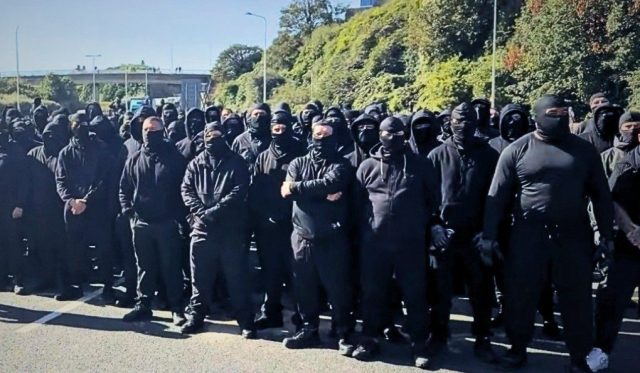
Can they be controlled? (Dan Hodges/Twitter)





George Orwell claimed that a hatred of uniforms was as much an enduring part of English identity as reverence for the law, suet puddings and misty skies. From an English perspective, he thought, the regimented politics on show in Thirties Germany and Italy, with their militaristic parades and costumes, appeared inherently ridiculous. Nancy Mitford suggested something similar when she mocked the self-importance of “masked men wearing Union Jack shirts”, a barely-veiled caricature of Oswald Mosley’s British Union of Fascists. Alas, you would struggle to find a suet pudding in an English kitchen today, but you might see several hundred men in black clothes and masks strolling through Dover, chanting “send them back”.
This demonstration, which took place on Saturday morning, marks a potential turning point in Britain’s anti-migration politics. In the social-media era, the most important aspect of protest is the image it presents to audiences watching elsewhere, and this was a spectacle designed to appear not just intimidating but, more importantly, organized and disciplined. That message was further amplified by the protesters managing to catch the authorities unawares, leaving them free to block a major port without the escort of high-vis police minders that tends to make such events look like futile tantrums.
What followed on Sunday night in Portsmouth was more messy. Another large group of demonstrators, apparently including a contingent of locals, tried to prevent the authorities from moving a newly arrived boatload of Channel migrants inland, leading to chaotic nighttime skirmishes with riot police. But here, too, there was a concerted effort to look organized and even official. Danny Thomas, the activist who appears to have orchestrated both protests, was filmed parlaying with police, making demands and requesting meetings with senior politicians. At one stage, he even read out a statement from a lawyer on a loudspeaker. In both Dover and Portsmouth, the demonstrators ultimately withdrew rather than escalating.
Having caught the country’s attention, Thomas has now burst onto the political scene. He describes his movement, Patriot Platform, as a “Christian patriotic army” which originated in a South London church (one of its slogans is “Christ is King”), and he claims it numbers in the tens of thousands. According to news reports, his previous career involved a number of manual and white-collar jobs, as well as a two-year prison sentence for attempting to kidnap someone at knifepoint over a drugs-related dispute. Besides his Christian awakening, in the past decade Thomas has been an associate of Tommy Robinson and has become a full-time anti-migration activist, traveling to the French coast to deter migrants from crossing.
The most intriguing aspect of Thomas’s past, though, is his stint as a tank driver in the Royal Hussars. As the Dover protest suggests, he aspires to a quasi-military style of politics, nonviolent but muscular, masculine and regimented. As he told Reform UK’s Zia Yusuf in a public dialogue this week, “we have working-class men… who build the houses that you live in, they build the roads that you drive on”, and now “they’re standing up for their women and children”. Insisting that he had no intention of breaking the law, Thomas theatrically asserted that the goal was to forge a mass-movement which would deliver a political party to power at the next election: “we are building a voting bloc… and that voting bloc will go to the most suitable candidate, and to the most suitable party that is able to bring this country back into order.” He ignores the fact that a patriotic Christian voting bloc sounds very much like the sectarianism which mass-immigration is routinely blamed for.
It remains to be seen whether Thomas really has the authority or the motives he claims, but any degree of professionalization in anti-migration protests will be a significant change. Until now, participation by concerned locals and sympathetic groups such as the Pink Ladies has tended to be overshadowed by aggressive and inebriated men seeking out confrontation with the police. This has suited the Government and other opponents quite well. Their strongest defenses against such demonstrations are social stigma and a police force which tracks down and arrests wrongdoers after the fact. So long as protests are associated with hooligans, coke-heads and petty criminals making a fool of themselves in front of police cameras, their political impact will be limited.
A movement with a semblance of structure could present a more serious challenge, to the state and potentially to British society as well. Protesters backed by a considered legal and public relations strategy will likely be more difficult to contain than those who simply want to express themselves. But, more ominously, a lesson of the 20th century is that disaffected young men find uniforms and institutional discipline rather appealing. In times when manpower mattered more than technology, political movements of Left and Right, and indeed entire nations, organized themselves around the mobilization of men in clubs, unions, and other associations. Dressing up and parading around for a political cause offers a sense of purpose and belonging, something that is hard to come by in an atomized, economically stagnant society like our own.
There is something to Orwell’s notion that this tendency has been less pronounced in England than elsewhere: in response to Mosley’s Blackshirts, the Government in 1936 went as far as banning political uniforms in public, a law that some have suggested should now be used against Thomas’s movement. But the picture looks rather different when you include Ireland. Armed and uniformed supporters of the Irish Unionists marched through English cities in the 1910s, and paramilitaries were, of course, central to the carnage of the Troubles in Northern Ireland during the Seventies and Eighties. That period of sectarian violence was the precedent that many observers reached for after Saturday’s demonstration in Dover.
The main reason for such chilling comparisons was the protesters’ use of masks and balaclavas, essentially a threat of anarchy in visual form. It is true that large masked crowds have been a feature of Palestine marches for years, and that masked adolescents on e-scooters have become commonplace in British cities since the pandemic. The latter may reflect the influence of drill music and its associations with gang culture, but generally speaking, masks are a natural consequence of the panopticon quality of contemporary society, where identification by the authorities or by online partisans is an ambient threat that can lead to entering a police database or being hounded out of employment. This was the basis on which Thomas defended the use of masks at protests. He will find sympathy from parts of the Right, where there is already a culture of online anonymity, presented as a necessary precaution for dissidents against a woke police state.
None of this changes the fundamentally threatening character of a group of men in masks. Whatever the intention, it is a gesture that communicates a willingness to act beyond the bounds of law and social norms. Given that our faces are our most intimate means of communication, it also signals a rejection of the public sphere as a place of political dialog. It is a sign of how powerful this symbolism is that it instantly created a divide within the broader anti-migration movement, with Nigel Farage and other Reform politicians denouncing the masked protesters in categorical terms. Farage has since gone further and proposed a ban on all face-coverings in public, including religious ones, on the grounds that “in a civilized society, people should be identifiable in public”.
This looks like an obvious way for Reform to draw a clear line between itself and more extreme expressions of anti-migration sentiment, but in fact, a figure like Thomas is a nightmare for the party. To offer him any kind of backing would leave Reform open to the very real risk that his protest movement will unravel into violence and criminality. That would be a stupid bet to make; but not making it will drive Thomas’s supporters towards Reform’s rival on the Right, Restore Britain, whose leader Rupert Lowe has endorsed the masked protests as “perfectly reasonable”. Lowe is targeting a smaller and more radical section of opinion, and so has less to worry about in terms of reputational harm; but his base is already big enough to cause serious electoral damage to Reform.
Another clear winner is Andy Burnham, who has denounced the weekend’s events as “the politics of poison”, and who can now use the specter of fascist mobs to help him lure Left-leaning voters back to the Labour Party. The only way that anti-migration protests are likely to persuade a broader section of the public is through the participation of people who appear ordinary and non-threatening, but it is unlikely that Thomas’s outfit will be any-more attractive to such people than his scrappy predecessors were.
Still, much will depend on how a more organized protest movement, assuming such a thing actually emerges, chooses to act. The most instructive examples come, ironically enough, from Left-wing politics, which has had a far greater impact in terms of direct action in recent years. In one scenario, the migration protests could follow the lead of groups like Extinction Rebellion, Just Stop Oil and Defend Our Juries, staging provocations that are calculated to polarize the public and thus build pressure on political parties. Another possible outcome is suggested by Antifa in the United States, a movement which exudes chaos and violence to the extent that it is more likely to discredit politicians who fail to distance themselves from it.
Antifa, of course, is no stranger to masks and uniforms, and herein lies the starkest warning about this style of politics. Orwell hated aggressive military displays because he thought they represented the raw enjoyment of power, in the form of a laughable spectacle that one is not allowed to laugh at. But when this tendency seeps into the politics of the street, another danger emerges. Uniforms may suggest a degree of order and discipline, but they are more likely to produce chaos: they invite individuals to submerge their identities in a collective commitment to a cause, a radicalizing process which can rapidly become a conduit for reckless and unpredictable forces to emerge. Thomas thinks he can direct his anonymous foot-soldiers, but once you put men in masks and identical clothing, you have started something that you likely cannot control.
Wessie du Toit writes about culture, design and ideas. His Substack is The Pathos of Things.
 wessiedutoit