




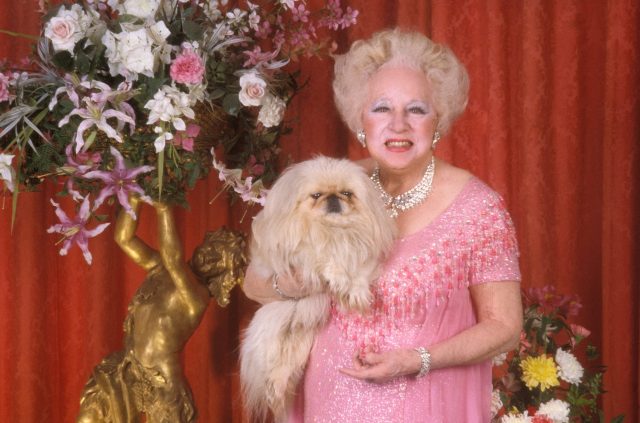
Pain is everywhere in Cartland’s fiction. (Credit: Jean GUICHARD/Gamma-Rapho/Getty)





Romance fiction is the genre of masochism: it’s less about love than control, less about pleasure than pain. This is why Matthew Sweet calls his superb new life of Cartland The Great Dictator: in homage to her control and to her pain. He sees it as he visits her house, which is more edifice than home. She had, he writes, “been generous to history. She had not destroyed the evidence of her pain.”
Yet pain is everywhere in Cartland’s fiction, if you scrub off the makeup and strip the pink away. The critic Peter Conrad claims “the romances she writes are as humid as pornography, though tamed by euphemism: her heroes are all red-blooded rampant phalluses . . . Her subject is always rape.” He’s right. I read Hazard of Hearts (1949), in which Serena Staveley’s father gambles her away to the Marquis of Vulcan and commits suicide by duel. Serena is threatened with rape by Lord Wrotham — “One grows tired of easy conquests, my sweet Serena, and a trifle of hatred will give our life together a spice and a piquancy” — before Vulcan’s tenderness, and his desire to control her, reveals itself. “She quivered for one second before she surrendered herself, utterly and completely. She knew then his strength, she knew then how strong and masterful he would always be and she gloried in it.”
In Cartland’s fiction, as in Cartland’s life, there is no redemption without terror. The first novel is always the best tell of a writer and in Jig-Saw (1927), she wrote, “If only he would lose his temper, be brutal or abusive, Mona felt she would adore him. The eternal considerateness and kindness towards her simply rasped on her nerves.” It makes me laugh to think that this most Establishment of novelists — she became a dame in 1991, thanks to the late Queen Mother — was writing sexual masochism all those years. She made hundreds of women out of paper, like marionettes, and gave them what she wanted, or thought she deserved.
Unhappiness, though, was her essential characteristic; that and snobbery. She was not an aristocrat, but she wanted to be; even Cecil Beaton called her a snob, and he would know. It is hard not to think, reading Hazard of Hearts: Cartland’s truest love was the class system, and that is, as she would say, a cruel master.
Instead, she was from immaculate Birmingham trade, which surely created the work ethic: her grandfather was a screw magnate, quite literally. He shot himself in the head when Cartland was two and the affluent life shattered: the house was sold, the maids were fired, the money was gone. Cartland heroines are habitually carried off to castles, but Cartland traveled in the opposite direction: from mansion to farmhouse. Her father, James, was an alcoholic: he did not know how to live without money. Cartland would write her anti-father all her life: men who were not drunks, but “masterful.” Even so, her mother, Polly, ran the family, and she held on to their aristocratic-style life by her fingernails, and with work. When there were plums in the garden, Cartland lived on plums, and Polly sold the rest; at one point Polly opened a dress shop above a pharmacy. For the young Cartland, this trauma was compounded by self-hatred: she felt herself unbeautiful, when beauty was all that mattered for girls. “I have spent many years of my life trying to lay the ghost of that plain child,” she said. “She has haunted me.”
Cartland was haunted by many things: her family fortune was lost to suicide; her father to alcoholism; her two brothers to the Second World War; her first marriage to adultery. It’s hard to imagine such a woman ever feeling safe, hence the fantasies of sexual domination, and nobility. She married at least one man she didn’t love; and she couldn’t love the only real girl she produced over 723 books: her daughter, Raine, who tried to be a mirror of her mother. It was a mistake.
She built the emotional edifice early. Her bizarre face — she used boot polish for mascara — would follow it, as if in sympathy. “Quite early on,” she said, “I learned the best way to survive is to pretend that anything unpleasant simply hasn’t happened.”
But unpleasant things did happen. After the Great War almost a million young men were missing. That generation’s lovemaking was morbidly extreme: her shell-shocked lovers threatened to shoot themselves and left her with “a horror of sympathy.” “I had no wish to be married to anyone,” she said, “I was frightened now of any deep emotion.” When she found out about sex — she initially thought you could get pregnant from a kiss on the neck — she called off her first engagement and married for money instead. “In the spring of 1927, I became engaged to be married to Alexander [“Sachie”] McCorquodale, whose father was chairman of the companies owning the largest printing group in England,” she wrote in her memoir The Isthmus Years (1945). McCorquodale was too rich to function and he drank too much. Cartland, though obliviously, had married her father. “I cried all through my first honeymoon,” she wrote. “He had a terrible inferiority complex. He drank to boost himself up. You can understand it.”
She wrote about her husband in If the Tree is Saved (1929) as if she hated him: “She had loved the back of his neck, but in the strong light from the window it looked purple and patchy, and she noticed with distaste the commencement of a small boil.” And again in For What? (1930). “Unreasonably romantic, she had looked to her honeymoon to create a spell which would change both Alan and herself into fictitious creatures so different from their true selves, that only a child could have imagined such a possibility”. Her marriage failed, she married Alexander’s cousin Hugh, and established the factory of terror and sex.
Cartland did not like women, real or fictional. So she terrorized them, punished them and fetishized virginity: the partial, or anti-woman. This is most obvious in her treatment of Raine, her only daughter. Cartland could not even bear to look at her as a baby: she had a special pram made, with the child facing outwards. When Raine excelled academically, it disappointed Cartland, who did not approve of female agency beyond her own. “Do tidy your hair, darling,” Cartland said, “No man wants a clever woman.” She called Raine “nauseating” — was it the child’s desire for her mother’s love that disgusted Cartland? — and admitted she was disappointed to have a girl: “I don’t think I’ve ever been so thrilled by anything as having a son”. Still, Raine tried to please her by following the trajectory of a series of Cartland heroines: she married an earl, then another earl, and then the son of a marquis. Raine was not mentioned in Cartland’s will, as if she deserved nothing. I didn’t think anything could make me like Raine Spencer, who inherited ugly snobbery from her pinked mother, but The Great Dictator did. She said she finished Das Kapital by 12, and it was “awfully boring”.
The fantasy she wove to conceal herself was superficially all-consuming: a glittering edifice filled with oddness and magic. According to Sweet, she claimed to be visited by ghosts; that her interior decorator was psychic; that a spirit guide helped her win at roulette; that her friend Lord Moutbatten invented elasticated shoelaces. She pretended she had aristocratic lovers when she didn’t: an extension of her novels. It is possible that she did not believe her fantasies. She told the writer Maboth Moseley, “I believe in being honest with oneself alone. If one told the truth to others about themselves one’s life wouldn’t be worth living.” This is not self-love, but self-annihilation; the language of absolute loneliness.
Towards the end of her life, her self-hatred became more explicit: she projected onto real women as well as fictional ones. She said things like, “Women shouldn’t have character. They should be like pretty chocolate boxes”; and “a stupid man is preferable to a clever woman”; and “Women . . . are not as intelligent as men, and they have awful squeaky voices”. When she was told the piles of Cartland heroines contradicted her own life — that she did have agency — she denied it. When Melvyn Bragg told her she was a career woman she replied: “When my [second] husband died I’d only written thirty or forty books.” When Alan Whicker told her, “I don’t think I’ve ever met anyone less in need of protection”, Cartland retorted, “You’re horrid to me. I just want a nice strong man to look after me.” We can’t know if she meant it, or if it was part of her strategy of concealment: I doubt she knew herself.
“This was the mask of a woman who could not quite see her own face,” Sweet writes: because she did not want to. “Reflection on these matters would have required Cartland to stop the machine, and the machine could not be stopped, because the machine was Cartland”. The most prolific romance novelist who ever lived was also the purest and most imaginative kind: the self-hating kind. Sweet has mastered Cartland, and with tenderness: it’s impossible to imagine her response. “That stupid sadness,” she told the psychiatrist Anthony Clare disgustedly, “that’s wrong. You’ve got to go on.”
‘The Great Dictator: a Life of Barbara Cartland’ is published tomorrow by Hodder & Stoughton
