




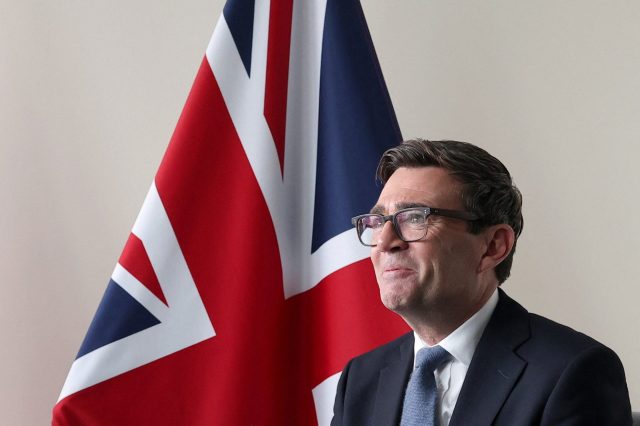
“Manchesterism” might be tempered by the Houthis. (Toby Melville/Getty)





“You may not be interested in war,” Leon Trotsky is supposed to have said, “but war is interested in you.” On the eve of his first Labour conference as leader, Andy Burnham is learning this maxim’s grim truth. Facing a deteriorating set of public finances, which threaten to leave his radical domestic agenda stillborn, this is in no small part due to conflict in the Middle East. Just as LBJ’s Great Society was knocked off course by the tactical genius of Ho Chi Minh, “Manchesterism” might be tempered by the Houthis, to say nothing of multilateralism’s fading potency in our increasingly unstable world.
There’s every chance, here, that Burnham was familiar with Trotsky’s quip long before he entered No. 10. Like many Labour statesmen — Tony Blair and Keir Starmer among them — he enjoyed a youthful flirtation with the Russian revolutionary’s ideas. That’s three out of the last four Labour PMs confessing to intellectual dalliances with the founder of the Red Army. Blair and Starmer, alas, achieved high office only to strengthen Britain’s nightmare political economy of bloated arms-length regulatory regimes, rampant rentierism, privatized national assets, and tragicomic levels of state incapacity, leaving us doubly vulnerable to today’s global shocks.
Labour’s latest prime minister claims to be different, promising a rupture in this peculiarly British mode of governance. But these kinds of epochal shifts, revolutionary premierships on the level of Gladstone or Attlee, are rare indeed. Burnham’s own Trotskyist fling was experienced via the contemporary protestations of the Eighties political celebrity Derek “Degsy” Hatton — a sharp-suited Scouse firebrand (and fellow Evertonian) with a predilection for gold watches, expensive tailors, personalized number plates and “vulgar Marxism”. Hatton was the larger-than-life de facto leader of Liverpool City Council when it thrust itself daringly into the national spotlight, setting illegal budgets and implementing mass housebuilding initiatives even as its Whitehall grant was slashed. Hatton offered a New Deal-style, localized and limited Keynesian stimulus effort dressed in revolutionary garb.
Yet that garb was important, as Degsy basked in a kind of belligerent, workerist anti-intellectualism, poking fun at the academic, London-based New Left scene. The Scouse Trot was quick to differentiate the kind of Liverpool socialism he was enacting with what he himself called the “Loony Left” — “more concerned,” Hatton said, “about black mayors and gay rights than… about building new homes.”
A teenaged Andy, fresh-faced and idealistic, would have seen Hatton on TV every night, fighting his birth city’s corner against Thatcherism. And it’s hard not to compare it to Burnham’s own stint as a righteously indignant mayor of Greater Manchester, railing against Covid lockdowns. But where Burnham’s anti-London combativity earned him the moniker “King in the North”, his former hero Degsy eventually became known as “King Rat”. After Hatton and his posse almost bankrupted Liverpool, expelled from Labour, and removed from office, he used his newfound infamy to launch a career in low-rent TV appearances and Christmas pantomimes. Now 78, he’s a successful property developer, albeit one awaiting trial for conspiracy to commit bribery and intimidate witnesses. There’s another instructive lesson for the prime minister: revolutions do have consequences, and often they are not especially positive.
Perhaps that history explains the caution Burnham has shown towards governing so far. To be sure, “resilience” has become the center-left’s economic watchword, overtaking the “efficiency” of the high neoliberal era. And why not? As the economist Wolfgang Streeck has noted, that hyper-global age entailed a “dictatorship of the lowest marginal cost” — all just-in-time supply chains, outsourced production, and highly mobile capital in search of the cheapest possible inputs. Yet if Burnham has imbibed the critique, and talks about a return to public control, reindustrialization, and economic security, his fine words have yet to translate into action. Yes, Burnham seems to have learned from Degsy, be a rebel — but not too much. Yes, embrace socialism — but not yet.
The problem, here, is that Burnham’s party doesn’t necessarily have time for moderation. The era demands a radical rupture because the old order has so palpably failed. As one MP tells me, the prime minister represents Labour’s “last roll of the dice”, to see if there’s life in the old dog yet. It’s a sentiment you can hear elsewhere too. A thoughtful essay by one of Starmer’s former speechwriters recently pondered whether the party would “go gently into the sociological night”, abandon a diminished working class, and lean into its minoritarian status as an institution for progressive public sector workers and professional urban graduates. The nadir of British social democracy experienced under Starmer required a forceful internal response. Yet if MPs acted to remove one serially unpopular leader and install the man that polls and focus groups deemed most acceptable, it’s unclear, as Burnham prepares to take the podium in an airless glass-and-steel convention center, whether that’ll be enough.
There are reasons to think it won’t be, not least given the looming geopolitical storm clouds. “We’ve all become accustomed to shit economic news over the past 18 years,” says one backbencher. “It’s baked in at this point.” Still, there’s an aching dissonance emerging between the inchoate Burnhamite message of hope and change, and the slow realization that the light at the end of the tunnel may turn out to be an oncoming train. Certainly, most of the public have not registered the implications of Iranian-backed insurgents holding the global economy hostage. The number of people who think they will be worse off next year has decreased from 40% to 33% since April, with 20% now thinking they’ll be doing better. Yet Britain is more exposed than most, especially since successive prime ministers — Hayekian free-marketeers and former Trotskyists alike — have created a service-based, import-dependent economy, one reliant on foreign capital inflows and buoyant international trade.
The irony, of course, is that Burnham always wanted to be a domestic leader, with cost-of-living salves held up as the great unifying totem of his new regime. But as Trotsky also learned — when, for instance, his plans for world revolution were stymied by the Poles in 1920 — exogenous events have a way of intruding on even the best-laid plans. With the Bab al-Mandab blocked, inflation expectations are likely to be adjusted upwards. From there, gilt yields will spike accordingly. John Healey’s first Budget anyway seems unlikely to be cheerful.
Perhaps the best Burnham can hope for in the short term is to borrow from Starmer’s book and act the statesman on the world stage. And, to be sure, sanctioning West Bank settlement goods will play well with sections of Labour’s base, just as action on AI safety does to wavering Lib Dems. But that hardly equals a revised settlement on Britain’s place in the new multipolar order. Nor does it solve the problem of our impotence in the face of a Washington hegemon seemingly intent on causing chaos. Burnham is no Mark Carney or Emmanuel Macron, progressive leaders with their own grand projets on “strategic autonomy” and the future of “middle powers”.
More than any particular policy, though, Burnham should probably take a more general lesson from Degsy and his Trotskyist forebears: if you’re backed into a corner, then fight. Thatcher may have beaten Degsy in the end, but the struggle was just and necessary. As Leon said, revolutions have a way of calcifying, recommending as an antidote a “permanent revolution” more than the settled “socialism in one country” backed by Stalin.
And there are plenty of candidates that a radicalized Burnham could choose to take on: the OBR and Treasury, which together treat investment as a liability rather than an asset; the Bank of England, which raises the cost of government borrowing by engaging in successive rounds of quantitative tightening; the ECHR, which would launch legal challenges against any moves to bring utilities back into public ownership without eye-watering sums being paid to foreign hedge-fund shareholders. “I think he’s doing well,” as one prominent backbencher puts it, but he “needs to grow in confidence… and generally speak and act with more clout and urgency.”
So rather than backing down against the legalistic instincts of the civil service, the orthodoxies of the Treasury, or the apoplexy of the business pages, perhaps Burnham should return to his roots, embody the tribune-of-the-people persona that served him well in the North West, and declare war against Britain’s established interests. An icepick to the head killed Trotsky’s revolution. Thatcher’s revolution killed Degsy’s in Liverpool. A ballot-box verdict, delivered with rather less drama, is what finishes leaders whose revolutions never even start.
Jonny Ball is a Contributing Editor at UnHerd. He formerly wrote under the name Despotic Inroad.
 DespoticInroad