




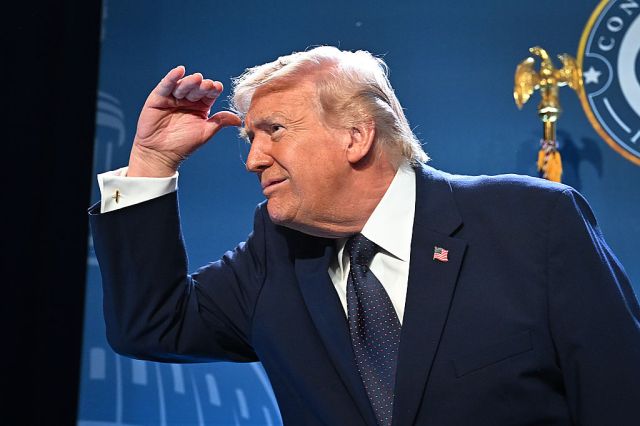
“Tragedy, as Shakespeare repeatedly shows, is borne of obsession.” (Roberto Schmidt/Getty)





The al-Qaeda attacks of 11 September 2001 on the World Trade Center and the Pentagon constituted one of the great head fakes of history. As on the sporting field, when a player uses a deceptive move to trick an opponent, 9/11 led us in one direction when we should have been heading in another. To understand why, it is necessary to go back to that time and see in sequence the national mood and assumptions.
“Few events can be as debilitating as a great victory,” wrote the eminent liberal Israeli journalist Amos Elon in his 1971 book, The Israelis. Elon was referring to the Six-Day War of 1967, which gave Israel control of the West Bank, Gaza, and other territories. Israelis rejoiced, unaware that they had been given a poisoned chalice. America’s victory in the Cold War in 1989 followed a similar pattern: when Communist regimes in Eastern Europe suddenly collapsed one after another, followed by the disintegration of the Soviet Union in 1991, America and its policy elite basked in triumphalism, seeing democracy as the natural order of things to come. The war in Yugoslavia and the genocide in Rwanda in the Nineties did not shatter the smug belief in a linear direction of historical Progress entertained by the powers-that-be; both events were horrific, but they were localized. Convinced that no geopolitical threats existed anymore, America sold its military interventions in Bosnia and Kosovo as a new kind of war, whose goal was purely humanitarian. Such was the misleading effect of the victory in the 44-year-long Cold War.
The realization that the end of the Cold War had given us not peace, but an even more dangerous and far more unstable world occurred in stages. And 9/11 was the first shock, magnified by the technology of television, which repeatedly showed the twin towers in lower Manhattan collapsing into a fiery pile of dust and rubble. The event hit Americans, lulled into the complacency of the Nineties, with the psychological force of Pearl Harbor, to which it was repeatedly compared. But when the Japanese attacked Pearl Harbor in December 1941 the world was already at war. The Nazis had already occupied France, and were at the gates of Moscow. The Japanese had already invaded China and committed the Rape of Nanjing. Thus, for Franklin D. Roosevelt to declare war on the Axis Powers was not only the right thing to do, but also the natural thing.
The direction of history after the attacks of 9/11 was not so clear. The world was otherwise at peace. The Chinese were still in the early phase of building a great navy, around which their military capability would be oriented. Moreover, China was still governed by the reformer Jiang Zemin, a leader friendly to the United States. Vladimir Putin had been in power less than two years and was still consolidating control. It was unclear in what direction he would take Russia. Great power conflict was the furthest thing from people’s minds.
And so, with China and Russia out of the mental picture, the public debate went from unreflectively assuming democracy was about to overtake the world to falling in line behind the Global War on Terrorism. In this way, 9/11 was incorporated into post-Cold War triumphalism. Indeed, as 9/11 had demonstrated, and as the conventional thinking went, the Arab world was politically sick, and the cure was to bring democracy to the greater Middle East.
The administration of President George W. Bush was actually slow to come to this conclusion. Caught off guard by the devastating attacks of 9/11, the Bush White House, burdened by guilt and thus determined that no chances could be taken in protecting American security, immediately conceived of a war to topple the Afghan regime of the Taliban, the hosts of the 9/11 killers. Two months after the attacks, the US military and its Afghan allies occupied the Afghan capital of Kabul. Victory had come easy, perhaps too easy, owing to an innovative, economy-of-force strategy emphasizing special operations forces and local Afghan fighters. But again, without much reflection, rebuilding Afghanistan was turned over to the big, conventional US Army bureaucracy, whose conception of Afghanistan — despite inventive interludes under certain commanders — would turn out to be analogous to that of the Soviet occupiers in the Eighties, who themselves withdrew in defeat.
Because Afghanistan was too easy (as it was then thought), and 9/11 still reverberated in a loud, deafening manner, a bigger response was conceived: the toppling of Saddam Hussein’s totalitarian regime in Iraq. After all, from a human rights perspective there was no worse regime in the world except for North Korea’s. And Bosnia and Kosovo had set the pattern for humanitarian interventions. As I can attest from reporting on the ground in the Middle East, Iraq back then was actually far more repressive than Iran, which had an element of democracy built into its theocratic system under the reformist president Mohammed Khatami, and more repressive even than fellow-Baathist Syria. Though the proof of Saddam aiding al-Qaeda was very flimsy at best, he was certainly supporting many other Arab terrorist groups. Then there was the issue of Iraq seeking a nuclear bomb, which not only the American intelligence community but other Western intelligence agencies assumed to be the case. This is not a defense of invading Iraq — a war I initially supported — merely an argument of how it was not outright madness to consider such an action in sequence, considering that China and Russia were not yet on the radar screen as great power threats, and 9/11 still overwhelmed the public debate.
History is ironic. Had 9/11 not occurred; had Saddam not acted like a guilty man, trying to convince the world that he had a nuclear program even though he didn’t; had the Bush administration’s guilt over 9/11 not led it to a take-no-chances approach in the Middle East, there likely never would have been an invasion of Iraq in the first place.
History is also governed by odd contingencies. Had several Arab armies not threatened Israel in the spring of 1967 — specifically, had King Hussein of Jordan heeded the many warnings not to open a military front against Israel in the West Bank — Israel would not have come into possession of an Arab population totaling 1.25 million at the time. The Jewish settlers’ movement never would have been born, forever deforming Israeli politics in the process. Egypt would have stayed stuck with ruling Gaza. And later on, Iran’s clerical regime, despite its hatred of Israel and the Jews, would have had much less propaganda material to work with. The results of the 1967 War could well be interpreted as a tragedy for Israel; just as the effect of 9/11 could be interpreted as a tragedy for the United States even beyond the initial, massive loss of life, spawning as it did a long and misconceived occupation of Afghanistan, followed by the disastrous war in Iraq.
The problem is that extremism can be emotionally satisfying, especially after a great event or catastrophe. Moderation does not do well when people are literally dancing in the street in Jerusalem like after the 1967 War, or baying for blood like after 9/11, or likewise after 7 October 2023 in Israel. Calls for regime change in Iraq or flattening Gaza appeal to the emotions and not to the intellect. That is their strength. The nuanced, middle-of-the-road technocrats and area specialists are at their weakest in such moments. The last American president who after a great, foreign outrage pursued limited objectives was the moderate conservative George H. W. Bush. Following Saddam Hussein’s unprovoked aggression of Kuwait in 1990, Bush decided to liberate Kuwait from Iraqi rule but otherwise leave Saddam in power and not invade Iraq, where America would likely have been bogged down for years to come. By saving his successor, President Bill Clinton, from this fate, Bush allowed Clinton to inherit a largely pacified geopolitical climate that, in turn, allowed Clinton to focus on humanitarian wars-of-choice in the former Yugoslavia. In fact, the relatively benign geopolitical climate bequeathed by the elder Bush was largely responsible for the naïve hubris of much of the American policy elite in the Nineties.
Remember that after the Napoleonic Wars, it was enlightened conservatives such as the Austrian statesman Klemens von Metternich, the British statesman Viscount Castlereagh, and the French statesman Talleyrand who, by not pursuing extreme and vindictive solutions, however emotionally satisfying they would have been at the time, bought Europe almost a century of peace. Ironically, it was the assumption that peace was the natural order of things that led several great European powers to stumble naively into the First World War.
Similarly, the success of limited interventions in Panama in 1989, in Bosnia in 1995, and in Kosovo in 1999 allowed significant sectors of the American elite to believe in the immediate aftermath of 9/11 that the US military could do anything in a world ordered to American goals and interests. It was this delusion that allowed the United States to stumble into Afghanistan and Iraq.
Beyond the gargantuan loss of life and treasure that the 9/11 wars cost the United States and the affected local populations, perhaps the greatest catastrophe was America’s grand strategic distraction while Russian and Chinese power grew exponentially. The decade of 9/11 wars was the decade when the Chinese military, especially its navy, unleashed its momentum of growth which continues to this day. Meanwhile, Putin consolidated his power in the Russian military and intelligence services, permitting him to rebuild the armed forces under virtual one-man rule for the first time since Stalin.
The result of all this has not been pretty. Terrorism has certainly not been eliminated. As Joseph Conrad showed in The Secret Agent (1907), all it takes is an angry, politically motivated individual or two, burrowing in the heart of a city, anonymous to their neighbors, to perpetrate great atrocities. And great power conflict now exists alongside terrorism. Despite the attempts by middle-level powers to navigate between the United States and China and chart a course of their own, the very survival of the global system is now in jeopardy. This is the world that has followed what was believed to have been the triumphant end to the Cold War. And 9/11 was a crucial inflection point in this tragic process: distracting us when we should have been focused on Russia and China. It was indeed a great head fake.
Alas, there is no relief from history. The rise and fall of great powers is never-ending, and policymakers’ tragic mistakes are baked into the process. And while the attack on Pearl Harbor in 1941 was avenged by the US victory over Japan in 1945, the United States is still searching for some sort of meaningful historical reply to 9/11 a quarter-century later. Indeed, our 9/11 wars, particularly in Iraq, only emboldened clerical Iran and enlarged its geopolitical footprint. The current war with Iran is part of the process that began with 9/11. The attacks brought us into a generational military struggle in the Middle East that shows no sign of abatement. And it isn’t only the Middle East’s inherent instability that is the problem, but our very obsession with it. Tragedy, as Shakespeare repeatedly shows, is borne of obsession.