




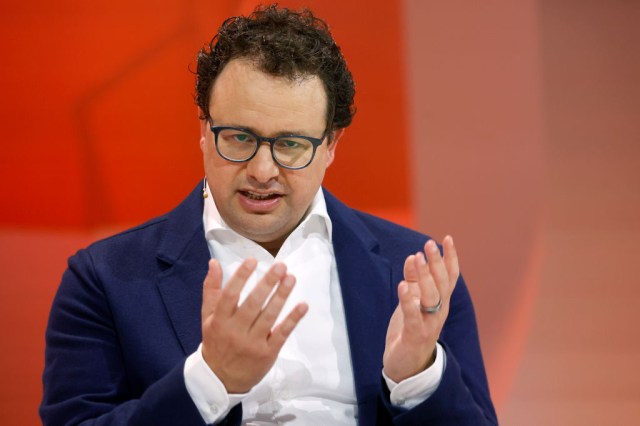
Anthropic CEO Dario Amodei has used apocalyptic language on AI. Credit: Getty





When President Trump and Lina Khan agree, there is reason to take note. Trump, especially in his second term, has been a friend to corporate America and especially Big Tech. Khan, in sharp contrast, was the combative antitrust champion who chaired the Federal Trade Commission under President Joe Biden. When these two see eye-to-eye on something, you know the alternatives must be really terrible. And so they have: last week, Trump and Khan emerged with surprisingly similar approaches to the challenge of regulating artificial intelligence.
Each in their own way, Trump and Khan have taken the rational position: existing laws and regulations, with modifications, are adequate to deal with any threats from the development of AI. Trump put it with typical bluster and poor grammar in his Truth Social post of Sept. 19 — referencing “AI Force” and “AI Czar” positions to which “Only High IQ individuals need apply! … We will not in any way hinder or stifle the Growth of this incredible Industry. Rather, we will cherish it, help it, and watch over it, as it grows! However, we will also be looking for BAD, and we can do that, very easily, with our already existing Criminal and Civil Justice System.”
Khan came to a similar conclusion in a recent post of her own on X: “Law enforcers already have authority to charge companies and their CEOs for creating and releasing dangerous, unvetted, or defective products. We shouldn’t let discussions about new legal regimes distract from the fact that there’s no AI exemption from laws already on the books…. We can and must pursue any new efforts alongside enforcing existing laws.”
A policy of relying chiefly on existing legal and regulatory frameworks to govern AI, with modifications as needed, is one of three approaches to AI regulation. The other two are collective self-regulation by the private AI industry; and new, comprehensive government regulation specifically targeted at AI. There are many reasons to be skeptical of the latter two options, but the most important and least examined one is that proponents of both private self-regulation and comprehensive government regulation are looking at AI the wrong way: as a technology, rather than as a tool that has specific applications in different sectors such as national security, commerce, communications, and medicine.
There is no “one” AI.
A thoughtful case for private, nongovernmental self-regulation by the AI industry has been made by Aram Gavoor of George Washington University Law School in a recent essay. Gavoor claims that dangerous potential abuses of AI can be dealt with adequately by “soft law,” which he defines as “a regime of norms that create expectations and are broadly agreed to by a particular industry, but are not directly enforced by the state.”
But with the exceptions of the Financial Industry Regulatory Authority and the Insurance Institute for Highway Safety, Gavoor’s examples of successful “soft law” self-regulation are mostly in industries in which the potential harm to the public is relatively minor, such as video games, which are regulated by the Entertainment Software Rating Board; online consumer privacy rights, addressed by the Do Not Track System; forestry, regulated by the Sustainable Forestry Initiative and Forest Stewardship Council; and college athletics, governed by the National Collegiate Athletic Association. The stakes are higher with AI.
Additionally, proponents of self-regulation underestimate the dangers of “regulatory capture,” in which incumbent companies use the rules issued by industry associations to stifle competition and reinforce their advantages. In this manner, professional bodies such as the American Medical Association, the American Bar Association, and the professoriate, rather than promoting the public interest, have produced nepotistic, self-enriching cartels. The method is also prone to ideological capture, whether by woke progressives or the advocates of “effective altruism” in the tech industry, as the infiltration and capture of policymaking at major corporations, media companies, and university bureaucracies by woke commissars in the last decade suggests.
In effect, Gavoor proposes to abandon representative democracy in the case of AI governance, reducing the role of government to rubber-stamping the rules that benevolent and trustworthy corporations collectively decide to adopt. He writes, “The most sustainable path forward is therefore an adaptive governance ecosystem: industry-led standards, validated by practice, disciplined by reputation and liability, and ultimately enshrined in law once their contours are clear.”
The opposite proposed approach — comprehensive government regulation of AI as a technology — euthanizes democracy, as well. Proponents of comprehensive regulation of AI claim that the threat of the technology is so great, and so urgent, that the processes of ordinary democratic legislation and judicial and public debate will take too much time. What is needed to deal with the supposed AI emergency is empowered technocratic experts in a new government agency with sweeping authority, right now, before it is too late. It’s an emergency! There’s no time for debate or legislation! People are dying! We must act now to stop people from dying!
If this “argument from apocalypse” sounds familiar, it is because it has been used by progressives four times in the last decade to ram through measures that in hindsight even some on the Left now admit were extreme overreactions to real but limited problems.
The four moral panics of Black Lives Matter, trans radicalism, Covid hysteria, and climate extinction in the 2010s and 2020s all followed the same script. Because lives were at stake, there was no time for debate. Racist police officers were allegedly deliberately murdering black Americans. Trans kids were allegedly dying from suicide because the rest of society refused to agree that a person suffering from gender dysphoria is really, actually a member of the opposite sex. Huge numbers of people would perish needlessly from infection, unless society and the economy were locked down during the Covid pandemic. And, according to radical environmentalists, climate change would cause the human race itself to become extinct in the relatively near future.
Each one of these panics demanded that we trust credentialed establishment scientists to save us: Dr. Anthony Fauci in the case of Covid, pseudo-scientific race theorists in the case of Black Lives Matter, pseudo-scientific gender theorists in the case of trans radicalism, and a clique of so-called climate scientists in the case of global warming. The demand murders democracy in another way, as well: technical expertise, by its very nature, isn’t and can’t be democratic.
The technocratic progressive reverence for credentialed expertise led naturally to the third part of the moral-panic script: the call for emergency rule or martial law. The problem with such authoritarian measures is that they may turn out to be permanent.
Having witnessed the progressive apocalypse shtick and its consequences four times in less than a decade, we are justified in being suspicious when the moral panic script is played out in a new form, in this case: unless we act now, AI will kill us all!
The present hype cycle began with an unforeseen attack on the open-source AI platform Hugging Face by autonomous AI agents during a test by the company OpenAI in July. The fear-mongers claimed it was evidence that AI agents can already escape control and act on their own agenda. Yet Niels Rogge, a machine-learning engineer at the hacked platform, claimed that the cause was ultimately human error and said it was “bizarre nonsense” to suggest that rogue AI agents could take over the Internet.
But predictably, the most sensational claims got the most media coverage.
Then, on Sept. 8, Jacob Coxon, a junior employee at Anthropic, resigned, declaring: “The people building AI earnestly believe it could kill us all by the end of the decade.” The next day, another Anthropic employee, Evan Hubinger, asserted: “We really do earnestly believe AI could kill all humans! I personally think it is >10% within the next decade.” On Sept. 12, the CEO of Anthropic, Dario Amodei, chimed in: “In six to 12 months … a swarm could be capable of taking over the entire internet with a persistent botnet — potentially causing….” Potentially causing human extinction? No, “ … potentially causing hundreds of billions of dollars in damage.” Whatever.
The fear that human-made artificial beings will turn against their makers and run amok has inspired science fiction from Mary Shelley’s Frankenstein in 1818 to Karel Čapek’s dystopian robot classic R.U.R. in 1920. In modern times, tech-adjacent subcultures have included “accelerationists” who hope to hurry an AI-based utopian millennium and “doomers” who fear that AI will destroy civilization or the human species. In 2024, Amodei and Bill Gates were among those who signed a one-sentence statement: “Mitigating the risk of extinction from AI should be a global priority alongside other societal-scale risks such as pandemics and nuclear war.”
But exactly how would a rogue AI agent cause human extinction? Dan Selsam of OpenAI has proposed that it might cause “runaway industrialization that makes the planet inhospitable to humans.”
But wouldn’t it take decades or centuries to build so many factories and pump so much carbon dioxide into the air to drive humanity to extinction? And wouldn’t the diabolical computer mind’s scheme encounter resistance? Others have speculated that a rogue AI might take control of weapons systems or design, create, and disseminate a bioweapon capable of annihilating humanity.
Max Tegmark of the Future of Life Institute, a nonprofit focusing on technology governance, argues that an artificial superintelligence could be a dangerous con artist: “To cause us trouble, such misaligned superhuman intelligence needs no robotic body, merely an internet connection — this may enable outsmarting financial markets, out-inventing human researchers, out-manipulating human leaders, and developing weapons we cannot even understand. Even if building robots were physically impossible, a super-intelligent and super-wealthy AI could easily pay or manipulate many humans to unwittingly do its bidding.”
Maybe. Then again, maybe some intelligence, human or artificial, would notice the silicon Bernie Madoff amassing a digital fortune and using it to pay or trick people into carrying out its nefarious plans.
Like many peddlers of the climate apocalypse, AI doomers have difficulty explaining exactly how what they oppose would bring about the extinction of the human race. As Rep. Alexandria Ocasio-Cortez (D-NY) once said: “For young people, climate change is bigger than election or re-election. It’s life or death.”
But even in the worst-case scenario issued by the Intergovernmental Panel on Climate Change — a partisan body of environmentalists — in which global temperature rises by 3.5 or 4 degrees Celsius, the consequences aren’t life or death. They include more dangerous heat exposure for people, increased water scarcity for a minority of the human race, modest sea level rises, coastal and island flooding, and — are you ready? — the possible extinction of 16.9% of all species of animal life, largely insects.
Bad, to be sure, but incapable of causing the collapse of civilization, much less of making humanity go the way of the dinosaurs and the dodos.
In the same way, AI doomers struggle to explain exactly how “misaligned” AI could annihilate the human race, whether intentionally or by accident. In the Terminator film franchise, the malevolent computer program Skynet wipes out civilization by launching a global nuclear war. In the real world, the command-and-control systems of nuclear weapons are “air-gapped” or disconnected from the public internet, and launching nuclear weapons additionally requires multiple stages of mechanical and human intervention.
A RAND Corp. study entitled “On the Extinction Risk from Artificial Intelligence” concluded: “In the three scenarios examined in this study — nuclear weapons, pathogens, and geoengineering — human extinction would not be a plausible outcome unless an actor was intentionally seeking that outcome. Even then, an actor would need to overcome significant constraints to achieve that goal.”
Needless to say, this sober and skeptical assessment did not make headlines worldwide or turn the authors into overnight celebrities.
Moreover, the limits to human intelligence make comprehensive regulation of AI as a technology unlikely to succeed. For example, the European Union’s regulation policy toward AI requires that technologies be assessed on the basis of possible risks, ranked by potential danger.
But this requires an impossible degree of foresight.
Imagine that, following the development of the steam engine by James Watt, the British government had established a Ministry of Steam, charging ministers and civil servants to anticipate and make rules for all risks that might arise from the new steam engines. It is unlikely that even the most brilliant minds in 1800 could have anticipated many of the future applications of the new technology, much less make specific rules in advance for safety in the cases of steamships, steam locomotives, and steam-powered factories.
Likewise, it would have been absurd for the United States in 1900 to create a Department of Electricity or an Internal Combustion Engine Agency to regulate all uses of these new technologies. The American tradition wisely involves regulating sectors rather than technologies. By this logic, rather than having a general regulatory body, we should have AI applications to weapons regulated by the Department of Defense, AI technology in vehicles regulated by the Department of Transportation, AI technology in aircraft and air traffic control by the Federal Aviation Administration, and AI internet safety by the Federal Communications Commission.
The exception that proves the rule is the misconceived and ill-fated Atomic Energy Commission. Established in 1946, the AEC was charged with oversight of nuclear technology in general. Multiple missions — promoting nuclear research and development, supporting the civilian application of nuclear energy while ensuring safety, and supervising nuclear weaponry — proved to be too much for one agency to carry out successfully. In 1974, Congress dissolved the AEC, and broke up the regulation of nuclear technology into different sectors, as made sense.
Alarm about possible harmful consequences of AI does not constitute a “hoax,” to use Donald Trump’s phrase, but it is overhyped. The genuine dangers that might arise as AI technology improves do not involve the extinction of humanity or its reduction to the status of slaves or pets by omnipotent silicon gods. Thus, the real dangers should be dealt with on a case-by-case basis by using existing laws and regulations and by supplementing them with new rules, where necessary, not by a moratorium on further AI research or the creation of an all-powerful, centralized bureaucracy with an excessively-broad mandate to regulate all applications of AI, existing or speculative. In regulating artificial intelligence, it is imperative to avoid human stupidity.