




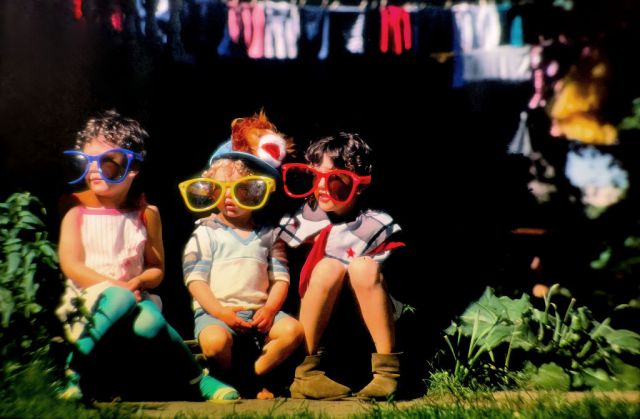
“They grant us new and bright perspectives about the world around us.” (Nik Kleinberg/Getty)





Smannell and Enham Church of England Primary School looks more like a chapel than a place of learning. On this fine morning, the Victorian-era building is quiet as I stare at its pebble-dashed walls and unobtrusive green fencing. Last year, Hampshire County Council decided that the place should be closed for want of pupils (24 at the last count). Parents were left angry, confused and anxious, says Andy Fitchet, a local Methodist minister, just as he was when his son’s school in Hatherden, a village just 10 minutes’ drive away, closed in 2022.
Few suspected it would come to this. Yet in Hampshire alone, the population of under-15s has shrunk by 2%, leading to the closure of two other primary schools and half-a-dozen mergers. Nor is Jane Austen country alone. In the past two years, 40 state-funded primary schools have shut nationwide. The reason is simple: not enough Britons want to have children. For any country’s population to remain stable, its total fertility rate needs to be at or above an average of 2.1 live births per woman. Britain’s fertility rate is 1.39. If this trend continues, our population will peak at 71 million in 2034, before dropping to as low as 48 million by 2100.
This is a global phenomenon. Birth rates are tanking from Australia to India, from the US to Uruguay, while the populations of countries including South Korea and Germany have already started to shrink. This is not a good thing. Your instinct may be that, with fewer people around, there will be less competition for resources and fewer carbon emissions pumped into the atmosphere. This is true, and immaterial: there may be less competition for minerals, say, but also fewer people to mine and process them, and Elon Musk’s Optimus butlers are a bet more than a certainty. Nor is depopulation easy to reverse. From encouraging letters (France) and tax incentives (Hungary) to limits on abortion (Russia), countries have tried everything, to no avail. Immigration doesn’t work either, not when the birth rates of new arrivals slow too.
What, then, will life be like in a world with fewer children? In places like Smannell and Hatherden, Fitchet argues, a feeling of managed decline will only accelerate. In these villages, he explains, primary schools are “the places where the families meet, the places where friendships begin, where generations put down roots” — the last place, in other words, that is likely to attract younger families to these places where the post office and the pub have long since vanished. Something similar will happen to our towns and cities. The daytime squeal of toddlers in trolley seats will diminish in our supermarkets, swimming pools and parkland. Other aspects of our social contract will also begin to fray. Expect emergency service provision in rural areas to experience further cuts, as budgets for ambulances, police and on-call fire stations are reprioritized to areas of greater population density.
Some big inter-generational resentments are also coming. A declining birth rate means, inevitably, that a diminishing number of young people are paying for the pensions of the old, the fiscal equivalent of a sweaty, inverted human pyramid. Do not expect the triple lock to hold. If current trends continue, the Office for Budget Responsibility said last year, healthcare and pensions spending will push government debt to 270% of GDP by the 2070s (it is currently 93.8%). According to a report by Policy Exchange, budget stabilization under this regime would require income tax to rise between 1.4-7.4% per taxpayer. The recruitment and retention crises currently facing the NHS and the social care sector will worsen. Managers running our old people’s homes will either need to increase the workload of their already-harried nursing staff or embrace the Japanese model of employing more robots (though some have argued this just makes life for caregivers even busier).
The British government should avoid this fiscal disaster, says David Miles, an economist at Imperial College London — provided it is willing to make some hard choices. One is making sure that the retirement age is realistic. “The majority of people, including the over-65s and maybe well into their seventies, are perfectly capable of some work,” Miles continues, arguing that a return to the original idea of the old-age pension as a stipend received in the last decade of life, rather than the last quarter, is logical. Pervasive ageism in the economy, he continues, will disappear once it becomes clear that an oversupply of eager young adults is a thing of the past. This assumes that older citizens can be persuaded to vote for a government that spends radically less on their pensions. That might happen by mid-century, by which time the demise of the Baby Boomers will have resulted in a wealth transfer of an estimated £5.5 trillion to Millennials.
Of course, there’s always the possibility that technology will have saved us by 2050, with robots and AI ensuring we live in a less crowded, less competitive archipelago. Dean Spears and Michael Geruso are skeptical on that point. As they convincingly argue in their depopulation jeremiad, After the Spike, innovation is an incremental byproduct of a growing population: the more people you have around, the more minds capable of conceiving and communicating billions of tiny improvements to our daily lives.
Depopulation kicks the stool from beneath this framework. History begins to slow, then reverse. By the 22nd century, we will probably still know how to deflect an asteroid, but we may not be able to build the rocket to do so in time, much less put our minds together to find the cure to the next pandemic-causing virus. Similar regressions have happened before. Take the development of cement, the recipe for which was perfected under the Roman Empire only to be lost for centuries after the collapse of imperial authority — and its population — in the 5th century. A counterargument to this might be the technological progress Europe ended up making after the Black Death, which culled about half of its population. But one wonders whether the AI-addled mind will cope as well as its medieval antecedents as our towns and cities start to empty.
Why should that be important to anyone living today? Though the decision to have children must always fall to individual couples, the fact that so many are choosing either to wait or skip altogether points to much deeper failings in our society. These are failings we should all care about and try, collectively, to mitigate by acting or voting for change, whether that’s related to global warming and pervasive air pollution, to the deteriorating quality of our food, the cost of living, or the daily horrors meted out to new mothers on maternity wards.
Anastasia Berg suspects it’s deeper than all that. A philosopher at the University of California, Irvine and the co-author of What Are Children For?, Berg points to Norway as an example of a place that has invested significantly in its education, healthcare and childcare systems — and yet still faces a declining birth rate. What’s actually happened, argues Berg and her co-author Rachel Wiseman, is a nigh-on unprecedented shift in attitudes toward parenthood itself in Western culture. Men and women now feel free to prioritize their career, finding the right partner, or simply living a life free of the responsibility of raising a tiny human. “Through all these domains, there are these paradigms that all point away from the possibility of having children,” says Berg. “They conspire to a situation where we kind of tolerate children as a kind of consumer choice, like we tolerate one another ordering from Amazon, even though we know we shouldn’t.”
In some ways, perhaps, this liberation should be celebrated: at no point in history has the individual, man or woman, had so much agency to define the course of their lives. If that course involves couples deciding that having children is not for them, that’s also completely fine. Berg agrees, but also observes that the culmination of this sense of agency is an odd sense of ambivalence in our culture toward parenthood, one amplified by a slew of podcasts, films, novels and television dramas that portray raising children as, at best, something that can wait, and at worst, completely thankless. In the end, all these possibilities crowd out the nuanced arguments that can be made for having children, suggests the philosopher, especially among women. “If feminism is about empowering women and knowledge is power,” Berg says, “then we need to make sure that people have all the knowledge from the start so they can really plan out the course of their lives and not feel like they were hoodwinked.”
It is impossible to avoid thinking that this is leading to a vast loss for society at large. As a father myself — of a two-year-old daughter, currently gathering shoes by our backdoor in the hope of a trip out, instead of one to her nightly bath — I am biased. Others make the case more eloquently. In his 1994 work The Philosophy of Childhood, Gareth Matthews convincingly argues that the child is much more than an adult-in-waiting, but someone who fundamentally changes the parent and caregiver. Children are irrepressibly curious, bold, unconstrained by the mental shackles imposed by year after year of toil, grief and accumulating responsibilities. They grant us new and bright perspectives about the world around us, pushing us to improve ourselves and our collective circumstances. Absent their plaintive cries and squeals of delight, society can only ossify. The world of adults is the world of compromises, the end of idealism.
I think, here, of Levin’s epiphany in Anna Karenina, his face lit up by summer storms, smiling at the gleaming sense of purpose brought into his life by his infant son. If God were to live anywhere, it would be in the laughter of children. You can hear it anywhere and benefit. Amid so many looming dangers, says Fitchet, “kicking a football around in a field, or going to a park and watching kids run around and scream and play with each other, makes that all disappear for a few minutes, because they’re completely oblivious to all of this.” For them, the world is a marvelous thing — and only just beginning.
Greg Noone is a journalist and writer living in Hampshire. His work has previously featured in The Atlantic, The Guardian, Outside and Hakai.
 gregmnoone