




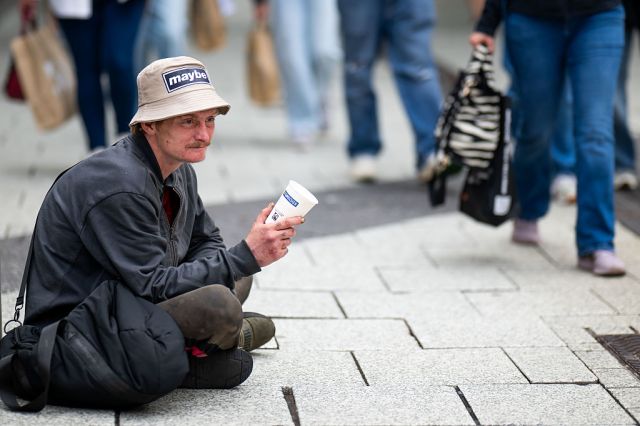
Scenes like this have become a feature of life in Britain. (Matthew Horwood/Getty)





Rough sleepers are a feature of everyday life for city dwellers. Though most regard this as regrettable, few believe responsibility for tackling it lies with them personally. And so they step around the bodies on their way to work, occasionally stopping to drop a coin in a cup. Familiarity has bred not indifference, but resignation.
That resignation has made the crisis easier for politicians to neglect. Those at the sharp end of homelessness make for a particularly powerless constituency. They are less likely to vote and therefore offer little electoral bang for buck. Excluded from the labor market, they wield little economic influence. Shelter’s latest analysis suggests that at least 382,000 people in England were homeless on a given day in 2025, many of them families stuck in temporary accommodation. Yet their plight rarely dominates the conversation at Westminster.
But if our politicians have concluded that there are few votes in homelessness, they have confused the political power of homeless people with the public’s attitude towards homelessness. An Ipsos poll of adults across the UK found that 83% regard homelessness as a serious national problem, while seven in 10 believe society paid it too little attention. Separate research commissioned by Homewards, Prince William’s homelessness programme, suggests that 72% support the aim of ending homelessness altogether.
Homeless people may be electorally marginal but homelessness is not. And this makes Andy Burnham’s first-day pledge to end rough sleeping politically astute as well as morally worthy.
The harder question is whether he can deliver. Though every person arrives on the street by a different route, those individual circumstances unfold within all-too-predictable structural conditions: a chronic shortage of genuinely affordable and secure housing; a welfare system that can be punitive, precarious and difficult to navigate; and mental-health and addiction services so underfunded and overstretched that support often kicks in only after a personal crisis has spiraled.
The scale of underinvestment is stark. Funding for adult alcohol and drug treatment fell by 40% in real terms between 2014-15 and 2021-22, while the number of bed spaces in homelessness accommodation projects has declined by 43% since 2008. As preventative and supportive capacity has contracted, council spending on temporary accommodation almost doubled between 2015–16 and 2023–24 — a costly system increasingly geared towards managing crises instead of preventing them.
I experienced homelessness myself in my late teens. Thankfully, I never ended up on the streets. But the circumstances that preceded my own spell of instability are common among those misfortunate enough to sleep rough. Through a combination of poverty, household stress, bereavement and trauma, many families are poorly equipped to withstand major life events without crumbling. Someone dies. A relationship breaks down. Perhaps a family member develops an addiction. My episode of homelessness was brief: thanks precisely to the wide range of services available in the early 2000s. I was referred by a mental-health professional to a supported-accommodation project, where I received the help I needed to get back on my feet. It goes without saying that this kind of assistance is extremely hard to come by today.
Indeed, the structural reasons for homelessness are as important as the personal. People leave prison, care, hospital or the armed forces without secure accommodation. Low wages and insecure work collide with rising rents, while councils facing severe financial pressure struggle to prevent homelessness before it occurs. Back in my day, the DWP was preparing to enter it’s nightmarish austerity phase, and I recall the temperature changing as I started being asked to attend “compliance” appointments, or when I was sanctioned for six weeks for missing a meeting due to a friend’s suicide attempt.
With public budgets under permanent strain, meaningful action inevitably requires hard choices. But money alone is not enough. Cuts across housing, welfare, health, justice and local government all create opportunities for buck-passing. Vulnerable people seeking urgent support are forced to traverse a bureaucratic obstacle course, from one department to the next, either by telephone or in person. And every time they’re lucky enough to get a response, they then have to recount every detail of their problem from the start: information-sharing is increasingly anathema across the modern British state.
The only thing that can shake this up is a change of culture, shaped by a clear mission. The indispensable ingredient is political will at the very top. Burnham has the authority to force departments to cooperate, commit resources over the long term and treat homelessness prevention as a shared obligation rather than an emergency response. And, equally importantly, he can hold services accountable when they fail.
But the King of the North knows all too well how quickly progress can stall: he himself fell short of his pledge to end rough sleeping in Greater Manchester, albeit after cutting it substantially via initiatives like A Bed Every Night. Still, even those experiences offer lessons.
There are, too, lessons to be learned from further afield; specifically, how rough sleeping can be reduced dramatically when housing is treated as the foundation of recovery rather than its eventual reward. Finland’s Housing First strategy replaced much of its hostel-based system with permanent homes, combining secure tenancies with tailored mental-health, addiction and social support. Between 2008 and 2022, long-term homelessness duly fell by 68%. This approach did not demand that people become sober, stable or “housing ready” before receiving somewhere to live; it recognized that stability is far easier to achieve once a person has a home of their own.
Vienna, for its part, illustrates the value of maintaining a large stock of affordable housing, rather than relying solely on intervention after homelessness occurs. The council and other developers provide around a quarter of homes in the Austrian capital, while a further third are publicly subsidized. Supported by long-term planning and relatively broad eligibility, the system keeps social housing available to low and middle-income households, and reduces their exposure to the private rental market.
Houston in Texas offers another instructive example, this time on the need for a genuine cross-departmental approach. Starting in 2012, the city brought public agencies, charities, housing providers and outreach services into a single coordinated system. Over 30,000 people were moved into stable accommodation over the following decade. The important innovation was not so much the provision of housing, as the removal of institutional fragmentation: agencies shared information, priorities and responsibilities, instead of repeatedly passing vulnerable people between them. Compared with Britain’s Kafkaesque bureaucracy, that sounds like an improvement.
To be clear, neither Finland, Vienna nor Texas have permanently abolished homelessness. Nor is this likely ever possible. People will always slip into periods of adversity, falling faster than the safety-nets can catch them. Indeed, Finland recorded renewed increases in homelessness over recent years, as the cost of living crisis and benefit cuts took their toll. These reversals serve as a sobering reminder that success is neither guaranteed nor irreversible but that political stamina is needed to build a system whereby people don’t routinely remain sleeping on the streets.
There’s a broader point here too. Only when success can be proved — in this case, through a palpable public sense that rough sleeping has declined — do once-radical ideas mutate into simple common sense. Burnham is therefore wise to focus on ending the shame of rough sleeping alone; anything more risks seeming unrealistic.
Proof of concept lies in the early days of the Covid pandemic. During the first lockdown, the Government instructed English local authorities to offer emergency accommodation to people sleeping rough, or at imminent risk of doing so. By mid-April 2020, around 5,400 people, estimated to represent 90% of those sleeping rough at the time, had been offered somewhere to stay. By November, over 33,000 people had been helped into accommodation through the Everyone In initiative.
The program did not eliminate homelessness: much of the accommodation was temporary, and the unexpectedly large number of people requiring help exposed how badly official counts had underestimated the scale of the problem. Nor could an emergency scheme address the shortage of affordable homes or guarantee lasting support. But it did establish a fundamental truth we’d all do well to remember in an age defined by myopic political can’t-do-ism. When decision makers treated rough sleeping as an emergency; lifted the usual bureaucratic barriers; offered resources; and instructed public bodies to act together — streets were cleared with remarkable speed.
In that short-lived achievement lies the crux of the matter: the obstacle to tackling rough sleeping is not an absence of practical means, but a lack of sustained political commitment. Burnham must persist not only for the benefit of those on the streets, but to restore public faith that government can make a material difference to people’s lives. Ending rough sleeping may be technically complicated, but its persistence is ultimately a political choice. And in giving the homeless somewhere to belong, Burnham may also offer a political home to many who no longer feel they have one.
Darren McGarvey is a Scottish hip hop artist and social commentator. In 2018, his book Poverty Safari won the Orwell Prize and his new book The Social Distance Between Us (Ebury Press) is out on 16th June.
 lokiscottishrap