




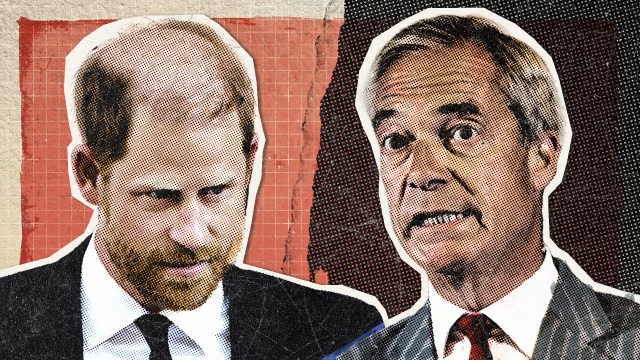
(J.G. Fox/Getty)





It’s partly the fault of Liz Truss that Prince Harry is so stressed. After a decade of Prime Ministerial merry-go-round that has seen more turnover at No. 10 than on Meghan Markle’s payroll, Britain has a record number of living current and former Prime Ministers. All nine of these are entitled to publicly funded security. As a result, so we gather, there aren’t enough officers spare to send any trailing after Harry and his family.
Even so, to universal tabloid rejoicing, the Sussexes are moving back to Britain. Though maybe only for a bit. And Chuck wasn’t told till the last minute. And Harry is still on non-speakers with Wills. And maybe it’s just for Meghan’s work. Except why are they even doing this when they said they’d never? What about the millions Harry owes the Mail? And so on.
The dichotomy that stands out, amid all the rubbernecking and rumor-mongering, is “public” and “private”. Megxit was all about Harry and Megs being private individuals, so well-known for appearing in public to tell us how desperately they needed their privacy they even got a South Park segment about their Privacy World Tour.
But despite being so private, Harry is still angling for the British public to pay for his security. But this doesn’t really make sense. Why would he be entitled to a state-funded heavy with an earpiece, if he’s just a private individual? Aren’t famous rich people expected to pay for their own bodyguards?
Harry’s difficulty is trying to reconcile two mutually exclusive kinds of fame: the kind that comes with high-profile public service, and the kind that comes with individual celebrity. In this sense, the nearest parallel — both in terms of divisiveness, and in terms of ambiguity — isn’t Britain’s panoply of still-living ex-PMs, but a man currently angling to join their number. The only Brit, in fact, clickbait-friendly enough to out-clickbait Prince Harry, and who functions even more powerfully as a human Rorschach test: Nigel Farage.
Farage, too, has been in the news lately in connection with arguments over his security and the nature of his public profile. To Farage’s admirers, he’s a hero and public servant: Britain’s last chance of escaping the Uniparty and restoring something more like the status quo ante Blair. To his many haters, meanwhile, he’s the odious imp responsible for the calamity of Brexit, whose comeback was oiled by almost winning I’m A Celebrity – Get Me Out Of Here! and whose conduct in public life has always indecorously blurred the lines between lucrative media and celebrity appearances, and purportedly selfless public service.
Amid this ambiguous maelstrom, Farage argues that the divisiveness of his public role has placed him at such grave risk of public attack that the Home Office should offer him greater state-funded protection than has hitherto been available. He has further asserted that the £5m donation at the center of the current parliamentary standards investigation was intended to help him with security costs the government refuses to cover. The whole debate became still grimmer following the murder of Reform migration spokeswoman Ann Widdecombe at her home.
So is Farage a celebrity or a political figure? Greedy grifter or vulnerable public servant whose safety is in the national interest? Harry, meanwhile, hasn’t (to my knowledge at least) received any undeclared donations from crypto bros of any kind. But — albeit perhaps for different reasons — he too acts as a kind of human Rorschach test, variously perceived (including perhaps by himself) as “public” as in high-profile public service, and “public” as in lucratively famous.
In Harry’s case this isn’t down to a role in parliamentary politics. It is instead the result of the unique nature of the “working royals” as public figures methodically insulated from the faintest whiff of commercial grabbiness.
Being “royal”, as far as royalty has operated in Britain since the last absolute monarch was deposed in the “Glorious Revolution” of 1688, is largely symbolic. The human individuals born royal are employed as symbolic placeholders for absolutism within a parliamentary democracy. It’s a weird job, one that comes with certain privileges, but also makes demands as well, especially when it comes to monetizing your public profile.
In a way that has some parallels with the restrictions on politicians, there is a profound taboo on monetizing living royals. Royalty works, inasmuch as it does work, by making the royals generic and representative. Celebrity is the exact opposite; it assembles an individual personal brand and privatizes any profits. Kate and Wills understand this dynamic and play along with a mix of dutiful reserve and understated wokeness that is (if you’ve spent any time around Britain’s upper castes) impeccably small-c conservative.
Harry, though, was always the wild one. It was Harry who went to a fancy-dress party dressed as a Nazi; who saw combat and then blabbed about slotting jihadis; who Went Too Far by getting therapy and reinventing himself as the Royal Lolcow with that awful memoir. He might not be the sharpest tool in the box, but he clearly never had a sufficiently bland personality to be wholly comfortable with a role as silent figurehead.
And it was also Harry who inherited his mother’s morbid fascination with the other kind of public life: the individual celebrity personal brand. Despite (so he recounts in That Memoir) an abiding fear of loved ones being hounded to death by the press, he somehow still married an actress and couldn’t stop reappearing in the public eye to demand privacy. And Meghan, meanwhile, clearly never understood the difference between royalty and celebrity.
This is perhaps understandable: America is a republican, entrepreneurial culture, and from that perspective it’s easy to see how royalty might be conflated with personal brand. Or perhaps it was just her. In any case, the result was wall-to-wall cringe, made even worse whenever Harry joined in.
Among the deeply bonkers, predominantly American “Sussex Squad” royal fandom, which seized on Megxit as a re-run of 1776, the settled narrative is that Markle was expelled from the Firm for being “too Black”. But the reality is the opposite: it was clear when they married that the British establishment and much of the public were over the moon at the prospect of a Diverse Royal. It was the deeply un-royal grabbiness and oversharing, not Meghan’s epidermis, that turned the British public against them. For lovers of royalty-as-represention, the idea of monetizing that aura prompts the kind of revulsion reserved for people who fundraise “for good causes” then (cough — Captain Tom — cough) trouser the proceeds.
Meghan had no such qualms. When the Sussexes announced their decision to step back as working royals, they simultaneously applied to trademark “Sussex Royal” and turn their HRH status into a lifestyle brand. Correctly sensing the imminent disaster of “HRH”-branded scatter cushions in Target, the Palace briskly put a stop to these maneuvers, spiking the brand application and drawing sharp lines to delineate the Sussexes’ activities from anything that might resemble “working royal” duties. The couple were only allowed to retain their “HRH” titles provided these were never employed in any public or commercial capacity.
Various tell-all cringefests have followed, to media fascination and cold Palace fury. And after all that, who can blame the Firm for wanting to ensure that their exit was unambiguous and their status simply that of private individuals, as they said they wanted? Accordingly Ravec, the committee that manages security for British public figures, has also treated them thus, ruling not only that Harry’s security should not be publicly funded, but that he would not be allowed to access government protection even if he reimbursed the taxpayer. Wealthy private individuals, even those closely related to the King, don’t get to rent armed protection from the British government.
But Harry seems not to want what he says he wants — nor perhaps to understand that you can’t be both a working royal and a regular celeb. Or, less charitably, perhaps he’s just realized he is rubbish at being a celebrity but can’t quite bring himself to go full Prodigal Son. All the Sussexes’ American ventures bombed, and there are still no HRH scatter cushions. Meanwhile Harry’s Invictus Games project is in Britain, and now Guy Ritchie has reportedly offered Megs a job. It turns out the only things they were ever good at were the two jobs they tried to leave behind, and then, disastrously, to merge: being a regular TV actress, and a working royal.
Now they seem to want it both ways again. He’s clearly angling for a kind of Premium Economy sort-of-royal status. Between this and his charitable gyrations it’s hard to avoid the suspicion that he longs to be a public representative again, like his nan. But his wife is just as clearly yearning to return to that other, mutually exclusive kind of fame. And if there’s one thing Harry could glean from the ongoing Farage farrago, it’s that the way to make yourself maximally vulnerable to press harassment is by trying to combine celebrity with public service.
So, assuming Harry was telling the truth about not enjoying such harassment, the Sussexes face a straight choice between symbolic representation and the celebrity kind. In other words, between Harry’s vocation and Meghan’s. Assuming he wants to stay married, in Harry’s shoes I’d be beginning to wonder what secret third thing would allow me to be famous, and politically powerful, and symbolically representative.
Under what circumstances could he enjoy both kinds of public aura? The answer is: it could, in theory, be done. But to achieve this, Harry would need to reach much further back than his grandma’s reign, to the monarchy as it was before his branch of the family got anywhere near it. That is, to royalty as it was understood in the British Isles before 1688. And with the exception of the other, even more bonkers, fringe of royal fandom, no one is quite ready for that — least of all Harry, or Meghan, or indeed Nigel Farage.
