




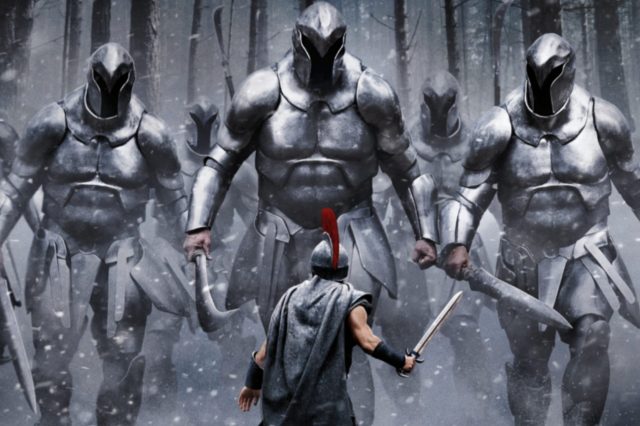
“Would I have enjoyed it if I were 12?” (The Odyssey/Universal Pictures)





I’m so late to this party that it’s possible that there is nothing left to drink and no one to talk to but since I’ve come all this way I’ll share my thoughts about The Odyssey with an already empty room.
By contrast with this late arrival I always try to arrive at a cinema in good time. Good in the sense of fractionally before the film itself starts in order to avoid the trailers for forthcoming attractions. Half of these are for historical sagas which, with some slight variations in costume (competing brands of body-hugging designer armor, differences in the cut of peasants’ coarse and loose-fitting work-wear), all look the same. Arriving early for The Last Viking I did catch one of these trailers and, to my astonishment, discovered that it was for Christopher Nolan’s The Odyssey. Which was surprising because it looked like all the other made-for-teens epics I’d had the misfortune to glimpse over the years.
The film came out. I had no desire to see it but if I was going to see it it had to be in an IMAX. Same with Dunkirk which proved to be an immense cinematic experience. Not that I’m easily seduced by the tech specs of a given release. The debate about whether Paul Thomas Anderson’s latest films were best seen in 70mm, VistaVision or in whatever format they happened to be served up at your local multiplex deflected discussion from the more pressing question of whether they were worth seeing at all. The Odyssey, it turned out, was impossible to see at an IMAX. Every screening in London was sold out till the end of time. A few seats were always available but, as anyone who has ended up at a chiropractor’s after the neck-strain contortions of sitting in the first couple of rows will attest, only the central segment of seats offers anything like full IMAX immersion. In a life lacking in focus and purpose all sorts of little things whoosh into the attendant vacuum so I became absorbed in the search for tickets. The impossibility of getting tickets became the motor for getting tickets. Because it was so difficult to see I became desperate to see a film I had no desire to see. And suddenly this dedication was rewarded. A batch of seats in the middle of the middle of the Leicester Square Cineworld became available for a mid-afternoon Sunday screening.
As O-Day drew closer I viewed the prospect with less-and-less enthusiasm. Reports came back from profoundly unreliable sources — my friend Rob Doyle who saw it twice, first in an IMAX and then, a week later, on a regular screen — claiming it was great. Others said that it was rubbish.
And they were right. It turned out to be exactly as feared: a total bore but this boredom had its peaks. The candle- and fire-lit feasts were the biggest bore of all. Followed closely by the fight scenes. That’s the strange thing about fights in action films, especially sword fights: they’re always a bore. (Is any sound in cinema more boring than the metallic swish of a sword being drawn from its scabbard?) The script was so unspeakably stupid it should have been called The Idiossey. A reversal of the censor’s certificates is in order indicating that a film like this which is deemed unsuitable for persons under the age of 15 should not be seen by anyone over the age of 15. Would I have enjoyed it if I were 12? Impossible to say but to my adult eyes it seemed a pale shadow of movies that warmed my young heart: Jason and the Argonauts with a hint — provided by Charlize Theron’s Calypso — of One Million Years BC.
It looked OK but not that great. There were some big seas, big beaches and big skies, like in Dunkirk, but without the patient queuing of the British troops which lent that film its double allegorical dimension: first as a realist parable of years of Soviet-style resignation in the face of canceled ferries and rail replacement services, and then as a still more prophetic — and politically ambiguous — depiction of the impossibility of stopping small boats crossing the channel. In a way The Idiossey was like several mini Dunkirks. Matt Damon and his crew are always rocking up on some beach with high hopes of it being the fringe of a Bounty advert, drawing their boring swords, and then splashing back to their boring boats to escape whichever monstrous bores happen to be in residence there. The lesson seems to be that Odysseus never learns his lesson. I admire and share Nolan’s aversion to CGI but what I learned from this latest venture is that he had gone to enormous effort and expense to create a reality that looks CG, like the irreal world of all those other historical epics pimped out in trailers.
CGI routinely dispenses with gravity but it also works its magic on another dimension of physics, that of time itself. It has created a mysterious realm, located somewhere in the bows-and-arrows past, but lacking what might be called historical specificity. It’s a realm of battles or rather a battle where the same fight — against tyranny or injustice (in The Odyssey it’s all about the breaking of Zeus’s Law) — can be endlessly waged and refought. It’s a realm in which the supernatural is indistinguishable from reality, where the historical record is no more than a mise-en-scène for the eternal struggle of getting people into the cinema to watch something not worth seeing. After the initial scene-setting captions — some empire or other has grown corrupt, the republic is giving way to dictatorship — we settle into the saga of some Birkenstock gladiator or other coming back to restore the founding values. In the age of Trump this has a certain appeal which, to be fair, Nolan milks like a gigantic cow. (Coming soon, in the sense of never: The Obamassy.) By contrast with this curiously ahistorical idea of history the much-loved caption from Second World War films — “1940: Somewhere in England” is a temporal and spatial pin-drop of extraordinary precision. Wherever we are it’s a dungeons-and-dragons theme park with a flotsam of historical bits and bobs — spears, swords, metallic knitwear — thrown in. The Odyssey is the biggest, most all-encompassing manifestation of this trend since it is set and made in a time when gods walk among us. More exactly when, by virtue of their various disguises, they look like they walk among us. The gods might well be — always are — Hollywood stars who, when decked out in Carhartt for contemporary dramas, look exactly like blue-collar guys who, on a Saturday, spend their money at the movies. Matt Damon is exemplary. Not just a regular guy but a regular God who, this time around, takes an inordinately long time to get home from work to his wife and kid. Of which religion, pray, are these gods the focus of such worship? The religion of giant paydays for all concerned. Including Emily Wilson who translated the book and then, to her immense credit, bit the Cyclopean hand that launched millions of dollars of royalties in her direction.
I left before the end but, like Damon on one of them islands, should have headed for the exit sooner. I had a lovely bike ride home from Leicester Square. Maybe the illusory world of The Odyssey enhanced my enjoyment of the real world: the tinder-dry grass of London’s parks, the thirsty trees, all the different nationalities straying from the pedestrian half of shared lanes into the bike part. I didn’t mind. I was glad that people from all over could come to this island, this city, get in to the National Gallery for free and enjoy a pleasant stroll home. I liked all of that but mainly what I liked was the reverse opportunity cost, the thought that if I hadn’t left early I’d still be watching this moronic film, this enormous waste of material, talent (Nolan’s especially) and, though I have not read it, source material. And maybe it reasserted a sense of cinematic priorities. Action films are a bore but, at the other extreme, I can’t get excited about Eric Rohmer’s little Sunday-afternoon on-the-beach comedies and in-the-suburbs proverbs either. But on this Sunday afternoon Rohmer’s close-to-home vision seemed nothing short of epic.