









August 23 2026 - 7:00pm
In this week’s Alaska Senate primary election, Democrat Mary Peltola beat Republican incumbent Dan Sullivan by five points. Under Alaska law, the four candidates who receive the most votes, regardless of party affiliation, go on the ballot in the November general election. And for that reason, it’s significant that the third-place finisher, garnering 2.4% of the vote, was also a Republican named Dan Sullivan.
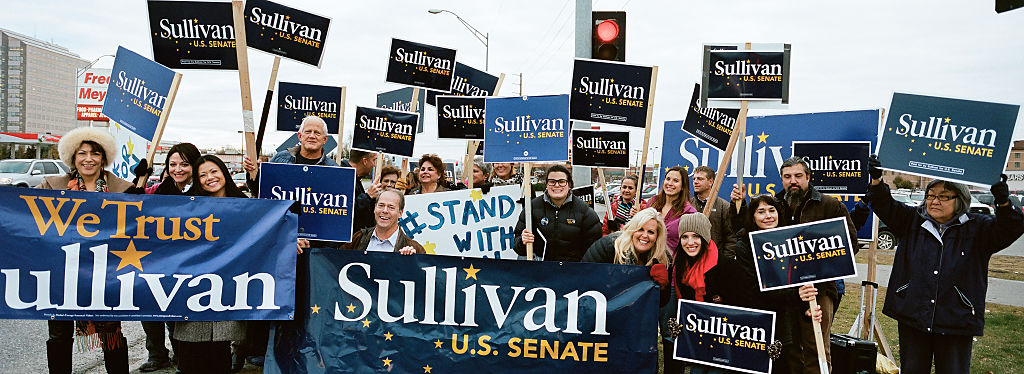
Two months ago, Sen. Dan Sullivan petitioned Alaska’s state Election Division to remove the second Dan Sullivan (a schoolteacher from rural Alaska with no political experience) from the ballot, calling his candidacy a Democrat dirty trick to deceive voters. The Election Division agreed and removed the name. But Alaska’s Supreme Court, finding no requirement in state election law that candidates run “in good faith”, reversed the Election Division’s decision and allowed the second Sullivan’s candidacy to stand.
What are the second Dan Sullivan’s intentions? Is he even a real Republican? New York Times reporter Kellen Browning traveled to Sullivan’s hometown of Petersburg, Alaska, population 3,394, to find out. According to Browning, Sullivan identifies as a “moderate Republican”. In the last three presidential elections, however, he voted for the Democratic nominee. In US House elections, he voted for Peltola in her 2022 and 2024 campaigns. He has participated in recent local protests against President Donald Trump, including “at least one” No Kings protest. Petersburg’s former mayor, when asked about Sullivan, “said he’d never known the local Mr Sullivan as anything other than a liberal.”
Even learning the above facts, the New York Times reporter claimed that he “did not find case-closing evidence of either a Democratic plot or a fully independent campaign without ulterior motives.” Readers can draw their own conclusions.
If Sullivan’s quixotic campaign is, as Republicans assert, an attempt to leech support from Sen. Dan Sullivan and facilitate a Peltola victory, it joins a long tradition of “same-name tricks” in American election history. It is, however, likely the first time that the trick has been deployed in a statewide election with national implications.
Historically, the insertion of same- or similarly-named candidates has been mainly an East Coast phenomenon. In the 1946 election for Massachusetts’ Eleventh Congressional District, future President John F. Kennedy’s campaign — worried about a unified Italian vote for Italian candidate Joe Russo — engineered the entrance of a second Joe Russo into the race. Kennedy won. In 1990, Massachusetts State Senate president William Bulger (brother of notorious mobster “Whitey” Bulger) faced a tough reelection campaign against Republican John DeJong. Close to election day, an unknown candidate named Jane DuPass entered the race. Bulger won.
In 2004, the New York Times identified four separate cases of deceptive same-name candidate pairings in recent New York State and City elections: José E. Serrano and Jose Serrano, John C. Liu and Jay C. Liu, Jose Rivera and Jose L. Rivera, Vito Lopez and Victor Lopez. And in 2020, there was the State Senate race in Miami-Dade County, Florida, which Republican Ileana Garcia won by 34 votes after her opponent, Democratic incumbent Sen. José Javier Rodríguez, was joined on the ballot by political unknown Alex Rodriguez. The scheme was eventually uncovered, and State Senator Frank Artiles was convicted of conspiracy for his role in it, but Garcia’s win stood.
The same-name trick’s long history suggests two uncomfortable facts. First, that it’s difficult to stop legally; state election laws often allow little recourse for political parties or election boards to remove even obvious spoiler candidates. Second, that it often works, particularly in close elections when only a handful of voters (in Garcia’s case, as few as 34) need to be deceived to win. In an election as close as Alaska’s, it may work.
Writing in Reason, Ilya Somin claimed that any voter confusion over Alaska’s two Sullivans would be part of America’s “much larger problem of political ignorance”. But this seems like an unnecessarily grand conclusion. The knowledge or ignorance of just a few thousand — perhaps even a few hundred — voters in America’s third-least-populous state could determine the outcome of a close Senate race. That’s a very small hook for Republicans to hang their hats on. And that’s why, whatever his intentions, a schoolteacher named Dan Sullivan could strike the decisive blow in handing the Senate back to Democrats this November.